|
|
||||||||||||||||
 |
||||||||||||||||
Pilot got green light to drop bombs
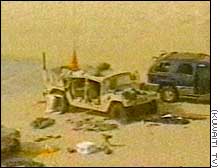
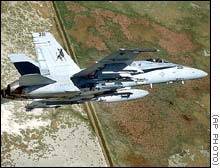
Air controller saw wrong target too late to abortWASHINGTON (CNN) -- A ground-based controller cleared a U.S. Navy pilot on a training mission to drop his bombs but realized too late they would hit an observation post, defense officials told CNN on Tuesday. Early Monday evening, the Navy F/A-18 Hornet dropped three bombs on the site, killing six people and wounding seven others. Pentagon officials said the F/A-18 was participating in a "close air support" exercise in which it would attack enemy troops close to friendly lines. The jet approached the target area at 10,000 feet and then descended to 5,000 feet before dropping the munitions -- in this case a trio of 500-pound Mk-82 bombs -- officials said. A ground-based forward air controller initially gave the pilot the green light to drop the bombs but moments later shouted "abort, abort" as he realized the bombs were heading toward the military observation site, a defense official said. "The forward air controller must have recognized that there was something wrong," the official said, adding that the air controller was either with the Army or the Air Force but that details were still being collected. Pilot was squadron leaderOfficials said the pilot was directed in the early stages of his approach by a Navy forward air controller in another aircraft, but in the final stage a ground-based controller directed the fighter into the immediate target area. The F/A-18 involved in the fatal incident has on-board equipment that detects a laser or infrared beam used by the controller on the ground to direct him to the target area. The pilot then releases the bombs, which travel unguided to the target under their own inertia, officials said.
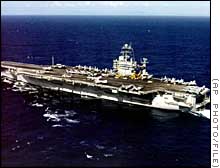
The pilot at the controls of the Navy F/A-18 Hornet in Monday's accident was the leader of his squadron and one of the most experienced pilots aboard the aircraft carrier USS Harry S. Truman, Navy officials said. The squadron commander, whose name has not been released, is the top pilot in one of three F/A-18 squadrons aboard the massive ship. The aircraft carrier is also home base to squadrons of F-14 Tomcats, EA-6B Prowlers, S-3 Vikings and a variety of other aircraft. Controller, pilot wearing night vision gogglesSources told CNN that the air controller radioed the pilot "cleared hot" as he descended for the strike, indicating that he was on course and clear to drop his ordnance. After the bombs were released from under the Hornet, however, the ground controller radioed "Abort, abort," according to a defense official.
The officials said that both the F/A-18 pilot and the forward air controller were wearing night vision goggles at the time of the incident. Of the six people killed, two were U.S. Army service members, two were Navy service members, and one was a New Zealand army officer. The sixth victim was also an American, but no other information has been released. Five of the wounded were U.S. service members, and the other two were Kuwaitis. The Kuwaiti Defense Ministry said the incident occurred near the end of a joint U.S., British and Kuwaiti exercise, but it said no Kuwaiti troops were involved in the exercise at the time. CNN National Security Producer Chris Plante and CNN Correspondents Satinder Bindra and David Ensor contributed to this report. |
||||||||||||||||
| Designed and maintained by Thesigan | ||||||||||||||||
|
|
||||||||||||||||
|
|
|
|||||||||||||||
|
|
||||||||||||||||