Halifax, Nova Scotia
On the outskirts of Halifax, Nova Scotia, there are rows and rows of granite gravestones all very similar. Some are weatherbeaten and some have names while others do not. One thing they all do have is the same date written into the upper face of the gravestone: April 15,1912. Below the date is a number. That number represents a person in which is buried in that tomb. A person who was found in the Atlantic Ocean 87 years ago. They are all from the Titanic.
In the late evening of April 15,1912, the Mackay-Bennett was ordered to retrieve as many bodies from the wreck site as possible. Orders of coffins and ice were placed and on April 17 they were finally ready. The Mackay-Bennett was compiled of an all-volunteer crew as well as some 40 members of the Funeral Directors Association. At noon on April 17, they set sail. Passenger ships were already changing course to avoid the wreck area so as not to upset its passengers if they were to see dead bodies floating in the vacinity where Titanic had sunk only days earlier. Some ships however did not alter course and were sending wireless messages to help guide the Mackay-Bennett to the site where bodies and wreckage had been spotted. The Bremen reported that nearly a hundred bodies were located at 42.00'N, 49.20'W. Word got out that passengers aboard the Bremen had seen bodies floating in the waters and when they had reached dock in New York, reporters rushed them for a story. One woman was quoted as saying she saw a woman dressed only in her nightgown holding her baby to her chest. She also saw bodies of 3 men clinging to a chair as well as about a dozen or so men wearing lifebelts all clinging to eachother. On April 21, the Mackay-Bennett had retrieved 51 bodies, as they had worked all day long. Each body that was brought aboard was to have a numbered piece of canvas attached to it. All personal effects that were found were placed in a canvas bag with the same number assigned to the body. Notes were taken with detailed descriptions of each body found to help try to indentify the body as very few had any indentification on them when found. The Sea had done some damage to the bodies within that past week in the water. Exposure to the wind and water had aged the bodies making it difficult to estimate the age of the person found. Several of the bodies were so disfigured after a week in the sea, that the embalmer decided to just bury them at sea. At 8:15 that night, a burial service was held on the forecastle deck. There was a total of 30 bodies that were to be buried at sea. Each was sewn carefully in canvas and one by one they were rolled over the side and sunk 2 1/2 miles below. With each body they buried, the Rev. Canon Hind would say "For as much as it hath pleased, we commit this body to the deep"-then a sudden "splash!" would be heard as it began its descent to the bottom of the sea. By the evening of April 22, the crew had recovered a total of 187 of Titanic's dead. On April 21 the Minia had been sent out to help the Mackay-Bennett recover bodies and on April 26th, had reached their destination. By noon on the 26, another 14 bodies had been found and now the Mackay-Bennet had used up all their ice and coffins and set sail back to Halifax. The Mackay-Bennett now had 190 bodies total aboard her. The Minia had continued to search for bodies until May 3rd. Between the two ships, 323 bodies had been recovered and 119 of them were buried at sea. (5 more bodies would be picked up as well by other passing ships.) On April 30th the Mackay-Bennett had reached Halifax and began unloading the bodies. Even in death the distinction of classes were observed: first off was the crew-packed in ice but not sewn in canvas nor embalmed. The second and third class passengers were next to be unloaded-all sewn in canvas. Lastly, the first class passengers-all embalmed and all in coffins. The authorities in Halifax were prepared for the Mackay-Bennett's return and had a temporary morgue set up for the bodies to be placed. There were 67 canvas enclosed cubicles set up, each holding 3 bodies. Only people who could proove they were relatives of the deceased or had proper authorization from the next of kin could enter the morgue. The second floor was set up for offices for the coroner and his staff to produce the documentation for death certificates. Each death certificate stated the cause of death as "accidental drowning, S.S. Titanic-at sea."
Some of the relatives requested bodies to be buried here in America if they could not afford to have them shipped back home. In the case of unidentified and unclaimed bodies, they were buried by an educated guess about the victim's religion. There were three cemetaries in which the bodies were to be buried: Fairview cemetary, a non-sectarian plot; Baron de Hirsch, for those who were Jewish; or Mount Olivet for Roman Catholics. All the cemetaries were within a 1/2 mile radius. The bodies were all embalmed and placed in yellow-pine coffins. On Friday, May 3rd, the first of many funeral services were to be held. A trust fund was set up by the White Star Line to maintain care for the gravestones. That fund is still held today, although it is now administered by Cunard, who assumed that responsibilty in the 1930s when they took over White Star Line.
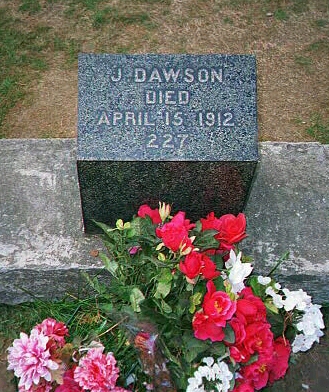
This is a picture of J. Dawson's grave. Many people who visit Fairview cemetary, especially teenage girls, associate J. Dawson with the ficticious Jack Dawson in James Cameron's award winning 1997 film Titanic however the person buried in this grave was actually a coal trimmer aboard the Titanic named James Dawson. When James's body was recovered from the icy waters where the Titanic had sunk, James was found wearing his coal stained shirt and jeans. His body was recorded as #227 as noted on his grave. His body unclaimed, he was buried at the Fairview cemetary in Halifax, Nova Scotia, expenses paid for by the White Star Line. * Photo by Marty Talbert from Titanic Distributors.