The Deceased
Major Archibald Butt
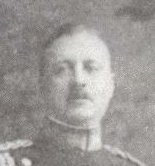
* Major Archibald Butt was the military aid to the President of the United
States, William Howard Taft. Butt in his time had also been a novelist, a
soldier, a news correspondent and a diplomat. Butt was returning home from a
visit to Italy where he was on a mission to the Vatican for the President.
For many years Butt had been a close friend to Theodore Roosevelt and had
become close friends with Taft while Taft was Roosevelt's vice president.
Roosevelt and Taft were friends, however they began feuding almost as soon as
Taft had filled Roosevelt's spo. The feud put Maj. Butt in a bad spot since
he was friends with and loyal to both men. The strain put on Butt was too
much for him and he asked to be transferred to another posting. Taft instead
gave him the mission to the Vatican hoping that the feud between he and
Roosevelt would die down while Butt was gone and that Butt would agree to
come back to his post when he returned. Butt brought along with him on his
trip to the Vatican his good friend Frank Millet. When the collision with the
iceberg occured, Butt, Millet, Clarence Moore and Arthur Ryerson were all in
the Smoking Room playing bridge. They had heard of the commotion going on the
Boat Deck but chose to continue playing cards. Around 1:00am, Maj. Archibald
Butt escorted Miss Marie Young, who was once the music governess to
Roosevelt's children, to lifeboat #8. Miss Young later recalled how Butt
wrapped her in blankets and put her into the lifeboat. Then Butt stepped back
and lifting his hat to her, and gave her a message for his family. "Goodbye
Miss Young. Good luck to you and don't forget to remember me to the folks
back home." He then went back to the Smoking Room to continue his bridge
game with Millet, Ryerson and Moore. Despite the tilting deck at around
1:45am, the four continued to play cards, uninterrupted until a little before
2:00am when they gathered on the Boat Deck talking quietly. The last anyone
ever saw of Maj. Butt was shortly before 2:00am. Butt was standing quietly on
the Boat Deck, not helping lower or fill the lifeboats but accepting his fate
as a typical soldier. A worried President Taft sent out the cruiser USS
Chester specifically to contact the Carpathia about his friend Maj. Butt. The
Chester's inquiry was ignored however, just like all the rest of the
inquiries about survivors from other wire services and newspapers. Taft's
fear was later confirmed however that his friend had perished in the Titanic
disaster. He erected a marble fountain in Washington D.C., dedicated to Maj.
Archibald Butt. It was paid for out of Taft's private funds in memory of his
friend.
John Jacob Astor

* Colonel John Jacob Astor IV was the great grandson of the first John Jacob
Astor who was a poor Schwabian who emigrated to the United States in 1783 and
who had built a fortune in fur trade, in turn investing his money in and
around New York. By the beginning of the twentieth century, the Astors owned
some of the most expensive real estate in the world, including the Astoria
Hotel, where coincidently, was the holding of the Senate Hearings after the
Titanic disaster. J.J. Astor IV was very ambitious as well at ruthless when
needed. Astor had raised a regiment of volunteers during the Spanish-American
War, with himself as colonel. Thereafter, he preferred to be addressed by his
rank. Astor had a mansion in Newport with an 18 car garage. Once he even
drove a train on his private railway that drew a coach filled with only
millionaires. His attitude toward money was cavalier. He once remarked, "a
man who has a million dollars is almost as well off as if he were wealthy."
In 1909 Astor had divorced his wife of 18 years, Ava Willing Astor, to marry
his 18 year old girlfriend Madeline Force who was actually younger than his
son Vincent. Divorce was highly looked down upon during the Edwardian Era,
something only the lower orders indulged in. Astor was visciously cut by all
his friends and socialites and therefore thought it best to take a trip with
his new wife to spend the winter elsewhere. They had married in the late
1911's and found it rather hard to even find a clergyman to perform the
ceremony.
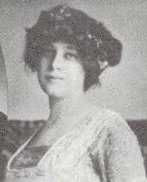
To create even more scandal, the new Mrs. Astor, who now had been
married for four months, was now four months pregnant as well. In the
Edwardian Era, many men had mistresses, but would never divorce their wives.
With Astor doing so, he may never have been able to regain his formal social
standing. He was now returning on the Titanic to New York after spending four
months in Egypt and Paris, hoping that his status would be salvaged when he
returned. When the Titanic reached Queenstown, many vendors had small boats
set up with handmade items to sell. Some of the more respectable sellers were
allowed aboard the Titanic and for an hour or so, the Promenade Deck had
become an open air market for Irish lace and linens, ceramics and etc. J.J.
Astor was so taken by an Irish lace jacket that he paid $800 for it on the
spot. On the night of April 14, 1912, J.J. Astor heard of the collision with
the iceberg and went on deck to take a look around. Not alarmed, Astor went
back to his suite and explained to Madeline that the ship had struck some ice
but it didn't seem serious. Hearing this, she wasn't alarmed either. Shortly
after, a steward notified the Astors to put a lifebelt on and get on deck.
Since Colonel Astor seemed unalarmed earlier, Mrs. Astor took her time
dressing. When Mrs. Astor finally arrived on deck, she was dressed in a black
broadtail coat with sable revers, a diamond necklace and carried a muff. As
the crew were loading and sending off the first lifeboats, the Astors
gathered in the gymnasium off the Boat Deck. There, J.J. and Madeline were
sitting side by side on the mechanical horses where J.J. took his penknife
out and sliced open one of the lifebelts to show Mrs. Astor what was inside.
A half hour later the Astors left the gymnasium and went back on deck. There
was still little urgency in loading the lifeboats as most passengers still
thought the fuss was just precautionary. Colonel Astor remarked while
watching lifeboat #5 being lowered, "We are safer on board the ship than in
that little boat." At 1:45am, Astor realized the situation was more serious
than earlier believed. He helped his wife into a lifeboat. He asked
Lightoller if he could join his wife, explaining that she was in "delicate
condition." Lightoller responded, "No, sir. No men are allowed into the boats
until the women are loaded first." Astor said, "Well, what boat is it?"
Lightoller informed him, "Boat #4 sir." With that, Astor turned to his wife
and said, "The sea is calm. You'll be all right. You're in good hands. I'll
meet you in the morning." Then Astor stepped away and returned back up the
Boat Deck. As the Titanic began its final plunge, Dr. Washington Dodge
reported seeing J.J. Astor standing on the bridge with Maj. Butt. When
Astor's body was recovered, it was crushed and covered with soot. Astor had
been one of the people crushed by the forward funnel as it collapsed. In
fact, Astor's body was the first to be claimed and released. Number 124, as
was his body recovery number, was fairly easy to indentify. Number 124 wore a
blue serge suit, a blue handkerchief, a gold buckled belt, brown shoes with
red rubber soles, and a brown flannel shirt with the initials "J.J.A." on the
collar. The body also carried $2,440, had a gold watch, gold cuff links, and
a diamond ring with three stones. Colonel Astor's body was claimed by his son
Vincent, his lawyer Nicholas Biddle, and the skipper of Astor's private
yacht, Captain Roberts. Mrs. Astor gave birth to a baby boy 5 months later.
She inherited Colonel Astor's fortune, with the understanding that she never
remarried. She did however re-marry many years later and gave up the Astor
fortune.
Charles Hays
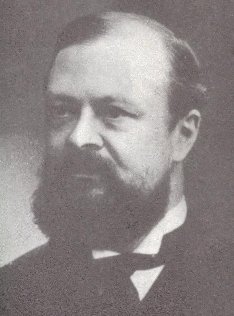
* Charles Hays was president of the Grand Trunk Railway. Charles was born and
raised in Canada. Hays built the Grand Trunk into the dominant railway around
the Great Lakes and into the northern Midwest states and the Canadian
provinces. He was looking to expand into the hotel business. Hays was
studying first hand management training in Europe and was returning home to
Canada on the Titanic to launch a new chain of hotels owned by the Grand
Trunk. When the Titanic hit the iceberg there was some ice chunks that fell
onboard the Titanic's steerage decks. A few First Class passengers watched
the Third Class people play with and kick around the ice. Hays was one of
them, standing with Maj. Peuchen. Suddenly Maj. Peuchen shouted, "Why, she's
listing! She should not do that! The water is perfectly calm and the ship has
stopped!" Hays simply stated, "Oh, I don't know. You cannot sink this
boat." Shortly after, Hays saw his new friend Maj Peuchen helping lower Boats
2 and 4 and shouted, "Peuchen, this ship is good for another 8 hours yet! I
have gotten this information from one of the best old seamen, Mr. Crosby of
Milwaukee." Little did Hays know that Crosby had hastily put his wife and
children off in a lifeboat. Now it was approximately 1:45 am and there were
few lifeboats left. Hays, realizing the seriousness of the situtation now,
put his wife off into lifeboat #3. Charles Hays stood off to one side of the
Boat Deck, probably recalling a conversation he had with Colonel Gracie only
hours earlier. Hays had remarked to Gracie, "The White Star, Cunard, and the
Hamburg-Amerika are now devoting their attention to a struggle with supremacy
in obtaining the most luxurious appointments for their ships. But the time
will soon come when the greatest and most appalling of all disasters at sea
will be the result." Hays never went near a lifeboat and remained on deck
until the end.
Isador Strauss
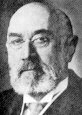
* Isador Strauss was a former Congressman and advisor to the President Of The
Untied States and was also part owner of Macy's department store. Isador was
returning from vacation on the French Riviera with his wife Ida. As
Lightoller was loading lifeboat # 8, the Strauss's were walking by. Just
before Lightoller was about to give the order to lower way, Ida stopped and
began getting into the lifeboat. At the last second she changed her mind and
turned to her husband and stated, "We have been living together for many
years; where you go, I go." Colonel Gracie and Hugh Woolner overheard Mrs.
Stauss and tried to persuade her to go but she would not. Finally Woolner
said to Mr. Strauss, "I'm sure no one would object to an old gentleman like
yourself getting in." Mr. Strauss replied firmly, " I will not go before any
other men." The issue was settled. Mrs. Strauss then turned to her maid and
helped her into lifeboat #8. Ida gave the maid her fur coat saying, "Here,
take this. I wont be needing it." Isador and Ida then backed away and sat on
a couple of deck chairs to await the end together. At Broadway and 106th
Street in New York City there is a monument erected in the memory of Isador
and Ida Strauss, funded by Macy employees.
William T. Stead
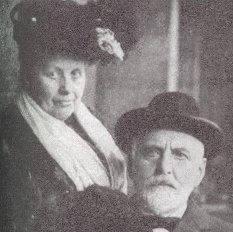
* William T. Stead was born on July 5, 1849 in Embleton, Northumberland,
England. His father was a Congregational minister with a large family and was
very poor. At 14 years old, William was entered into severe poverty. He found
a position as errand boy in a merchant's office. His salary went to the
family, all except 6 cents a week which he could spend on whatever he would
like. Instead of spending it however, William saved it. Penny by penny he
saved until every so often he would splurge on a cheap edition of a book of
his desire. At 17, the Boy's Own Magazine was offering prizes for an essay
contest. Stead wrote one on Oliver Cromwell and won. The prize was not in
money however but in books. He was probably most pleased with the prize of
books rather than anything else. He soon became assistant editor of the Pall
Mall Gazette, then virtual editor. At that time, London had alot of white
slavery going on. There were many, many young girls that were being sold and
bartered. London knew of this but did nothing to investigate further. William
T. Stead knew however and exposed it all in an expose which would make the
public aware and would force to abolish it all. Stead found indisputable
evidence of everything he wanted to proove. Stead had names upon names and
incident after incident recorded and then one day, he blew the story wide
open. He had called his story, "The Maiden Tribute Of Babylon." Stead
explained of how he was able to purchase the services of a 13 year old
prostitute for only 5 pounds. Stead was arrested on the grounds of committing
an infraction of the laws. Stead did not mind-he knew he had won and that the
parliament would be forced to abolish the white slavery, and they did. The
public outcry demanded he be released and he was. The Parliament also was
forced to raise the age of consent from 13 to 16 due to Stead's breaking
story. In 1890, Stead founded his own monthky journal, 'The Review Of
Reviews.' Quickly, it became one of the most influential publications of its
day. In 1893, after he was out of prison, he had come to Chicago where he
would write a book that would make him more famous than ever around the
world. The book was called," If Christ Came To Chicago." It swept the
country. William T. Stead would become the writer who interviewed more
celebrities than any other writer in history. In April of 1912, William T.
Stead was traveling to New York, at President Taft's personal invitation, to
speak at an invitational peace conference scheduled to open April 21st. The
night of April 14,1912, Stead had taken a stroll around deck at the time of
the collision. He then went down below to his cabin, unaware anything had
ahppened. He only resurfaced when he heard the engines had stopped. William
saw Frank Millet standing nearby and asked him, "What do they say is the
trouble?" Frank replied ,"Icebergs." Stead then said," Well, I guess it's
nothing serious, I think I'll got back to my cabin to read." A short while
later, Steward Cunningham knocked on Stead's door. The steward asked him to
put on a lifebelt and come up to deck. Stead protested but eventually went.
Waiting, he then went to the First Class Smoking Room where he sat in a
leather armchair and began to read. The commotion outside never disturbed him
one bit and there he sat, absorbed in his book, never puting on his lifebelt
or showing any concern about the state of the ship. It is there, that is
believed, to be where Stead had met his ill fate.
Thomas Andrews

* Thomas Andrews was overseeing the immense task of the building of Titanic
as the shipyard's managing director. Andrews, born in February 1873, was the
second son born to Thomas Andrews Sr. and Eliza Pirrie, Lord Pirrie's
daughter. Thomas Jr. had always had a fascination for ships and at the age of
16 became a premium apprentice at Harland and Wolff. His apprenticeship
lasted 5 years, beginning with 3 months in the joiner's shop, a month in the
cabinetmaker's shop, then two months actually working on ships. After that
came two months working in the warehouse, then 5 months spent with the
shipwrights, two in the molding loft, two with the painters, 8 months with
the iron shipwrights, 6 months with the fitters, three with the
patternmakers, and 8 with the smiths. Andrews then completed his
apprenticeship with a year and a half in the drawing office. He learned not
only what was needed to build a ship but how to perform the tasks as well. In
the spring of 1910, Andrews brought his wife Helen, who he had married in
June of 1908, to the yard to see the progression of Titanic. There they stood
on the half finished decks of Titanic as they stared out into the sky. Helen
was then pregnant with their first and only child that was born in
1910-Elizabeth.
As a perfectionist, Thomas Andrews sailed on the Titanic on it's maiden
voyage to check for any faults, problems or breakdown that always plague new
ships. After dinner on the night of April 14,1912, Andrews retired to his
cabin, A-36, looking over blueprints. At the time of the collision, Andrews
was unaware they had hit an iceberg. He received a call from Capt. Smith
informing him of the collision. He then went on deck to meet with Capt. Smith
and they began an inspection of the ship. They found the forward cargo holds
flooded as well as the mailroom and the squash court floor. Smith and Andrews
went back to Andrews' cabin to look over the structual diagram of the ship to
assess the damage made. Andrews outlined the problem as he explained to Capt.
Smith how the watertight bulkheads worked. He explained how water would fill
one then flow over to the next until the ship eventually sank. Andrews
informed Smith the Titanic had only about an hour and half before she sank.
Only Andrews, Smith and a handful of officers had the knowledge that there
were not enough lifeboats for all aboard.
Thomas Andrews helped to get women together to board the lifeboats,
yelling out for more women and children as he walked past each lifeboat. At
approximately 2:10am, a steward rushing by the First Class Smoking Room,
glanced in and noticed Thomas Andrews standing in the center of the room with
his arms folded across his chest, standing motionless before the fireplace
with a face of no expression. Steward Stewart stopped and asked Andrews,
"Aren't you even going to try for it, Mr. Andrews?" Thomas Andrews never
replied, as if he never even heard the question asked to him. He simply
continued to stare at the painting before him-"The Approach to Plymouth
Harbour", his lifebelt lay carelessly tossed across a card table. That was
the last time he was seen.
Benjamin Guggenheim
* Benjamin Guggenheim was one of seven sons of Meyer Guggenheim. Benjamin and
his brothers had ran a family enterprise from banking and financing to mining
and smelting. Benjamin had taken a close interest in smelting, as new
industries were demanding more refined metals than just simple iron and
steel. Benjamin had invested heavily in the smelting business and transformed
the American smelting industry, leaving all other of the interests of the
family secondary. Benjamin had just finished an extended trip in Paris with
his mistress, Madame Aubert, while his wife was back in New York. In cabin
B-84, after the collision with the iceberg, Steward Etches was helping Mr.
Guggenheim into his lifebelt. Etches persuaded Benjamin to wear a heavier
sweater before going out onto the Boat Deck. Somewhere between the hours of
12:30am and 1:00am, Guggenheim disappeared from the Boat Deck. He was seen
again around 1:30am, no longer wearing the heavier sweaters Etches had talked
him into wearing and missing also was his lifebelt. Benjamin Guggenheim was
now wearing a white tie and tails along with his secretary. Standing calm and
dignified on the Boat Deck, he gave a message to Steward Johnson to give to
Mrs. Guggenheim: "I think there is grave doubt that the men will get off. I
am willing to remain and play the man's game if there are not enough boats
for the women and children. I won't die here like a beast. Tell my wife,
Johnson, if it should happen that my secretary and I both go down and you are
saved, tell her I played the game straight out and to the end. No woman shall
be left aboard this ship because Benjamin Guggenheim was a coward." When he
was asked why he lay his lifebelt aside and dressed in evening clothes, he
simply stated, "We've dressed in our best and are prepared to go down like
gentlemen."