
Some characteristics of the kingdom Protista are shown below. A protist is a eukaryote, meaning it has membrane-bound organelles and most of its metabollic processes occur inside that membrane. There are three major branches of protists; protozoa, fungus-like protists, and algae.
Protozoa are also known as the animal-like protists. They are all unicellular hetereotrophs. They eat either other organinsms or organic material that is dead. Most of them are able to reproduce asexually but some do so sexually. Most of the protozoans are divided on how they move, some use cilia or flagella and others find other ways. They other way the are divided is which ones are parasitic. There are four major groups of protozoa; amoeba, flagellates, cilialites, and sporozoans.
The next division of protists are the algae. Algae are known as the plant-like protists. They use the technique of photosynthesis to survive. They all contain up to four types of chlorophyl pigments. They are classified based on the color pigments they contain. They can contain the colors purple, red, brown, yellow, and a golden-brown. Algae can be mutlicellular or unicellular (also known as phytoplankton). They are divided into six main phylas, they unicellular can be either diatoms, dinoflagellates, and the euglenoids. The multicellar could be either in the green, red, and brown phylas.
The last division of protists are the fungus-like protists. They are hetereotrohpic and feed by decomposing organic material. The fungus-like protists are divided into three main phyla. Included in these divisions are slime molds (they contain key characteristics of fungi and protozoans and are classified on their meothod or reproduction) and water molds.
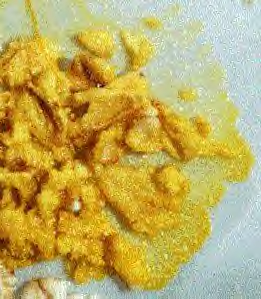
This is a Physarum
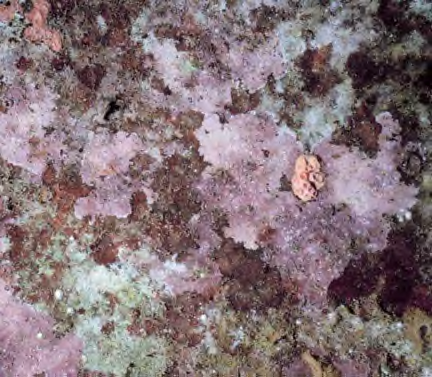
This is a Corraline Algae

The kingdom Fungi used to be mushed into the plant kingdom but soon scientists learned fungi, although they grew bottom heavy in soil and had cell walls, were actually more unqiue than scientists had originally thought. They decompose organic materials in order to obtain food. Most of the branches of fungi are multicellular. Plants have cell walls made of cellulose, but fungi's cell walls are made of chitin. Chitin makes the cell walls strong and flexible. Fungi reproduce sexually and asexually (they do so by budding, fragmentation, and spores). Spores are single cells that have the ability to grow into the organism.
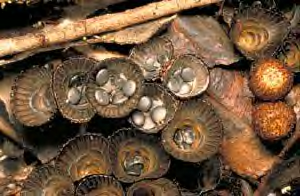
This is a Bird's Nest fungus.
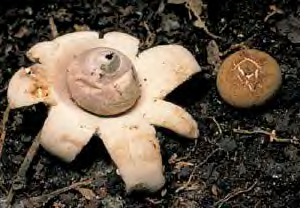
This is a Earthstar fungus.

The kingdom Plantae has a large variety of plants. Plants are multicellular eukaryotes. They use the process photosynthesis to covert sunlight into glucose which is their main energy source. They have thick cell wals made of cellulose. They also have a waxy coating called cuticle on their stems and leaves to make them waterproof. Scientists have placed plants into twelve main divisions. There are two major groups of plants, non-seed and seed plants.
Non-seed plants are divided into seven subdivisions; lycophytes, pterophytes, hepatophytes, sphenophytes, bryophytes, anthocerophytes, and sporophytes. They reproduce hard-walled reproductive cells (aka spores) . They can be vascular or non-vascular.
Seed plants are broken down into five subdivisions; cycadophyta, gnetophyta, ginkophyta, coniferophyta, and anthophyta. All seed plants are vascular. Seeds produced by these plants contain a embryonic plant and a food supply. They are more effective than spores when it comes to survival in the world.
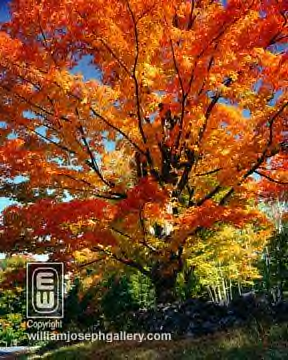
This is a Maple Tree!
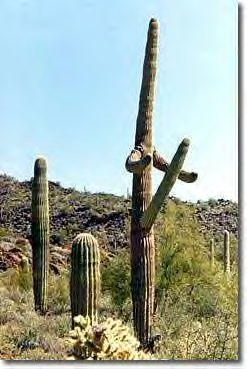
This is a Pachycereus pringlei

The final kingdom we'll cover is the kindgom Animalia. It is composed of animals. A animal is a muticellular organism that has the ability to move which allows it to complete certain tasks. Some of these tasks could be protection, getting food, and the creation of offspring. Unlike plants, once animals reach their "adult" stage, they tend to not continue to grow, with the exception of a few areas (for example: nose on humans). Animals also are composed of special cells that make tissues, muscles, and such. They are all hetereotrophic (cannot create their own food) so they depend on plants and other species to help them obtain the energy they need. So even carnivores are indirectly dependant on autotrophs. All animals are alo in some way built for a symmetry, this allows them to move around easier.

This is a human (lol)
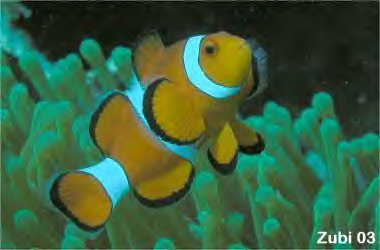
This is a clownfish!

