 Objective: Students will gain
and apply concepts associated with Fungi.
Objective: Students will gain
and apply concepts associated with Fungi.
|
Lesson |
Lecture:
I. If someone mentions fungus the first thing that pops into your
head is probably a mushroom, but it is just one part of a
complicated life cycle of one organism in this kingdom
called fungi. Other organisms in this kingdom can cause
diseases of both humans or plants while still other can
cure disease like Penicillium. Some are economically
important like yeast that help us in baking and brewing,
while others are just a pain like mold and mildew in the bathroom.
A. Basically the "place in the food chain" for all fungi is
decomposer; even though some are saprophytes and
others parasites. All absorb nutrients like bacteria, by
secreting enzymes outside their bodies and digesting
complex molecules which can be absorbed through cell
walls.
B. Cell walls of these organisms are generally composed
of chitin, just like arthropods which is a link towards animals
and definitely not plants. The inability to move about is
another nonplant characteristic.
C. The most visible part of most fungi, like a mushroom, is
a reproductive structure, but the main body or mycelium
of most fungi is an interwoven mass of threadlike filaments
one-cell thick called hyphae. It depends on the species as
to whether the hyphae are subdivided by partitions called
septa or not, each containing many or one nuclei.
Reproduction includes an alternation of generations
using mitosis and meiosis and some spores are
produces asexually while others are produced sexually,
but all are haploid.
- II. Characteristics of Fungi:
- 1. Fungi are eukaryotic
- 2. The majority are multicellular ( yeast is single celled)
- 3. Lack chlorophyll
- 4. Nutritionally they are heterotrophic, they digest food outside the
body and absorb it . They are saprophytes, parasites and some
are mutualistic.- 5. Their basic body plan constitutes a mass of netlike filaments
called hyphae. The entire mass is called the mycelium.
Most fungal hyphae are divided into cells by cross walls
called septa. Some fungi are aseptate, lacking cross walls.
They are said to be coenocytic. Some types of fungi contain
lateral hyphae that absorb nutrients from other organisms,
called haustoria.- 6. Reproduction is accomplished by the release of sexual or
asexual spores. For many species of fungi sexual reproduction
is a contingency used when environmental conditions are difficult.
Under favorable conditions asexual spores are produced by the
millions and dispersed over a large area. Haploid conditions prevail
in the life cycles of most fungi. Conjugation occurs in many fungal
species.
DIVISION (PHYLA)
EXAMPLE ORGANISMS
CHARACTERISTICS
Chytridiomycota Chytrids Probable link between fungi and protist, only example with flagellated spores Zygomcota Rhizopus - black bread mold Asexually -> spores resistant to freezing & drying Ascomycota Saccharomycetes - yeasts Aspergillus - some toxic, some carcinogenic, some used in dairy industry;
Dutch Elm disease
truffles
Asexually -> naked spores Basidiomycota Neurospora - bread mold eatable mushrooms
poisonous mushrooms
shelf & bracket fungi
puffballs
plant pathogens
Sexually -> spores Deuteromycota Penicillium - antibiotic ringworm & Athlete’s foot - (human parasites)
black spot & tomato blight- (plant pathogens)
Asexually -> spores Mycophycophyta lichens - algae + fungi mutual exploitation , able to live where neither can survive alone
- III. Diversity of Fungi:
- Fungi are classified into units called Divisions. There are 4 divisions based primarily on variations of sexual reproduction. The names of the divisions are based on the sexual structure that characterizes that group of fungi.
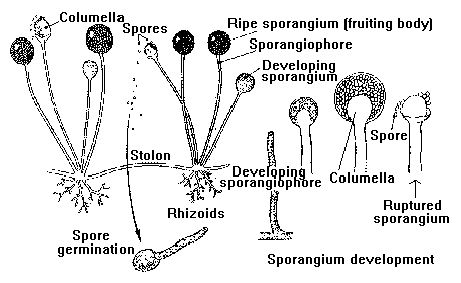
- 1. Division Zygomycota: These are mostly terrestrial fungi that live in soil or on decaying plant or animal material. Their hyphae are coenocytic, with many haploid nuclei. Asexual spores, usually wind swept, are produced by structures called sporangia, at the tips of aerial hyphae. Sexual reproduction involves the formation of resistant bodies called zygosporangia that can remain dormant when the environment is too harsh for growth. Examples are black bread mold ( Rhizopus stolonifer).
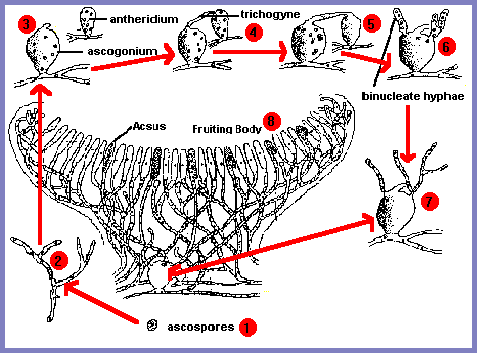
- Division Ascomycota: These are sac fungi. They range from unicellular yeast to large cup fungi. The sexual reproductive structure is the asci, a small sac like structure. These asci are packed into large fruiting structures called ascocarps. The hyphae are multicellular septate structures. They lack sporangia but reproduce asexually by producing chains of spores at the tip of specialized hyphae. These spores are called conidia. Two types of spores are produced by this type of fungus, conidia and ascospores. Conidia are asexual, while the ascospores are sexual.
- Reproduction of Ascomycetes:
- These fungi are important in decomposing lignin and collagen of dead plants and animals. Some are mutualistic ( lichen) and many are parasitic to plants ( powdery mildew and Dutch elm disease).
- Division Basidomycota: The mushroom, shelf fungi, puffballs and stink horns are examples of this division. The name is derived from the sexual reproductive structure called the basidium. The club like shape gives the name to some of the most common fungal types in this division.
- Division Deuteromycota: These organism have no known sexual life style. They are also known as fungi imperfecti. Examples of this group are Penicillium and Arthrobotrys.
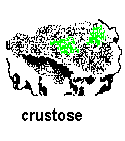
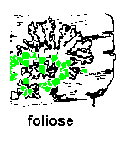
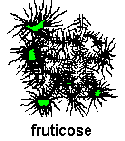
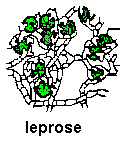
- Lichens: Highly integrated symbiotic associations of millions of algal cells tangled in a lattice of fungal hyphae. Classification: leafy ( foliose), fruticose ( shrubby), and crustose ( crusty).
- Mycorrhizae: mutualistic association of a fungus and a root. 90% of the fungi is bascidomycota