|
|
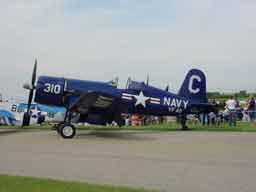
Chance Vought F4U-4 Corsair
|
Name: CORSAIR
Designation: F4U-4
Manufacturer: Chance Vought
Aircraft, Inc.
Type: Carrier/land-based
fighter/bomber
Crew: Pilot only
Power Plant: 2,100 hp Pratt
& Whitney R-2800-18W
Dimensions: Span 41'; length 33'
8
Weight: 14,670 lbs gross
Speed: 447 mph maximum
Range: 500 miles tactical
|
|
|
|
|
|
In production longer than any other U.S. fighter in World War II
(1942-1952) with 12,582 built, the Vought F4U "Corsair" had
several claims to fame. It was credited with an 11:1 ratio of kills to
losses in action against Japanese aircraft and was the last piston-engine
fighter in production for any of the U.S. services. Built around a
powerful 2000 hp, double-bank radial engine, the distinctive feature of
the F4U was the inverted gull-wing that provided less drag in flight,
allowed for shorter landing gear to accommodate an oversized propeller,
and enabled the wings to be folded directly over the canopy with room to
spare on the hangar deck. The shorter landing gear permitted rearward
retraction which in turn allowed for greater wing-fuel capacity.
Due to inadequate cockpit visibility, adverse stall characteristics at
slow approach speeds, and a tendency for the tail-hook to not engage due
to aircraft bounce when it hit the carrier deck, the F4U was restricted
from carrier operations until late 1944. In the interim, Marine Corps and
some Navy squadrons were actively engaged in Pacific combat operations
beginning in early 1943 from land-based island locations. One Marine Corps
squadron was credited with downing 135 aircraft over an eighteen month
period and produced ten aces. One Marine pilot went so far as to down an
enemy aircraft with his propellor.
The famous Marine Corps "Black Sheep" squadron led by Major
Gregory "Pappy" Boyington accumulated ninety-seven aerial
victories over a twelve week period with "Pappy" accounting for
twenty-two of them including five on one mission. These WW II kills by
Boyington were in addition to six others accumulated earlier while serving
with the Flying Tigers in China.
One Navy fighter squadron (VF-17) known as the "Jolly Rogers"
shot down 154 Japanese aircraft over a seventy-six day period including
sixty in one five-day period.
The "Corsair" which was also produced by Goodyear as the FG and
Brewster as the F3A-1D ended the war with 2,140 enemy aircraft destroyed
with a loss of only 538 to enemy fire. Known to the Japanese as
"Whistling Death" due to the whining noise it made in a dive,
the "Corsair" also saw combat service during the Korean War in
interdiction/support operations. The Navy's only Korean war ace was a
"Corsair" night fighter pilot, while another pilot,LTJG Thomas
Hudner, also flying an F4U, was awarded the Medal of Honor for landing
under hostile fire, in enemy terrain, to attempt a valiant but
unsuccessful effort to rescue the pilot who could not be extricated from
his damaged cockpit following a forced landing. |
|
|
|
Return to: Travel - Fargo
Airsho 2002 - table
of contents
|
|