Regional 'godfather' or local bully?
A look at China's relations
with its neighbors
By Bruce Kennedy
CNN Interactive
(CNN) -- China's policies
concerning its regional neighbors appear, at first, to be quite idiosyncratic.
One year after its founding
in 1949, the People's Republic entered a war on the side of Communist ally
North Korea against an anti-Communist United Nations force. Three decades later
Chinese troops clashed with forces from Communist Vietnam in a brief war that
combined a border dispute with ideological issues.
In recent years China has
quarreled with Japan over who controls a desolate group of islands 112 miles
northeast of Taiwan. The islands, which the Chinese call Diaoyu and the
Japanese call Senkaku, are known historically as productive fisheries, but the
area also may contain oil and gas reserves.
Beijing also has claimed
total control over the Spratly Islands, an archipelago believed to be rich in
oil and mineral deposits off the coast of southern Vietnam in the South China
Sea. That assertion is contested by Brunei, Malaysia, the Philippines, Taiwan
and Vietnam, each of which claims all or part of the Spratlys.
China's mixed signals
As a show of force in a
confrontation with the Philippines in December 1998, three Chinese warships
anchored within the Mischief Reef in the disputed Spratly Islands
China officially pursues what
it calls an "independent and peaceful foreign policy."
"China does not
participate in the arms race, nor does it seek military expansion," said
then-Chinese Premier Li Peng in a 1996 speech intended to clarify Beijing's
foreign policy.
Li also underscored China's
opposition to hegemonism -- one nation seeking greater influence over another.
China, he said, was against "power politics, aggression and expansion in
whatever form, as well as encroachments perpetrated by one country on the
sovereignty and territorial integrity of another, or interference in the internal
affairs of another nation under the pretext of ethnic, religious or human
rights issues."
Warren Cohen, professor of
history at the University of Maryland, Baltimore County, says Beijing's
regional policies are sending a mixed message.
"What you get is a
signal that 'We have the power.' But there's a certain amount of restraint.
They want very much to be the dominant power in East Asia without having to use
force," said Cohen, author of several books on China, including
"America's Response to China."
Michael Swaine, research
director for the Rand Corporation's Center for Asia-Pacific Policy, believes
China wants to assert its control over certain parts of East Asia without
letting the process escalate into a military confrontation.
Swaine says there have been
exceptions to that rule, such as China's brief wars with India in 1962 and with
Vietnam in 1979.
"The Chinese have used
military force in the past in the belief they could convey a lesson," he
says. "They do believe military force can be applied in a limited
situation to back up diplomacy."
Post-Cold War landscape
What has changed in recent
years is an apparent shift in Beijing's world view as it copes with the new,
post-Cold War era.
"China has viewed itself
as both an international and a regional power," says Steven Goldstein,
professor of government at Smith College and author of several books on Chinese
politics. "As reforms started in the late 1970s and '80s, China's emphasis
was on the global balance of power ... but there is a lot more for them to be
paying attention to now in Asia."
Goldstein says the political
situation in Asia is unusual because there are now two strong powers in the
region -- Japan and China.
Japan's Imperial Army
captured Nanjing in late 1937 and went on a two-month spree of brutality. At
least 300,000 Chinese civilians died, according to the latest research.
"Each of them sees
themselves as a global power and a central regional power," he says.
"Historically there has been a see-saw; when one is down the other is up.
I think the central dynamic is two powers totally distrustful of each other. As
far as the Chinese are concerned, Japan has never done what Germany has done,
to take full blame for the [atrocities committed during World War II], so China
takes a distrustful line toward the Japanese."
Goldstein suggests that China
has also been able to take advantage of its own history -- specifically the
intervention and exploitation of China in the 19th and early 20th centuries by
overseas powers -- not just at home but also in international relations.
"There is this
cultivation of victimization for two reasons," he says. "To drum up
support for the regime and second as a bargaining ploy. When they sit down at
the negotiating table [with other countries] they can use it to take the moral
high ground -- 'Look what you've done to us.'"
Says Swaine: "The whole
question of territorial claims for the Chinese in general are bound up with
issues of equity and justice, based on the last 150 years of imperialist
aggression. There's a lot of symbolic sensitivity. The [Chinese] leadership
doesn't want to be seen as too weak, yet too assertive."
'Realpolitik' calculations
China's size and status have
come to its advantage at recent negotiations between China, the United States
and the two Koreas designed to bring a lasting peace to the Korean Peninsula.
Korean diplomacy presents a challenge to China's foreign ministry. Beijing's
trade negotiations with Seoul could be seen as running counter to China's
longtime support of its former comrades-in-arms in North Korea.
"There's more of a
realpolitik calculation in the Chinese mind," Swaine says. "They
don't want to have North Korea go down the tubes. They prefer to have a buffer
of sorts on the Korean Peninsula, a regime hostile to the U.S., and they don't
want to be seen as turning their back on North Korean credibility."
Swaine also believes China's
recent efforts to modernize the military are geared more toward showing its
people that the country can defend itself and that it can remain free from
overseas coercion.
"The Chinese do not feel
this immeasurable self-confidence that they have the run of the roost in
Asia," he says. "They want to attend to crises within 500 miles of
their borders, and that really requires theater denial capabilities. They can't
really prevent other sophisticated powers from dominating their borders [now]
in a time of crisis."
Swaine believes China's
policy toward its neighbors is ambiguous; it is more concerned with domestic
order, political stability and economic development.
"I think China wants to
be seen as a global power in the sense of its status," he says, "a
global decision-maker because it has nuclear weapons, because it is on the
United Nations Security Council, because of its sheer size and expanse. On that
basis China thinks it should have a place in the global arena.
"But does that
translate," Swaine asks, "into an aspiration for global military
power, like the United States? I don't see the Chinese thinking in those
terms."
China-U.S.
rivalry
Fear, suspicion drive post-Cold
War ties between Beijing, Washington
By Bruce Kennedy
CNN Interactive
(CNN) -- It was late on a
Saturday night this past May when Lea Durdin, an American student at Nanjing
University, heard the news: China's embassy in Belgrade had been bombed during
a NATO air raid on the Yugoslav capital.
"We heard this roar of
people chanting in the street," she remembers. "The protesters began
with chants against NATO. But soon, says Durdin, "someone started yelling
Da dao Meiguo! ("Down with America!"), and then everyone who came by
chanted that."
As the protests continued
into Sunday evening, Durdin says the banners became more anti-American.
"People made posters of 'Americans' with huge noses and the shadow of a
devil holding a bomb. Things were said about America picking on poorer
countries just to improve our own economy ... that the citizens of the U.S.
demanded the war, and that's why the government started it."
In Beijing thousands of
demonstrators besieged the U.S. Embassy, pelting it with stones and paint. The
anger in China's streets over the bombing of its Belgrade embassy has since
played itself out. But relations between China and the United States -- much
like the walls of the U.S. Embassy building -- remain scarred.
The Chinese Embassy bombing,
in which three people were killed and 20 injured, is just one of several
incidents during the past year that have helped chill diplomatic relations
between Washington and Beijing. Others include:
* Allegations that China has
for years stolen nuclear secrets from U.S. government laboratories.
* Allegations that China
funneled hundreds of thousands of dollars in illegal campaign contributions to
Democratic Party officials.
* America's blocking of
China's entry into the World Trade Organization. Beijing has sought to join the
WTO for the past 13 years -- but it must still work out a deal with the United
States, its largest trading partner.
* America's support of Taiwan,
which China considers a renegade province.
* Continued accusations by
U.S. activists and lawmakers of human rights abuses in China.
Just over 10 years ago it
appeared the two nations were at the start of a much more cooperative future.
Chinese leader Deng Xiaoping and his reforms led many Americans to believe
closer economic and political ties were in store.
But the violent military
crackdown on pro-democracy demonstrators in Beijing's Tiananmen Square in June
1989 changed U.S.-Chinese relations practically overnight.
Every year in Washington
since 1989, around the anniversary of the suppression of the Tiananmen
demonstrations, U.S. lawmakers have debated whether Washington should renew its
Most Favored Nation trading status, now known as Normal Trading Relations
(NTR), with China. The status must be renewed every year under U.S. law.
Other sticking points in
recent years include the U.S. accusation that China has sold nuclear and
missile technology to Pakistan -- an allegation China has denied. Western
officials feared such technology transfers would increase the possibility of a
nuclear confrontation between Pakistan and its longtime rival, India.
In 1995 officials in Beijing
were outraged when Taiwan President Lee Teng-hui was allowed into the United
States on what was characterized as a "private" visit. A year later,
China's show of military force in the Taiwan Strait prompted the United States
to send two aircraft carrier groups into the region.
Adding to this atmosphere of
distrust in 1996 was the best-selling book, "China Can Say No," a
collection of essays by five 30-something Chinese intellectuals, including two
journalists, a poet and a university professor.
The 435-page book calls on
Chinese to embrace their own sense of identity and say "no" to
political, economic and cultural influences from the United States, Britain,
Japan and other nations, countries the authors argue hinder China's emergence
as a world power.
Along with the tensions,
however, have come moments of China-U.S. cooperation. The two nations have been
working together to bring a peaceful resolution to the decades-long tensions
between North and South Korea. The United States and China also have one of the
largest trading relationships in the world -- although a trade deficit in
China's favor, estimated at $57 billion, has been a source of American
irritation.
"What we have is two
great powers who are suspicious of each other," says Robert Ross,
professor of political science at Boston College. "I think we are going to
naturally focus on the country that presents the greatest challenge to our
national interests. To the United States that means China, to China that's the
U.S."
Ross, a former Fulbright
professor at the College of Foreign Affairs in Beijing, believes the collapse
of the Soviet Union and the end of the Cold War have led many in the United
States to wrongly look on China as America's next great Cold War rival -- with
all the fears that accompanied the U.S.-Soviet rivalry.
"The U.S.-Soviet
relationship was one of the worst bipolar controversies in history," he
says. "It's wrong to assume that all great power confrontations are like
that. With U.S.-China relations we won't have arms races, the Cuban Missile
Crisis, or proxy wars in the Third World."
For its part, China appears
to be increasingly worried by U.S. military expansion in the post-Cold War
world. According to London's Financial Times, NATO's actions in Kosovo prompted
one senior Chinese official to wonder: "Where will NATO stop? Will they
next intervene in Azerbaijan or maybe in Tajikistan on China's border?"
China's attempts to modernize its massive military have also raised concerns in
the United States.
Winston Lord, who has been at
the forefront of China-U.S. relations for three decades, is cautiously
optimistic about the future.
"Right now, obviously,
we're in a delicate and difficult phase," Lord says, "but we've gone
through tough phases before. China still needs us for geopolitical and economic
reasons, at least for a couple of decades."
Lord, who accompanied U.S.
President Richard Nixon on his historic 1972 visit to Beijing and was U.S.
ambassador to China from 1985 to 1989, describes China as a "proud nation,
nationalistic, the Middle Kingdom for four or five thousand years ... a curious
mix of self-confidence and pride on one hand, humiliation by foreigners on the
other."
And the Chinese government,
Lord notes, "is playing on this emotion. As they discard Marxism, there is
a sense of a lack of values. In addition to trying to lift the standards of
living, the Communist Party appeals to nationalism -- 'We were No. 1 once,
we'll be No. 1 again.'"
Lord, who served five U.S.
presidents, most recently as assistant secretary of state for East Asian and
Pacific affairs in the Clinton administration, says the reports of
anti-American sentiment in China should not be exaggerated -- nor should the
U.S. perspective of China be fueled only by certain issues.
"The debate has gotten
distorted in this country," he says. "For many it boils down to money
versus morality. I'm in favor of pressing China on human rights. A more open
and democratic China at home would mean a more friendly and benign China
abroad. I also believe in expanding economic links. But these are not the only
two issues. [U.S.] presidential leadership is important -- to stress more than
economic and human rights. There are areas of possible cooperation, like Korea,
South Asia, drugs, crime and the environment."
Lord says the ongoing
controversy of Taiwan's status will be the "wild card" in future
Chinese-U.S. relations. In any event, he predicted a "mixed bag of
competition and cooperation" between Beijing and Washington.
"I think [China's]
government will be more open," he says. "I'm not predicting a
Jeffersonian democracy. But with a new generation, the more they are open
domestically the less aggressive they will be overseas. ... [However] if China
continues to be as tight-fisted, as paranoid, as nationalistic as now, then
there's going to be a difficult relationship."
CNN MAP
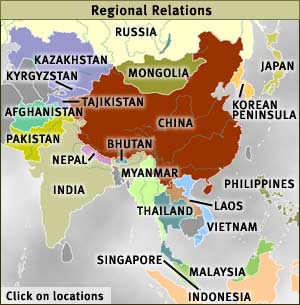
KOREAN PENINSULA: China came to the aid of North Korea in the 1950s during the
Korean War -- sending thousands of Chinese troops to aid Pyongyang's faltering
war effort against United Nations forces. In recent years, China has attempted
to keep relations open between itself and both Koreas. North Korea remains an
ideological ally, but growing trade between China and South Korea has helped
improve that diplomatic relationship. The Chinese recently hosted talks in Beijing
in an attempt to resolve the decades-long conflict on the Korean peninsula.
JAPAN: Relations
between Tokyo and Beijing have been haunted for decades by the atrocities
committed by Japanese forces against the Chinese during the 1930s and '40s. But
relations have improved. China and Japan signed a bilateral peace and
friendship treaty in the 1970s. Japanese companies have invested heavily in
China, and in 1997 trade between the two countries came to more than $63
billion. But China remains suspicious of Japan's close relations with the
United States.
PHILLIPINES: Tensions
have grown in recent months between China and the Philippines over their mutual
claims to the Spratly Islands -- a potentially oil-rich archipelago in the
South China Sea. In 1998, China
criticized the detention of a group of Chinese fishermen near the islands by
the Philippine navy. For its part,
the Philippines accused China of sending armed naval ships to the area to build
what Manila said looked like permanent structures for military use.
VIETNAM: China supported Vietnam during its war against the United States.
But by the war's end in 1975, China considered Vietnam in the camp of the rival
Soviets. Vietnam's invasion of Cambodia in December 1978 and the ouster of the
Chinese-backed Khmer Rouge regime there led to a brief war between Beijing and
Hanoi two months later. Vietnam's
withdrawal from Cambodia in 1989 soothed Chinese-Vietnamese relations. But
there have been renewed tensions over who controls the Spratly Islands -- an
archipelago in the South China Sea claimed by Vietnam, China and several other
Southeast Asian nations.
LAOS: As a
Vietnamese ally during Hanoi's war with the United States, Laos' relations with
China were good during the conflict -- but deteriorated in the late 1970s when
China went to war with Vietnam.
Sino-Laotian relations began to improve by the late 1980s. And
with the collapse of the Soviet Union -- which had supported both Laos and
Vietnam -- Laos went out of its way to strengthen relations with China and much
of the outside world.
THAILAND: Thailand and China are studying the possibility of jointly
building a hydroelectric station in China's southwestern Yunnan Province. The
station would provide power to Thailand, and if approved could go online by
2004.
SINGAPORE: Chinese officials during the time of Mao were dismissive of the
former British colony's rulers. The late Chinese Premier Chou En-lai once
referred to Singapore's British-educated prime minister, Lee Kuan Yew, as a
"banana" -- yellow on the outside, white on the inside.
Lee and other Singapore officials are now helping to advise
China's government as Beijing attempts to broaden its economic reforms.
MALAYSIA: Like China, Malaysia is one of several East Asian countries
claiming ownership to the Spratly Islands in the South China sea.
INDONESIA: Recent attacks against ethnic Chinese in Indonesia, as part of
the general unrest there, have triggered strong criticism against Indonesia
from Beijing and other Chinese communities worldwide.
MYANMAR: China has been the primary diplomatic supporter for Myanmar's
State Law and Order Restoration Council (SLORC), the nation's governing
military regime. SLORC made international headlines in recent years for its
brutal suppression of a pro-democracy movement.
Beijing also has supplied substantial financial aid to Myanmar
(formerly known as Burma) -- as well as billions of dollars toward the
modernization of SLORC's military.
BHUTAN: One of the world's poorest countries, Bhutan relies on
neighboring India for much of its exports and imports. That reliance on India
has created tensions between China and Bhutan.
NEPAL: Landlocked, small in size and caught between two regional powers,
Nepal has sought good relations with both China and India. Nepal began formal
relations with China in 1956 -- but it has strong traditional, economic and
cultural ties with India.
INDIA: Relations between China and India have been strained since 1950,
when China annexed neighboring Tibet. India gave asylum to Tibet's spiritual
leader, the Dalai Lama, after a failed Tibetan uprising in 1959. Tensions
boiled over into a full-scale war with India in 1962, which China won. Beijing
later withdrew from much of the Indian territory it occupied and established a
demilitarized zone.
In recent years, India has taken offense at China's support of
India's arch rival, Pakistan -- especially Beijing's technical assistance for
Pakistan's fledgling nuclear program. For its part, China has criticized
India's resumption of nuclear testing in 1998, and its recent testing of
ballistic missiles.
PAKISTAN: Pakistan was among the first nations to grant diplomatic
recognition to the People's Republic of China. Relations strengthened following
China's war with Pakistan's arch rival, India, in 1962. China supported Pakistan's opposition to
the Soviet invasion of Afghanistan in 1979. Beijing has provided Islamabad with
technical, economic and military assistance -- as well as aid for its nuclear
energy programs. Critics have accused the Chinese of helping Pakistan with
nuclear weapon technology.
AFGHANISTAN: China supported international condemnation of the Soviet invasion
of Afghanistan in 1979 -- and has supported Afghan factions that opposed the
Soviets. China is a member of the
so-called Six Plus Two United Nations contact group -- which is seeking a
solution to Afghanistan's current ethnic, political and factional conflict. It
sent a delegation to Kabul early in 1999 for talks with Afghanistan's ruling
Taliban militia.
TAJIKSTAN, KYRGYZSTAN, KAZAKHSTAN: In 1996, these three former
Soviet republics and Russia signed an agreement with China. The treaty was
meant to reduce tensions along the countries' mutual borders -- tensions that
originated during the Chinese-Soviet rivalry of the Cold War.
RUSSIA: Russia and China were bitter rivals following their ideological
split in the 1960s. A series of clashes along their mutual border during that
decade brought fears of a possible nuclear war between the two communist giants
-- but diplomacy and calmer heads prevailed.
Relations between Moscow and Beijing began to thaw in the 1980s
and have noticeably improved since the end of the Soviet Union and the start of
the Russian Federation. A series of new treaties and high-level, official
visits in recent years have further cemented the Chinese-Russian relationship.
MONGOLIA: Relations between China and Mongolia have improved since the low
of the 1980s. That was when Mongolia, allied at the time with the Soviet Union,
began systematically expelling ethnic Chinese -- many of whom had arrived in
Mongolia in the 1950s to assist in construction projects. Mongolian-Chinese
relations have been on the mend since the early 1990s. A Treaty of Friendship
and Cooperation -- respecting both sides' independence and territorial
integrity -- was signed by the two countries in 1994. In 1997, Mongolia's
defense and foreign ministers visited Beijing and the Chinese foreign minister
went to the Mongolian capital for talks.