One side note - ALL TAPING SHOULD BE DONE OUTSIDE OF PRACTICE!!! THIS APPLIES TO ALL FLAGS AND WEAPONS!!!
5. Pull the fabric so that the seam is straight all the way down and tape the silk to the pole at the bottom of the silk.
Right Shoulder
This is the most basic of the flag positions
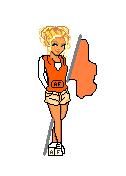
Right Shoulder is when the flag is straight up and down in front of you. Your left hand should be at the BOTTOM of the pole with your pinkie flush with the bottom of the stopper (not wrapped). The right hand should be where the tape meets the fabric, or as close as you can physically come to that.
While you are at right shoulder the entire body should be at attention, good posture and an alert stance. This should be relatively obvious. Don't lean forward or backward, tense your abs and your butt, and hold your ribs over your hips. As in attention, there should be a straight line down the center of your body. Elbows are out, not in at the side.
Flag Movement
Flags can be smooth and flowing but they can also be sharp and definite. If your instructor gives you a move which is supposed to be sharp...make it sharp. This should be basic but a lot of people fail to make flag moves as crisp as they could be.
Whenever you are told to move to an angle make it tight and definite...no wobbling around. If a move is supposed to be smooth, don't be a robot!
Watch your planes on everything you do. If you aren't sure what that is, imagine that you are in a toaster and if your flag leans forward or back, you will be ZAPPED!! Don't cut planes!!!
Flags can be the most elegant of all the pieces due to the movement of the fabric so take advantage! When a stir, or spin, anything that is a gentle move takes place just let the flag to the work. Loosen up your arms and body but keep your hands tight, doing smooth work is all about not being stiff in your arms and wrists.
A good exercise to improve your snapping power is to stand at right shoulder then bring the flag down to flat at your waist very quickly. At first the pole may wobble but if you apply wrist strength and tighten your grip as the pole reaches it's position you'll be able to make a hard stop. Try bringing the flag down to level then back to right shoulder repeatedly until you have a nice crisp stop.
Sails
If your flag looks like a cutup and it's dragging through the air chances are you've got a sail. Sails are when the flag wraps itself over or around the pole. What's the point of having a big beautiful piece of fabric to show off if no one can see it? During practice this is not a big deal to fix, but at a show it may become a pretty stressful issue. Say you're performing during outdoor and it's raining...lovely, and windy..even better, and you end up with a sail..
1)Calm down...it will be okay. This isn't the first time it has happened and it won't be the last
2)DONT SHAKE THE FLAG! Shaking or flicking the flag around will only draw attention to the fact that you've got a big ol' sail!
3)Keep your mind in the work, focus on being in time, not the sail. The judges are watching to see that you continue to perform despite the sail.
4)When you get the chance, use a hand which is close by to tug at the silk without altering the work any.
5)Sails also fall out if you make your work more crisp or take advantage of a plane that might help you to unravel the little bugger.
6)Avoid Sails to begin with...
Try not to cut through the same curve or path twice, this will drag the pole right into the fabric. Imagine that the fabric is chasing the pole and you don't want to help the fabric catch it.
Tossing
Tossing is all about posture and good technique. While tosses vary widely in technique from a wind-up release to pole tosses, here are a few brief tips that may help in general.
When tossing from the forth count of a wind up,
Make sure that your hands are in right place, left hand near the tape while the right hand should be splitting the distance from the tape to the end of the pole at the flag end. This hand placement should feel unbalanced and awkward at first, that is because the bulk of the pole's weight has been moved to the bottem end. This actually aids the movement of the pole. The closer the right hand is to the tape the less leverage you have to make the toss making it even more difficult to pull off the correct rotation.
Use your left hand as a tool for propelling your toss. Many guard members forget to utilize the left hand to help push the rotation of the flag. Think of your right hand as the wrist hand or the hand that controls the height and rotations and think of the left hand as the power house that actually moves the pole. If you push down hard with the left hand(thumb) as you go into your release you will have a stronger toss and it will relieve pressure that is put on the right hand.
The height of a toss is determined by the hieght of your arm at release. If you are tossing a low toss, generally a single, your right arm should be at a right angle from your shoulder forming a backwards L. If the toss is higher(one and a half or double) raise your hand up to a straight line from shoulder to wrist. If you want the toss to have a great amount of rotation than height simply lower the hand and focus more on the wrist movements.
Remember to keep your left hand at your side against your body unless directed to do otherwise. There is no reason for that hand to be doing anything else.
You may have the natural tendency to hop or bounce when you toss, this is actually hurting the amount of force behind each toss. By keeping your feet firmly on the ground your body has a bit of an anchor/base to pull strength up from. When you hop you take away that stability and the bounce isn't putting the flag up that much higher.
Catching
Catching is obviously a pretty important part of the toss. Unfortunettly much of the trick to catching a toss correctly comes from experience and learning where to expect the flag will come down. However there are some bad techniques that may arrise from an uncertainty in catching that can be remedied early on.
Anticipating the catch with your hands or bringing your hands up for the catch too soon is one of the most common mistakes made by new members. In the perfect toss the right hand either remains in the point of release or comes down to the side of the body until it's time to catch. The problem lies when people move their hand to an anticipated catch point too soon and end up waiting for the catch. To fix the problem try and count out the duration of the toss and move your hand half a count before the catch. This should keep you from moving too early.
A wobbley catch is the result of either lack of muscle strengh, too little rotation on the actual toss, or the inability to snap the pole into place. Unless the toss is caught on an angle the idea is to stop the pole straight up and down in front of you. If the pole wigglies or moves around rather then snapping into that placement it just plain looks bad. To fix this either work on your snapping ability by reviewing hard hit exercises or try and push the rotation so that it makes it the entire way around during the toss.
Borrowed from silkonline.org.
Got any other tips? Check out the message board or email me at Ghguardprincess@yahoo.com