Grabbing grounders
John P. McCarthy, Jr.
Youth Baseball: The Guide for Coaches & Parents
Catching infield grounders is arguably the toughest defensive skill for young ball players to master. It takes a keen, quick reflex, speed and good concentration to be an infielder.
To develop fielding skills, the first thing you should do is find a smooth surface on which your child can practice. Most grass fields are terrible. They only teach a kid to fear grounders, since bad hops occur very frequently. A dirt field is much better, and you can rake out any ruts and remove stones. Throw the ball sidearm, or somehow make sure you release it about two feet from the ground—the height where a bat would hit it. At first let, your child stand fairly close, and throw the ball softly, getting it to him or her on one bounce. Again, throwing the ball works as well as hitting it and takes less skill on your part. After a while, when your child can handle it, make it tougher. Give a couple of bounces, vary the speed, throw to the right or left. After skills are improved, move onto a regular infield and use a bat.
...the glove should be down, way down.
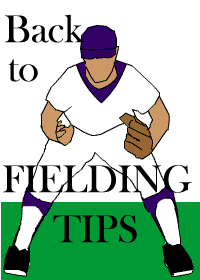
As with outfielding, the idea is to get in front of the ball. The player initially stands in a crouch, facing the batter, legs spread out a bit, knees and hips bent, hands and gloves down by the knees, weight forward on the toes so the fielder can spring either way. When the ball is hit, the player springs, not steps, to get quickly to the spot where she can make the play.
Try telling your infielders they have to "stand up and sit down at the same time." The legs are spread apart, left foot up, right foot back. The knees are bent so the backside is down low. (Not really sitting of course, but it makes the point: we want the body low.) Most players prefer to bend over at the waist; a waist bend is needed but not at the expense of bending the knees. The back and head should be down, back nearly parallel to the ground, head on the ball.
Finally, the glove should be down, way down. If the ball goes under the glove, it's all over. Start the glove low, and bring it forward and up to meet the ball. Have your players visualize a triangle with the glove and both feet. Players often expect the ball to bounce up to them, but sometimes it doesn't. If it was hit on the top of the ball, the topspin will make it skim the ground. The glove must always be low in anticipation of this. If the ball skims, it's easier to bring the glove up to meet it than down.
Click the button above to go back to the web page or
web site you were at before coming to this page
You are visitor
to visit this page!
Since May 7, 2002
This
site is awarded the

In
recognition of creativity, integrity and excellence on the Web.
 The
term "Little League" and the Little League logo are
trademarks of Little League Baseball, Inc., Williamsport, Pa.,
extended only to local chartered leagues for purposes of
identification and publicity
The
term "Little League" and the Little League logo are
trademarks of Little League Baseball, Inc., Williamsport, Pa.,
extended only to local chartered leagues for purposes of
identification and publicity
Copyright © 2000 Brookside Little League, Inc. All rights reserved

Please, drop us a line and let us know what you think, like or dislike or would like to see on our site!


Thank You , for visiting Brookside Little League's web Site

by
Jon Anderson
jontanderson@juno.com