
|
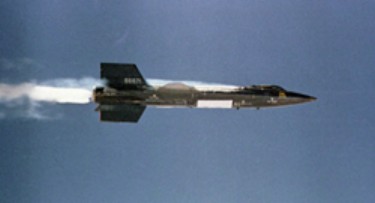
The X-1 was flown by Chuck Yeager to fast than Mach 1. Later Scott Crossfield took a similar model of plane past Mach 2. The plane's shape is that of the German Me-163. The X-1 was very hard to handle and the plane started shaking
violently at about Mach 1 then as it had passed Mach 1 the X-1 stopped shaking. This is, what is call transonic buffeting. They tried go slower and that did not help. So it must be assumed that it was agreed that fat must be better. There a problems that arise with high acceleration. The errors that happen in steering would become a problem much faster. The fact that thrust comes from the tail rather then being pulled by the propeller from the nose or the wing makes the design less stable. The amount of aerodynamic drag (the resistance due to shape) is very high, the back of the X-1 has a gentler slope then the
front.
The X-15 was made to go much faster than the X-1 and to do this as safely as possible. It was designed to correct what they thought the problems were and to handle what might happen if they were in error. The design may look crude at first glance but it is all on purpose. The back end is to provide drag at the back end when the engine is shutdown in case there is a control error and the plane gets askew to the direction it is going. The fully moveable horizontal tail surfaces to effect adequate control even in thin air or holding the body and wings at a high attack angle. (These will later find there way on to most high performance airplanes.) The lower tail is for control holding the plane vertical while at high attack angles.
|
|

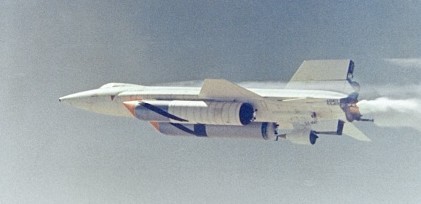
These two pictures I have include after the others. The first part to consider is the as they are calling the scramjet. This by what was know at the time is not a true scramjet. This is more of a ramjet then a scramjet. The ramjet by definition requires that the air be slow to subsonic speeds for combustion this giving a combustion like a car or a jet engine. From the jets at that time it was considered that the air must be going under 400 miles per hour when combustion was taking place for it to occur properly. The standard was then to calculate the compression ratio and at cruising speed with the compressed gases moving slower then 400 miles per hour. This engine is more of a hybrid of the ramjet and scramjet. A true ramjet which by this combustion was not considered to be effective a above mach 4. The way that this hybrid is works I do not believe it is wise to say at this time even though it is not very effective. The problems for the hybrid ramjet/scramjet as tried on the X-15a-2 was that it cannot be used at a high angle of attack. For the hybrid ramjet/scramjet to be effective also from the point of thrust to weight ratio the walls must be thin. The air currents from where the wing joins the fuselage on the X-15a-2 beat the hybrid ramjet/scramjet to where it was ruined.
The second part that is import from these pictures is the ablative coating on the X-15a-2 on your left. The windows are not visible in that picture because they are covered up. The first launch of the X-15a-2 with ablative coating it was found that the ablative coating burned on to the glass. The escort plane had to tell the pilot how far to the ground. This is probably part of the reason that NASA choose the silicon tiles over an ablative coating. The window have covers over them until after they are down below around 70,000 ft.. I had figured on ablative coating before I learned of this problem.

|

The YF-12 shows it is the result of the research of the X-15 far more than the SR-71 does. The top fin and out wing are hinged. This is to give access to the engine for remove. The is how the YF-12s were modified in to the YF-12C with the other fins. This is from pictures in different books and thinking of how they doing what they say they are doing. The stability need for a high performance plane was not need for high speed plane so the lower fin was eliminated and the upper fin was reduced in strength. This will be lead to a complete recalculation of the strength needed in the airframe for the SR-71. The SR-71 is a much lighter design then YF-12s or A-12. (The Russians will begin working on the Mig-23 Foxbat to counter a plane we will not develop.) The missiles that were to have gone here were better than anyone had hoped and did not need this much plane. They will find there way on to the F-14 and F-15 after the Vietnam War. (One dud missile on the ground is more trouble than any losses.) This is the basic history of this part of the X-planes. Then if, one wants to develop a plane to leave the planet one must look at the X-15 because the SR-71 design was limited so that it could better perform the mission of high speed spy plane.

 |
The first is very important and I will not discuss it at present.
The controls here are the first for high Gs environment and a stick in the middle. The reaction or rocket controls on one side and the high Gs control on the other. There would not be a landing without a wing man if at all possible
because of visibility of the ground on approach. That is a piece of plywood just setting on the floor there to cover that hole. You can tell by the fit that they do not work with wood to much it is a fine rocket plane thought. The use of veneer if properly sealed (Sealed while in a vacuum) large metal surfaces would do a lot to reduce the heat sink effect of having to warm all that metal at
once.

 |
The seat was to lay back to allow access to the "living area and equipment. This type of seat back would have to be reinforced and have pins into the wall on either side of the seat. This is necessary for the smallest possible plane. Later when I look close at that little picture and then get a magnifying glass for a closer look. I will see the little room behind the seat of the X-15. The seat must lay down or it must be removable there is no information on that part of the plane. I have found this picture recently that gives a better view of the whole plane X-15 Big Cutaway I was about now wonder how much more there was that I had not see or how much more they were thinking of doing. The atlas rocket used tanks thin enough to be tore by a socket. A supported balder of metal over insulation to protect edges and there could be more fuel and more room after launch. This is just a start but starts are important.
This one I wish you would take my word on but in the news reel that goes with the this still, they are having a hard time standing still. If you saw the movie the Right Stuff the wives say everyone is so interested in maintaining an even keel. The heart rates would in the X-15 climb to over 140 beats a minute just before release and stayed high though out the flight. This is why they picked older test pilots for the job. The reason being they hoped that having experiencing this sort of thing would lessen the effect but it tends to grow on a person. John Glenn is the most leave headed of the group and I think has twice shown us his get back to work nature. Charles "Chuck" Yeager remained a quiet soldier. If we are to belief the Right Stuff about anything Gordon Cooper probably got the go for the 3 orbit launch based on his habit of going to sleep when there was a break in what he was doing.
There is a lot to learn just from these four pictures.
Bob L. Petersen
Bob Petersen
| | 
