
THE FORT DONELSON CAMPAIGN
Battle of
Fort Donelson
Date: February 13-16,
1862
Location: Tennessee
Confederate
Commander: John B. Floyd/Simon
B. Buckner
Union Commander:
Ulysses S. Grant
Confederate Forces
Engaged: 21,000
Union Forces Engaged:
27,000
Winner:
Union
Casualties:
19,455 (2,832 Union and 16,623
Confederate)

 |
 |
||
|
(1822-1885) |
(1806-1863) |
||
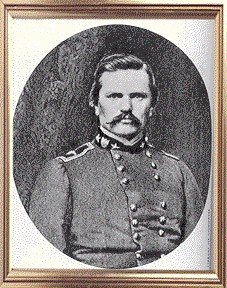 |
|||
|
(1818-1893) |
The Battle of Fort Donelson
(Feb. 13-16, 1862)
Begun in the East, the war was
spreading to the West, even beyond the Mississippi where the fate of the
important border state of Missouri and the chief city of the West in those days,
St. Louis, hung in the balance between slaveholding and non -slaveholding
elements. This, from the days of the Kansas-Nebraska troubles in the fifties,
had been "dark and bloody ground" Both sides claimed Missouri and both sides
needed her. In August 1861, a Union army was defeated at Wilson's Creek in
southwestern Missouri and the casualties amounted to over 23 per cent of all
engaged, among them the stalwart Unionist General Nathaniel Lyon. The following
March came the Battle of Pea Ridge in northwestern Arkansas. This was the first
clear and decisive victory gained by the North in a pitched battle west of the
Mississippi River, and until 1864 the last effort of the South to carry the war
into Missouri except by abortive raids. More importantly perhaps, its result
made it possible for veterans of a long series of minor engagements west of the
Mississippi to reinforce the armies in the mid South under Buell, Rosecrans,
Sherman, and Grant.
In this area the object of the Federal armies was, of course, to cut the
Confederacy in half by clearing the Mississippi from St. Louis all the way to
the Gulf and to stab at the heart of the Confederacy via the Tennessee and
Cumberland rivers. If successful, these maneuvers would cut Texas off from the
main body of the South, hold Kentucky firmly in the Union, and make it difficult
for Tennessee to cooperate with her sister states.
In February 1862, Fort Henry, commanding the Tennessee River, was
captured with support from gunboats on the river by a taciturn, rumpled, cigar
smoking (some said whisky-drinking) character named Ulysses Simpson Grant of
Illinois. Ten days later, Fort Donelson, eleven miles away on the Cumberland
River and a very much stronger position for the Confederates, followed suit. The
North was beside itself, reveling in the victory and in Grant's memorable answer
to Buckner, the Confederate commander who had asked for terms. "No terms except
unconditional and immediate surrender can be accepted, " said Grant. "I propose
to move immediately upon your works." Apparently Mr. Lincoln had at last found a
fighting general in Unconditional Surrender Grant.
General Grant invested Fort
Donelson on the 12th of February, 1862, with 15,000 troops, reinforced that
evening by six regiments of infantry and Flag-Officer Foote's fleet of four
ironclad and two wooden gunboats--the St. Louis, Carondelet, Louisville,
Pittsburg, Tyler and Conestoga. Reinforcements continued to arrive. Wallace's
division was brought over from Fort Henry, 10,000 men were sent by General Buell,
and the Confederate lines were enveloped by 24,000 troops. General Buckner
states, in his report, that at the close of the attack Grant's forces exceeded
50,000. Brig.-Gen. John B. Floyd, of Virginia, commanded the Confederate forces,
amounting to 12,000 men. General Pillow commanded the left, General Buckner the
right.
The Tennesseeans present were, the Third Tennessee, Col. John C. Brown;
Eighteenth, Col. Jos. B. Palmer: Twenty-sixth, Col. John M. Lillard;
Thirty-second, Col. Ed. C. Cook; Forty-first, Col. Robert Farquharson; Tenth,
Col. A. Heiman; Forty-second, Col. W. A. Quarles; Thirtieth, Col. John W. Head;
Forty-ninth, Col. James E. Bailey; Forty-eighth, Col. W. M. Voorhees; Tennessee
battalion, Colonel Browder; Fiftieth, Colonel Sugg; five companies of infantry,
Col. S. H. Colms; Fifty-third, Col. Alfred H. Abernathy; Forrest's regiment of
cavalry, Col. N. B. Forrest; Ninth battalion of cavalry, Lieut.-Col. George
Gantt; Maney's light battery of four guns, Capt. Grant Maney; Green's battery,
Captain Green; Porter's battery, six guns, Capt. Thomas Kennedy Porter. The
heavy guns were commanded by Capt. J. H. Dixon; one battery of 32-pounders, one
rifle gun, one 10-inch columbiad and two howitzers were commanded by Capt. R. R.
Ross; Capt. B. G. Bidwell, Thirtieth Tennessee infantry, was assigned to a
battery of four 32-pounders; Capt. T. W. Beaumont, Company A, Fiftieth Tennessee
infantry, had charge of a battery of four 32-pounders, and a battery of eight
32-pounders was commanded by Capt. Jacob Culbertson. Brig.-Gen. Gideon J.
Pillow, Brig.-Gen. Simon B. Buckner and Brig.-Gen. Bushrod R. Johnson commanded
the troops, General Floyd in chief command. The Tennessee brigade commanders
were Col. A. Heiman, Col. John C. Brown and Col. James E. Bailey, the latter
commanding the garrison of the fort; Col. N. B. Forrest commanded the cavalry.
The investment of Fort Donelson and the works occupied by the Confederate
forces was complete by the afternoon of the 12th of February, and on the 13th an
unsuccessful assault was made on Bushrod Johnson's left wing. It was met
gallantly and repulsed by the Tenth Tennessee, Lieut.-Col. R. W. MacGavock; the
Fifty-third Tennessee, Lieut.-Col. Thomas F. Winston; the Forty-eighth
Tennessee, Col. W. M. Voorhees; the Forty-second Tennessee, Col. W. A. Quarles,
and Maney's battery. General Johnson and Colonel Heiman both commended in high
terms the conduct of the men who met this attack. After a second and third
assault, the enemy retired, leaving his dead and wounded on the field. He had
met three bloody repulses. The principal sufferer on the part of Heiman's
brigade was Maney's battery; it was fought without protection and with skill and
courage, but his loss, chiefly from sharpshooters, was such that he was
afterward unable to man two of his four guns. Colonel Brown, commanding brigade,
reports that pending this engagement of two hours' duration, "the enemy planted
one section of a battery (of field guns) almost in front of Captain Graves,
commanding a Kentucky battery, and opened an enfilading fire upon the left of my
line, and at the same time a cross-fire upon Colonel Heiman. Captain Graves,
handling his favorite rifle piece with the same fearless courage that
characterized his conduct during the entire week, in less than ten minutes
knocked one of the enemy's guns from its carriage, and almost at the same moment
the gallant Porter (commanding battery) disabled and silenced the other, while
the supporting infantry retreated precipitately before the storm of grape and
canister poured into their ranks from both batteries." Two hours before this
assault on Heiman's brigade, General Buckner reports, "the enemy made a vigorous
attack on Hanson's position (the Second Kentucky, Col. Roger W. Hanson), but was
repulsed with heavy loss. The attack was subsequently renewed by three heavy
regiments, but was again repulsed by the Second Kentucky, aided by a part of the
Eighteenth Tennessee (Colonel Palmer). In both of these affairs, also in a third
repulse of the enemy from the same position, Porter's battery played a
conspicuous part." Col. Roger Hanson, in his report of this action, states that
"in resisting these attacks I was greatly assisted by Porter's battery upon the
left. It always fired at the right time and to the right place.
General Grant had so far failed to accomplish anything with his army. On
the 14th the main attack was made with the enemy's gunboats. Flag-Officer A. H.
Foote, United States navy, reported that the action continued one hour and a
half, and that "in the latter part of the action his fleet was less than 400
yards from the fort." "The wheel of this vessel [the flagship], by a shot
through her pilot-house, was carried away, and the tiller-ropes of the
Louisville also disabled by a shot, which rendered the two boats wholly
unmanageable. They then drifted down the river. The two remaining boats, the
Pittsburg and Carondelet, were also greatly damaged between wind and water, and
soon followed us, the enemy rapidly renewing the fire as we drifted helplessly
down the river. This vessel, the St. Louis, alone received 59 shots, four
between wind and water, and one in the pilot-house, mortally wounding the pilot
and others. There were 54 killed and wounded" on the several vessels.
Capt. Joseph H. Dixon, an officer of great intelligence and courage, was
killed on the evening of the 13th when a few shots were exchanged between the
fleet and fort. One shot came through the embrasure, striking the left cheek of
one of the gun-carriages out of which a screw bolt was driven, striking him in
the forehead, killing him instantly. This was the only casualty sustained by the
batteries. Colonel Bailey's brigade constituted the garrison of the fort and
rendered great assistance to the gunners.
No battle or combat of the war was more decided than that between the
heavy batteries and the Federal fleet, and there were no higher intelligence and
gallantry displayed on any field of service than that exhibited by Captains
Dixon, Culbertson, Ross, Beaumont, Bidwell and Graham. Lieutenants Stankiewitz,
Fitzgerald, Spark-man, Bedford, George Martin and W. C. Allen were honorably
mentioned. Captain Culberson reported that "our success is mainly attributed" to
Lieut. H. S. Bedford, who directed the 10-inch gun. Captain Bidwell, referring
to Private John G. Frequa (or Fuqua) in his report, stated that "at the highest
gun in my battery he stood perfectly upright, calm, cool and collected. I heard
him say, 'Now, boys, see me take a chimney.' The chimney [of the vessel] and the
flag both fell. Very soon he sent a ball through a porthole and the boat fell
back." Captain Beaumont makes honorable mention of Major Robertson, who
volunteered to serve one of his guns; also of Sergt. J. S. Martin, Corps. W. H.
Proctor and Dan C. Lyle, and of Privates Elisha Downs, Poston Couts, Nelson
Davis, Isaac Christie, Wm. Trotter, Thomas Pearce and R. M. Crumpler. But no
duty was omitted by officers or men, and Tennessee will always hold in grateful
memory the prowess of her sons who manned the heavy guns in the defense of Fort
Donelson.
On the 15th of February a combined attack was made by the two divisions
commanded by Generals Pillow and Buckner. General Pillow led the left to the
attack, soon followed by the right. Pillow's division constituted two-thirds of
the army. The battle raged from daylight to 1 o'clock and to that hour was a
great success. It was won by the troops of all of the States. Virginia,
Kentucky, Mississippi, Tennessee, Texas, Alabama, all shared alike in the glory
of the achievement. The object of this attack is stated in the report of General
Floyd to have been, as the result of a consultation with the officers of
divisions and brigades, "to dislodge the enemy from the position on our left,
and thus to pass our people into the open country."
Col. John G. Brown reported that when his brigade moved out on Saturday
morning it "was provided with three days' cooked rations and marched with
knapsacks, the purpose being to turn the enemy's right wing and march out on the
Wynn's Ferry road to fall back on Nashville." After several fierce combats in
cooperation with the left division he reports that he "led the Third, Eighteenth
and Thirty-second Tennessee across an open field on the right of Wynn's Ferry
road under the fire of a battery posted on that road." The infantry support
retreated, leaving one section of the battery in his hands. He pursued the
retreating forces. After this another fierce combat ensued, but after the firing
of a few volleys of musketry the enemy abandoned the field, leaving 800 killed
and wounded. In this last combat Colonel Brown was reinforced by the Fourteenth
Mississippi regiment and Graves' battery. The brigade lost 50 in killed and
wounded, among them Col. Thomas M. Gordon of the Third, wounded, and the
accomplished Lieut.-Col. W. P. Moore, mortally wounded.
General Pillow, leaving Heiman's brigade in the trenches, with the
balance of the left division, assisted by Forrest's cavalry, engaged the enemy
hotly for two hours and succeeded in driving him back on Buckner's division.
Forrest's cavalry charged the infantry support of and captured a battery
composed of four field pieces and two 24-pounders. Gen. Bushrod Johnson, of
Tennessee, always reliable and strong in battle, contributed largely to the
success of the movement. His command became united with the forces of General
Buckner as the enemy retired, as General Pillow reports, "and engaged the enemy
in a hot contest of nearly one hour, with large forces of fresh troops that had
now met us. This position of the enemy being carried by our joint forces, I
called off further pursuit after seven hours of continuous and bloody conflict,
in which our loss was severe, and leaving not less than 1,000 of the enemy dead
on the field." The object of this battle seemed to be accomplished, but our
council of war was divided, and the troops were ordered to their original
position in the intrenchments.
As Buckner returned he found the Federal forces of Gen. C. F. Smith
advancing rapidly to take possession of his portion of our works, bravely
opposed by Maj. James J. Turner of the Thirtieth Tennessee. He had a stubborn
conflict lasting one hour and a half, resulting in the seizure of our extreme
right. This position was in rear of the Confederate river batteries and
field-work for their protection, and was the key to the Confederate situation.
It took Buckner in reverse and necessitated the ultimate surrender of our
forces. The position seized by the Federal forces had been occupied by the
Second Kentucky. In the struggle to regain it, this gallant regiment was
reinforced by the Eighteenth, the Third and Thirty-second Tennessee, and
subsequently by the regiments of Colonels Quarles, Sugg and Bailey. General
Buckner reported that "the enemy made repeated attempts to storm my line on the
right, but the well-directed fire of Porter's and Graves' artillery, and the
musketry fire of the infantry, repelled the attempts and forced him to shelter.
Porter's battery, from its exposed position, lost more than half its gunners,
and the intrepid commander was severely wounded late in the afternoon of
Saturday, being succeeded in command by the gallant Lieutenant Morton."
The artillery of Tennessee was especially conspicuous. Colonel Heiman
reported that in the battle of the 13th, referring to Maney's battery. "First
Lieutenant Burns was one of the first who fell. Second Lieutenant Massie was
also mortally wounded. but the gallant Maney, with the balance of his men, stood
by their guns like true heroes." Generals Pillow and Bushrod Johnson warmly
commended Captains Maney and Green; and General Floyd, commander-in-chief, in
his report of the battle of the 13th, said: "Too high praise cannot be bestowed
upon the battery of Captain Porter for their participation in the rout of the
enemy in this assault. My position was immediately in front of the point of
attack, and I was thus enabled to witness the incidents of it." Col. John C.
Brown reported that Captains Porter and Graves "excited the admiration of the
whole command by an exhibition of coolness and bravery, under a heavy fire from
which they had no protection, which could not be excelled. Captain Porter fell
dangerously wounded by a minie ball through his thigh while working one of his
guns, his gunners being nearly all of them disabled or killed. The command then
devolved upon Lieutenant Morton, a beardless youth, who stepped forward like an
old veteran, and nobly did he emulate the example of his brave captain."
Lieutenant Morton subsequently became distinguished as captain of Morton's
battery of Forrest's cavalry.
Gen. N. B. Forrest, then colonel of Forrest's Tennessee cavalry, disputed
the advance of General Grant on Fort Donelson with commendable enterprise and
skill, no other obstacle being offered to the march from Fort Henry, and pending
the engagement he was actively employed on the flanks of our army. Besides his
own regiment, three mounted companies from Kentucky, commanded by Captains
Williams, Wilcox and Henry, were assigned to his command, and gallantly assisted
him. He also had assigned to him Gantt's Tennessee battalion. Forrest reported
that he "charged two batteries of artillery, taking nine pieces of artillery
with 4,000 stand of arms." He lost between 300 and 400 men, killed, wounded and
missing, a greater loss than was sustained by any other regiment of the army.
Among his killed was Capt. Charles May, who fell leading his company to a charge
on the enemy. Fort Donelson was the opening of a career to Forrest that carried
his name and fame to the civilized world and yet excites the admiration of all
who read of his personal prowess and heroic actions. He retired from Fort
Donelson before its final surrender. General Floyd with his brigade, and General
Pillow with his staff, left on a transport pending negotiations.
The Confederate forces amounted to 12,000 to 14,500 men. General Badeau,
in his life of Grant, Vol. I, page 36, says, on the last day of the fight Grant
had 27,000 men, and other reinforcements arrived after the surrender; but
General Buckner believed that this was far below the number, and General Buell
stated in 1865 that Grant had 30,000 to 35,000 exclusive of the naval
contingent.
The Federal loss amounted to 2,500 killed, wounded and missing. The
Confederate loss was about 1,420. On Thursday there was a rainfall, followed by
snow on Friday, with freezing weather, and by the evening of Saturday, the 15th,
the men who had spent a week in the trenches without sleep and without fire to
warm them, were worn out to such an extent that General Buckner decided he could
not longer maintain himself, and surrendered the troops on the morning of the
16th.
