
Welcome to the "My Major" page. Compared to everything else, this has to be pretty boring. My major is Chemical Engineering, hence all the pipes and the dumb reference to "How's it flowing."
You might be surprised that I'm really good at web design despite the ChemE major. After viewing my hobby, Computer Science might seem to be the way to go. However, I still like Chemical Engineering and appreciate all that goes into it. Lots of math and studying, but so far the courses have been very promising. It's one thing with which to get into fun stuff, but it's another to have a job in it.
To say the least, not too many people can say they don't want to be chemical engineers because it is not interesting. No, the curriculum is tough. Right now, I'm taking Staged Separations, Reactor Design, Heat and Mass Transfer, and Physical Chemistry Lab. Last semester, I took Thermodynamics, Fluid Mechanics, and Statistics. Taking so many of these courses at once is the physical equivalent of taking a stapler and inserting a metal knot in your brain for every day that goes by. For this reason, people tend to shy away from chemical engineering as a major.
Chemical engineering is supposed to be about the field in which we optimize any sort of process that produces chemical products. Now chemical products include everything in existence, since everything is a chemical in some way, shape or form. Chemical engineers are asked to design chemical manufacturing plants, to answer performance-related problems with manufacturing, to maintain control over safety and environmental issues, and to perform several other tasks related to production and safety.
Often, people confuse chemists with chemical engineers.
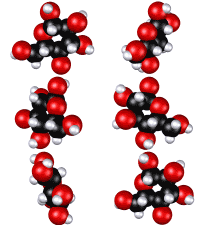 Chemists develop the chemicals
that make our wonderful world go round.
Chemists develop the chemicals
that make our wonderful world go round.
 Chemical Engineers
find out how to make them better, cheaper, and in a timely fashion.
Chemical Engineers
find out how to make them better, cheaper, and in a timely fashion.
This last thing is what I've always wanted to do, even though I've always held an interest in things like chemistry and biology. As an engineer, I have the mindset to solve problems and accept challenges as they appear. Although I believe problem-solving skills are best used by everyone, engineers need to apply them mathematically and rationally at the same time. Fun stuff--for a job.
| Process Control Engineer | Resides near headquarters of company or at a chemical manufacturing plant. This engineer develops functional designs of the manufacturing process, supervises preliminary test runs, and conducts maintenance tasks to ensure optimized performance. Takes on the responsibility of providing guidance, training, and support to engineers, technicians, and operators at one or more facilities. |
| Designer Analyst/Programmer | This position offers work on software development, such as Object Oriented Analysis and design, windows programming, networking, gui programming, C++, SQL, HTML, java, and database design. |
You can see that what is required of a chemical engineer in these two positions is radically different. This is because the skills that may be used by an engineer may diversify into several possible outlets. Problem solving can be used in the traditional sense of a process control engineer, who uses all the information taught in the classroom to optimize chemical processes.
On the other hand, a chemical engineer can work in a less degree-oriented field yet still do relevant problem-solving work that pertains to the engineering or scientific field in some way.
These are but a few examples of what chemical engineers can do. I selected two extremities: one of the most "academic" orientation, the other from the most "application" orientation. All sorts of jobs in between the two are available to ChemEs. The two you see in the table above were based on a small selection of a very large number of online classified ads!
There is no way I'll be able to discuss all of the courses in chemical engineering in any reasonable amount of space. I will give a description of some of my current courses. I have already stated that these courses are difficult, but all are very interesting.
This concludes my boring "My Major" page. By now you're so close to passing out that you'll probably do anything to stay awake, like play stuff on Camp Chaos, etc.
This page was created by
Chris Allen.
Last revised: October 4, 2000.
