
JETFOIL
TESTING PROGRAM (BOEING MODEL 929)
From July 1974
to February 1975, JETFOIL 001 underwent an extensive testing program to verify,
evaluate and improve performance and to obtain vehicle class certification.
The ship was
initially configured in a "Lead Ship" test arrangement. With the
exception of the ACS (Automatic Control System), all basic ship systems were in
a production configuration. The production ACS was installed about half way
through the testing program. The passenger interiors were not installed,
although the seats were available and used occasionally to accommodate
observers, special test support personnel and to permit demonstrations to be
carried out. A ballast barrel system, borrowed from Flight Test, was used to
control weight and balance and to simulate passenger-loading conditions. The
craft configuration was rigidly controlled throughout the testing program.
A data system
provided for 150 measurements, 60 channels of FM and 90 of PCM. Real time
monitoring of 16 selectable channels was available at all times. A secondary
data system was also installed for use in "special" performance
tests. It provided 30 additional channels of which 16 could be displayed in
real time. This permitted us to double our on the spot monitoring capability
when doing exploratory or diagnostic type testing.
Initial Tests
The initial
scope of tests carried out in a new hydrofoil are intended to determine how the
vehicle behaves relative to its design objectives and to establish when it is
ready to proceed with the more critical testing phases of rough water trials,
certification trials and customer demonstrations and builders trials. These
tests are carried out in relatively ca]m water and light winds and the entire
envelopes of performance and behavior are expanded in a gradual manner in the
same way that an airplane program is carried forward. The first few days are
spent evaluating hullborne handling characteristics - the taxi tests. Since the
thrust vectoring system on the 929 was a new design, extra time was allowed for
familiarization and evaluation. Hullborne maneuverability was good to excellent
depending on the position of the foils. Maximum control was achieved with the
aft struts up and the forward strut down with strut steering engaged.
Following
the hullborne tests, speed was gradually increased to accomplish first takeoff
and straight away flight. At this time, the first performance anomaly showed up
when it became apparent that the thrust available was insufficient to achieve
takeoff. The design thrust-drag curve for the 929 is presented below.
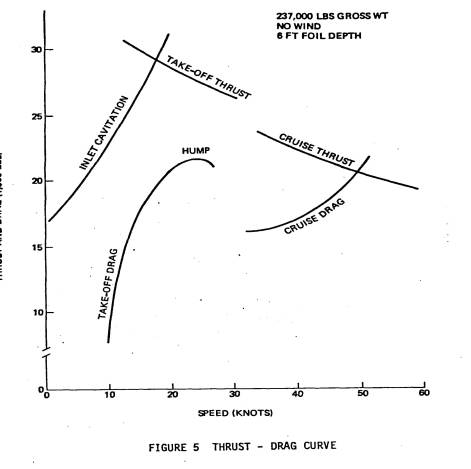
The
curve demonstrates the classical "hump drag" associated with high
speed marine vehicles. This arises because hull drag increases as the cube of
the velocity while foil drag increases as the square. As lift develops on the
foils, the hull drag builds up rapidly. When the hull finally breaks free, the
drag drops and then follows the square law as does an airplane wing. The
takeoff problem is one of setting the "hump drag" in a proper relationship
with the peak of the thrust curve to obtain maximum acceleration force to
get through the hump region. This can be affected by: the propulsion system,
the takeoff controller program and the incidence setting of the foils. As a
result of past hydrofoil work, it was anticipated that such a situation might
occur. A modification was made to the waterjet exit nozzles and takeoff was
successfully accomplished. Subsequent tests resulted in changes to both the
takeoff control program and to the foil incidence angle setting, which
permitted the original nozzles to be reinstalled.
Initial calm water
tests continued through August in order to fully characterize takeoff
performance, low speed trim and turning, low speed control dynamics and medium
speed trim and maneuvering. Specific tests were run to verify various automatic
control aspects including the takeoff controller, dynamic responses to step
inputs, responses to sinusoidal inputs, behavior in low and high speed turns
and high rate turns, shallow foil depth operations and simulated failures. Ship
performance throughout this entire series was very close to predicted with two
notable exceptions. The maximum speed attained was 43 knots, which was below
the expected maximum speed. During shallow depth turning tests and during
simulated broaching tests, turbine shut downs occurred. These were caused by
the inlet un-wetting which in turn un-loaded the free turbine. A protective
over-speed shutdown device in the engine automatically shut down the turbine
when this condition occurred. It was apparent that both of these situations
required additional testing in order to diagnose what was actually happening
and to develop suitable fixes.
Engineering Trials
Although special tests to develop engineering data were run
during the entire program the period from the end of August until mid-December
was devoted almost exclusively to this effort. In all, 144 trials were run
during this period for this purpose. Sixty-two were devoted to propulsion
system testing in order to try to determine whether the inability to achieve
expected maximum speeds was due to a thrust deficiency or to an excess of drag.
In all, three different size nozzles, four different inlet designs and three
different pump stators were evaluated, providing 12 basic combinations of real
interest. At the same time, twenty-eight trials were carried out to evaluate
the hydrodynamics, particularly drag. Tests were conducted at various foil
incidence angles to determine optimum settings. Flutter tests were run and
various fairing and pod revisions were made to assess their contribution to
drag. A series of drogue tests and engine shut down tests were also run in an
attempt to positively identify whether thrust was low or drag was high, with
the results indicating low thrust to be the difficulty. By December, it had
been possible to reduce the required power by 26% to produce the same speed or
conversely to increase speed between four and five knots with the major
contributions coming from a stator change (10%) and the incidence change (9%}.
Forty trials were run for foilborne control testing, twenty
on the test ACS and twenty more when the production ACS was installed. These
tests were aimed at optimizing the takeoff controller, closing the lateral
acceleration to rudder stability loop at design gain, fully evaluating
directional stability both open and closed loop and with and without the tip
fins and to eliminate any height and speed transients during turns. In
addition, a series of simulated failures were run to establish that the
resulting craft motions were not hazardous to the passengers.
Fourteen trials were run to acquire data on the various
subsystems, particularly steering and reversing, fuel, engine space cooling,
lubrication and sea water. During these tests, both interior and external
acoustic tests were also run to verify that the design levels had been met.
Rough Water Tests
The period from mid-December to the end of Ship 001 testing on
1 February 1975, was primarily devoted to rough water testing and to
certification trials. Generally, the seastate trials conditions were Seastate 4
(significant wave heights to eight feet); however, testing was also
accomplished in large swell type seas {equivalent to Seastate 5) with measured
waves to 24 feet high encountered.
Normally the JETFOIL platforms the waves, that is, the ACS
attempts to keep the deck as level as possible at a pre-selected height above
the mean surface of the sea. For seas with significant wave heights of eight to
ten feet -- or about equal to the effective strut length -- the resulting
vertical accelerations were within predicted values and the ride quality is
excellent on all headings to the seaway. Pitch and roll motions are quite safe.
As the waves increase in size, hull cresting through the
tops of the waves becomes a normal occurrence. The hull shape was designed to
keep the resulting forces and accelerations to a minimum when this happens. In
very large waves, on some headings, it is possible for the forward foil to come
near the surface, or to completely fly out of the water. This is called
"foil broaching". On other occasions, the water inlet would come to
the surface and produce the turbine shutdown situation discussed earlier. Two
modifications were developed which have been effective in solving this problem.
A "contouring" mode of control was provided which would reduce both
foil and inlet broaching, but at some degradation in ride quality. To further
protect the engines from shutdown, a pressure sensing system was installed at
the inlet, which automatically throttles the turbines back when the water
pressure drops. By combining contouring with the sensing system and using good
handling techniques, the shutdowns have been eliminated in all but extreme sea
operations.
Directional stability in all seas and for all conditions
tested was excellent. Lateral accelerations are low and were as predicted.
Maneuverability was good with full rate turns possible in all seas. Hullborne
operations, takeoffs and normal and rapid landings were made on all major
headings bm the seas and craft performance was quite good.
Certification Trials
Certification testing consists of both dockside and underway
tests and must be run on every vehicle to verify that it can be operated in a
safe manner. Generally this involves simulating electrical failures, hydraulic
failures and power failures - but the 929, being an automatically controlled
hydrofoil, presented a new problem for the agencies. To fully prove out the
vehicle, a new approach was developed.
A complete safety analysis was carried out in which all possible
failures were simulated and the resulting craft motions and forces on
passengers, crew or structure were predicted. The agencies then reviewed the
analysis and selected those failures that they wished to have demonstrated
(Table I). In addition to the usual ones, they also selected those that
produced the largest motions and/or forces (*). Since it was impossible to
simulate the latter without a considerable amount of special equipment, it was
agreed that they would only need to be demonstrated on 001. The test results
showed that the ship responses and the forces .were more benign than had been
predicted by the analysis and they fully substantiated the structural integrity
and safety of the design.
|
REGULATORY AGENCY
SIMULATED FAILURE TRIALS FOILBORNE - RATED
POWER - STRAIGHT RUNNING FORWARD
FLAPS FULL UP AND FULL DOWN * FORWARD
STRUT HARD OVER * AFT
OUTBOARD FLAP FULL DOWN * AFT
INBOARD FLAP FULL DOWN * SINGLE
HYDRAULIC SYSTEM FAILURE SINGLE
AND DUAL HEIGHT SENSOR FAILURES GYRO
SYNCHRO FAILURE * ACS
PRIMARY POWER FAILURE ACS
TOTAL POWER FAILURE FOILBORNE - RATED
POWER - MAX. RATE TURN AFT
OUTBOARD FLAP FULL UP * FORWARD
FLAPS FULL DOWN * HULLBORNE - NORMAL
RUNNING SINGLE ENGINE OPERATION SINGLE HYDRAULIC SYSTEM OPERATION TABLE I |
002 and 003 Tests
By December, 002 had entered into test. It was a slightly different configuration with the main performance difference being
that it had much shorter struts than 001. In 25 testing days, 002 accumulated
62 flight hours and in the process completed builders trials and certification
trials. The owner, Far East Hydrofoil Company, Ltd., accepted the ship in
February and as the "Madeira" it entered scheduled service between
Hong Kong and Macao in April, 1975.
003 began testing in March and completed 101 flight hours in 28 test
days. The main highlights of its program was the completion of all U. S. Coast
Guard certification testing and the completion of acceptance tests for the
customer, Pacific Sea Transportation Company, Ltd. of Hawaii. 003, christened "Kamehameha",
began inter island service in Hawaii in June, 1975.
SUMMARY
The testing program carried out on the Boeing 929 was the most extensive
test program ever run on a hydrofoil. From a testers point of view, it was very
successful. It demonstrated what the 929 could do, what its limitations were
and where improvements had to be made. It provided the information that was
needed to train the operating crews and maintenance personnel.
From first flight to introduction of the first Jetfoil into scheduled service
took ten months. It is interesting to note that the average time from first
flight to first service for the 707, 720, 727, 737 and 747 was also ten months.
.
