When Dragons make war,Whole worlds can only tremble in the Shadow of angry wings...
Dragons are an ancient,winged Reptilian race.They are known and feared for their size,physical prowess,and magical abilities.The oldest dragons are among the most powerfull creatures in the world.Most Dragons are identified by the color of their scales.
There are many known subspecies of dragons several of which fall into three broad categories:Chromatic,Gem,and Metallic Dragons.Chromatic dragons include:Black,Blue,Green,Red and White Dragons;all are extremley evil and feared by most.The metallic dragons are the Brass,Bronze,Copper,Gold and Silver dragons;these are noble and good,highly respected by wise people.
The Gem dragons are the Amethyst,Crystal,Emerald,Sapphire,and Topaz Dragons;they are neutral with respect to good and evil,and are very charismatic and suave,masters of persuasion who delight in riddles.Though generally smaller and slower than other dragons,gem dragons are often wiser and more intelligent,and have powers to compensate,like Psionics.
In addition to the dragons in these three classifications,there are other dragons that may at first seem to be members of those categories.For instance,the steel dragon seems to be a metallic dragon,but has only one breath weapon;while each "true" metallic dragon has two.Likewise,the brown dragon seems to be a typical chromatic dragon;but has no wings,so it is not a "true" chromatic dragon.
Although all subspecies of dragons are believed to have come form the same roots tens of thousands of years ago,the present subspecies keep to themselves,working together only under extreme circumstances,such as a powerfull mutual threat.Good dragons never work with evil dragons,however though a few neutral dragons have been known associate with evil or good dragons,and emerld dragons are sometimes found with sapphire dragons.
When evil dragons of different species encounter eachother,they usually fight to protect their territories.While good dragons of different subspecies are more tolerant of eachother,they are still territorial.They usually try and work out the sitiaution peacefully.Gem dragons solve such problems via Riddle contests.
All subspecies of Dragons have 12 age categories,an gain more abiliteis and greater powers as they age.Dragons range in size from several feet at hatchling age,to more then a 100 feet after they have attained the status of Great Wyrm.The exact size varies according to age and subspecies.A dragons wingspan is about equal to its body length;15-20% of a dragons body length is neck.
During the early part of a dragons young adult stage it leaves its parents,greed driving it to start a lair of its own.Sometimes although Rarely,juvenile dragons leave their parents to start their own lives.As a pair of mated dragons age beyond the mature adult stage,they split up,independence and the lust for treasure driving them apart.Older dragons of either sex sometimes raise young,but only on teir own-the other parent leaves when the egss are laid.
Dagons especially older ones, are generally solitary due to necessity and preference.They distance themselves from civilzation,which they consider to be a petty and foolish mortal invention.
Dragons are fearsome predators,but scavenge when necessary and can eat almost anything if they are hungry enough.A dragons Metabolism operates like a highly effecient furnace,making use of 95% of all food the dragon eats.A dragon can also metabolize inorganic material,and some dragons have developed a taste for such fare.
Although dragons goals and ideals vary among subspecies,all dragons are covetous.They like to hoard wealth,collecting mounds of coins and gathering as many gems,jewels and magical items as possible.They find treasure pleasing to look at,and they bask in the radience of magical items.For a dragon there is never enough treasure.Those with large hoards are loath to leave them for long,venturing out of their lairs only to patrol the immediate areas or to get food.Dragons like to make beds of their treasure,shaping nooks and mounds to fit their bodies.By the time They mature to the great wyrm stage,hundreds of gems and coins are imbedded in their hides.
Dragon Defenses:A dragons armor class improves as it gets older and the creature becomes tougher.Old or Older dragons are immune to normal missiles;their gem encrusted hides deflect arrows and other small projectiles.Large missiles(from catupults,giants,etc.)and magical missiles affect them normally(unless otherwise stated).Yong adult and older dragons radiate a personal aura that makes them partially resitant to harmfull magic.A dragons resitance to magic increases with age.
Dragon Hide:Dragon skin is prized by armorers with the skill to turn it into shileds and armor,valuable because of its apearannce and the protection it affords.Dragon armor grants its wearer an armor class of 4 less then the armor class of the dragon it was taken from,for a minimum AC of 8.For example,armor from a juvenile brass dragon (AC 0)grants its wearer AC 4.Dragon armor is supple and non-bulky,weighing only 25lbs.
The scales of gem dragons take on properties of actual gems;they are faceted and reflect light.They are slightly more brittle than those of other dragons,so armor made from them requires repair more often.
Dragon armor affords no extra protection,such as resitance to fire or cold,although the armor can be enchanted to provide such protection.A dragons resitance to certain elements is based on its total make up,not just its skin.Plain dragon armor is expensive to make,costing 1,000- 10,000 gp,based on the workmanship and protection it affords.Dragon skin armor can be enchanted,just as other forms of armor can,to a maximum of +5
Dragon shields offer no additional protection.they are made of stretched hide over a wooden frame.Such shields weigh 3 pounds(if small)or 8 pounds(if large) and cost 20-120 or 30-89 gp.
Dragon Senses:All Dragons have excellent senses of sight,smell and hearing.Their enhanced senses enable them to detect all invisble objects and creatures(including those in darkness or fog)within a radius equal to 10' times their age category.All dragons posses a natural clairaudience ability with respect to their lairs;the range is 20' per age category.The Dragon must concentrate on a specific section within its lair or surrouding area to hear what is going on.
Some dragons are able to communicate telepathically with any intelligent.The percentage chance for a dragon to speak is based is based on its intelligence and age category.Refer to individual descriptions for percentages.
Dragon Lairs:All Dragon lairs are far from mortal civilization,and they are difficult to find because the dragons take carefull measures to cloak their comings and goings.There is usually little ,if any wildlife around the lairs beacuase neighboring creatures fear the dragons,and most dragons eat the few creatures that are foolish enough to remain.
When a young adult dragon leaves its parents in search of its own lair,it spends a few years moving from place to place to find a cave or cavern which best suits its personality.In most cases,the dragons search for increasingly larger caves which can easily accomodate them as they grow.Usually by the time a dragon has reached the mature adult stage,it has selected a larg lair it plans to keep for the remainder of its life.A dragon at this stage has gathered a considerable amount of treasure and is loathe to move it to a different location.
The location and character of dragons lairs vary based on each subspecies;consult indivdual dragons for specific information.However,one thing remains constant:any dragon considers its lair and neighboring areas its domains.A creature which violates or threatens the lair is threatening the dragon and will be dealt with harshly.Some good dragons may be more lenient than other subspecies in this matter.All dragons keep their treasure hidden deep within their lairs,and some dragons create hazardous conditions within their lair to keep unwary creatures from reaching the treasure.
Dragon Flight:Despite their large size,dragons are gracefull and competent fliers;most are maneuverablity class C.This is due partially to thir powerfull wings,and partially to the dragons inate magic.Dragons can climb at half speed,and dive at double speed.
A dragon can change direction quickly by executinga wingover maneuver.A dragon cannot gain altitude during the round it executes a wingover,but it may dive.The maneuver enables the dragon to make a turn of 120 to 240 degrees regardless of its speed or size.
Diving dragons can strike with their claws with a +2 bonus to attack rolls.Dragons diving on land-bound can also strike with both wings,but then must land immediatly after attacking.
when engaging other flying opponents,dragons can either claw or bite,not both.an airborne dragon must glide to cast spells(but inate abilities can be used at any time)A gliding dragon loses 1,000' of altitude per round,and its forward speed is equl to one half its flight speed on the round before it began gliding.
Dragon Table:
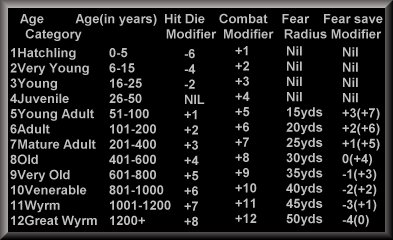
Dragon Fear:Dragons can inspire panic or fear.The Mere sight of a young adult or older dragon casues creatures with fewer then 1 hit die(as well as all noncarnivorous,nonaggressive creatures with fewer Hit Dice)to automatically flee in panic for 4d6 rounds.
Trained warmounts,organised millitary units and single creatures with 1 hit die or more,but fewer hit dice then the dragon are not panciked,but they may be stricken with fear if they are in the dragons fear aura.The aura surrounds attacking or charging Dragon in the specified radius and in a path along the ground directly beneath the fying dragon whose altitude is 250' or less.Creatures not automatically panicked are entitled to saving throws vs. Petrification.Creatures Failing their saving throws are striken with fear and fight at a -2 penalty to their attack and damage rolls.The aura increases in size and power based on the age category of the dragon;creatures subjected to the aura recieve a aving throw bonus or penalty as specified on the Dragon Table.All Creatures with Hit Dice Greater than or equal to those of the dragons are immune to its fear effect.
Gem dragons are not as inherently fearsome as other dragons are,so saving throw bonusues apply in parenthesis on the Dragon Table
Dragon Hit Die Modifier:Dragon Hit dice vary between subpecies and are modified based on age category.The Older a dragon gets,the more hit dice it has.
Dragons saving throws are tid to their hit dice.Each dragon saves as a fighter equal in level to their hit dice.(for example,4hd saves as a fouth level fighter,20HD saves as 20th level and so on)
Dragon Combat Modifier:A Dragons combat modifer varies with age category.The Bonus or penalty applies to to damage rolls for each physical attack.It does not apply to a dragons breath weapon.The Combat modifier is also applied to its base Spellcasting level.
Dragon Attacks:All Dragons have a Claw/Claw/Bite attack form and a breath weapon.The latter can be used once every three rounds.Dragons also employ several other attack forms wiich are detailed in the following text.Dragons frequently divide attacks between opponents,using the more dangerous attaks such as the bite,against the foes they percieve to be the toughest.
A dragon's prefered attacks are usually,in order:Breath weapon,Magical abilities(or spells),and Physical attacks.A Dragon that breathes during a round of combat canot also attack physically.Magical ablities(but not spells) can be used in addition to any attacks,except the breath weapon.
Claws:A Dragon can use its claws to attack creatures to its front and sides.If The Dragon Kicks with one rear leg,it can attack with only one claw(the other must be used to maintain balance)
Bite:Because of the Dragons long neck,it can bite creatures to its back and sides.
Snatch:Only young adult and older dragons can snatch.This occurs when a flying dragon dives and attempts to grab a creature in one of its claws.A creature struck by this method is taken into the air.There is a 50% chance that a snatched creature has its arms pinned,and therefore cannot physically attack the dragon.Snatched creatures are sometimes taken to great heights and dropped.The Snatched Creature can be squeezed in the claw for auotomatic claw damage each round,or transfered to the dragons mouth(The Transfer requires a succesfull attack roll).If the Transfer succeeds,the victim automatically suffers bite damage each round;if it fails the victim is dropped.dragons of age old and older can carry a victim in each claw,and they can try and snatch two victims at once.Wyrms and Great Wyrms can carry three victims,but one of the first two must be trnsfered to its mouth before the third can be snatched.
A dragon can snatch creatures two or more size categories smaller then itself.
Plummet:An Airborne drgon or adragon jumping and descending from at least 30' above a target,can land on the victim.The Dragon crushes and pins opponents using its claws and tail,inflictin damage equal to its bite.The Dragon can crush as many creatures as its combat modifier.The Dragon rolls a seperate attack against each creature effected.Creatures that are missed are asumed to have escaped.Creatures that are crushed must roll a succesfull saving throw vs. petrification or be pinned under the dragon,automatically suffering crushing damage during the next round unless the dragon moves off of them.If the dragon choses to maintain the pin'the victims must roll a succesfull saving throw vs. petrification to get free.The Dragons combat modifier applies as a penalty to all saving throws vs.the crush.A dragon cannot take any other actions while performing this maneuver.
Kick:Any dragon can kick creatures attacking it from behind.A kick delivers claw damage,and creatures struck must roll thier dexterity or less on a d20 or be kicked back 1d6 feet +1 foot per age category of the dragon.Those knocked back must make a succesfull saving throw vs petrification(adjusted by the dragons cobat modifier) or fall.If the dragon attacks with one claw,it can kick with one leg(the other must be used for balance).it cant slap its tail while kicking.
Wing Buffet:Young adult and older dragons can employ thei wings in combat;targets must be at the dragons sides.The damage inflicted is the same as a claw attack,and creatures struck must roll their dexterity or less on a 1d20 or be knocked prone.
Tail Slap:Adult and older dragons can use their tails to attack creatures to their sides and rear.A Tail attack inflicts the same damage as two claw attacks and affects as many targets as the dragons age category.The Dragon rolls a seperate attack against each creature.Creatures struck must make a succesfull saving throw vs. petrification(adjusted by the dragons combat modifier) or be stunned for 1d4 +1 minutes.A Tail slap can smash a light wooden structure nd even damage a cube of force(one charge per two points of combat modifier,round down)
Stall:Any dragon flying near the ground can halt its forward motion and hover for one round;it must lad immediatly thereafter.Once stopped the dragon can attack with its bite and all four legs.It can use its breath weapon instead,but this barley happens since dragons can breathe on the wing.If a dragon stalls in an area filled with lots of loose earth or trees,the draft from its wings creates a dust cloud with the same radius as its fear aura.Creatures caught within the cloud are blinded,and no spell casting is possible.The dust lasts for one round.
Spells:Dragons learn spells haphazardly over the yeras.Dragons do not use spell books or pray to deities;they simply sleep,concentrate when they awaken,and rember their spels.Dragon spells have only a verbal component,the spells have a casting time of 1 regardless of level.Dragons cannot physically attack,use their breath weapon,use their magicall abilities,or fly(except to glide),while casting a spell.