Slide 4 of 25
Notes:
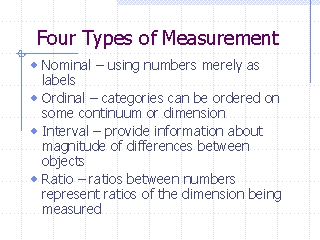
- Investigation might classify a group of people according to their religion – Jewish, Protestant, Catholic, and others – and use the numbers 1, 2, 3, 4 for these categories. In this case, the numbers have no special quality about them, used merely as labels. If we wanted to we could have used any other set of numbers (for instance, 7, 13, 48, 10). In SS basic statistics for nominal measurement are frequencies, proportions, and percentages (e.g., how many people are Democrats, how many are republicans).
- Investigator wants to know the effects of psychological stress on fetal growth, uses height of newborn as an index of physical growth. Takes four newborns who differ in height and assigns the number 1 to the shortest, number 2 to the next shortest infant, 3 to the next shortest, and 4 to the tallest. W/ordinal measurement, researcher classifies individuals into different categories that, in turn, are ordered along a dimension of interest.
- Interval measures have all the properties of ordinal measures but allow us to do more than order objects on a dimension. Also provide information about the magnitude of the differences between the objects. For example, interval measure not only tell us which infant is taller than another, but would also convey a sense of how much taller on infant is than another. Interval measures have the property that numerically equal distances on the scale represent equal distances on the dimension being measured.
- Ratio measures have all the properties of interval measures but provide even more information. Specifically, ratio measures map onto the underlying dimension in such a way that ratios between the numbers represent ratios of the dimension being measured. Example, if we use inches to measure the underlying dimension of height, it is the case that a child who is 50 inches tall is twice the height of child who is 25 inches tall.