|
|
|
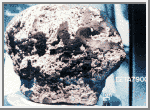
One of the primary goals of studying meteorites is to determine the history and origin of their parent bodies. Several achondrites sampled from Antarctica since 1981 have conclusively been shown to have originated from the moon based on compositional matches of lunar rocks obtained by the Apollo missions of 1969-1972. Sources of other specific metorites remain unproven, although another set of eight achondrites are suspected to have come from Mars. These meteorites contain atmospheric gases trapped in shock melted minerals which match the composition of the Martian atmosphere as measured by the Viking landers in 1976. All other groups are presumed to have originated on asteroids or comets; the majority of meteorites are believed to be fragments of asteroids.
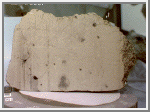
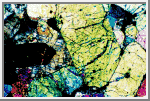
Meteorites have proven difficult to classify, but the three broadest groupings are stony, stony iron, and iron. The most common meteorites are chondrites, which are stony meteorites. Radiometric dating of chondrites has placed them at the age of 4.55 billion years, which is the approximate age of the solar system. They are considered pristine samples of early solar system matter, although in many cases their properties have been modified by thermal metamorphism or icy alteration. Some meteoriticists have suggested that the different properties found in various chondrites suggest the location in which they were formed. Enstatite chondrites contain the most refractory elements and are believed to have formed in the inner solar system. Ordinary chondrites, being the most common type containing both volatile and oxidized elements, are thought to have formed in the inner asteroid belt. Carbonaceous chondrites, which have the highest proportions of volatile elements and are the most oxidized, are thought to have originated in even greater solar distances. Each of these classes can be further subdivided into smaller groups with distinct properties. Other meteorite types which have been geologically processed are achondrites, irons and pallasites. Achondrites are also stony meteorites, but they are considered differentiated or reprocessed matter. They are formed by melting and recrystallization on or within meteorite parent bodies; as a result, achondrites have distinct textures and mineralogies indicative of igneous processes. Pallasites are stony iron meteorites composed of olivine enclosed in metal. Iron meteorites are classified into thirteen major groups and consist primarily of iron-nickel alloys with minor amounts of carbon, sulfur, and phosphorus. These meteorites formed when molten metal segregated from less dense silicate material and cooled, showing another type of melting behavior within meteorite parent bodies. Thus, meteoritescontain evidence of changes that occurred on the parent bodies from which they were removed or broken off, presumably by impacts, to be placed in the first of many revolutions. The motion of meteoroids can be severely perturbed by the gravitational fields of major planets. Jupiter's gravitational influence is capable of reshaping an asteroid's orbit from the main belt so that it dives into the inner solar system and crosses the orbit of Earth. This is apparently the case of the Apollo and Vesta asteroid fragments. Particles found in highly correlated orbits are called a stream components and those found in random orbits are called sporadic components. It is thought that most meteor streams are formed by the decay of a comet nucleus and consequently are spread around the original orbit of the comet. When Earth's orbit intersects a meteor stream, the meteor rate is increased and a meteor shower results. A meteor shower typically will be active for several days. A particularly intense meteor shower is called a meteor storm. Sporadic meteors are believed to have had a gradual loss of orbital coherence with a meteor shower due to collisions and radiative effects, further enhanced by gravitational influences. There is still some debate concerning sporadic meteors and their relationship with showers.
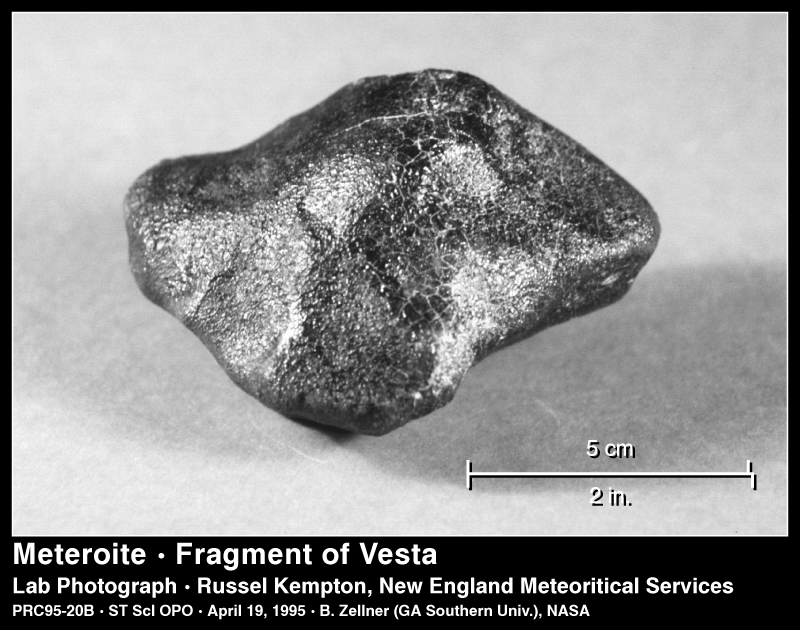
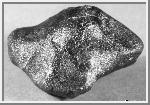
Most of the identified meteorites from Vesta are in the care of the Western
Australian Museum. This 1.4 pound (631 gm) specimen comes from the New England
Meteoritical Services. It is a complete specimen measuring 9.6 x 8.1 x 8.7
centimeters (3.7 x 3.1 x 3.4 inches), showing the fusion crust, evidence of the
last stage in its journey to Earth. (Photo Credit: R. Kempton, New England
Meteoritical Services)
Beatty, J. K. and A. Chaikin. The New Solar System. Massachusetts: Sky Publishing, 3rd Edition, 1990. Maran, Stephen P. The Astronomy and Astrophysics Encyclopedia. New York: Van Nostrand Reinhold, pp. 430-445, 1992. Seeds, Michael A. Horizons. Belmont, California: Wadsworth, 1995. | ||||||