|
|
|
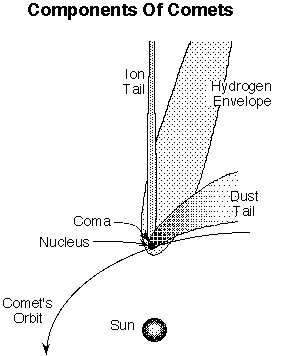
Comet structures are diverse and very dynamic, but they all develop a surrounding cloud of diffuse material, called a coma, that usually grows in size and brightness as the comet approaches the Sun. Usually a small, bright nucleus (less than 10 km in diameter) is visible in the middle of the coma. The coma and the nucleus together constitute the head of the comet.
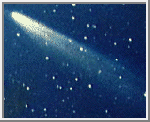
As comets approach the Sun they develop enormous tails of luminous material that extend for millions of kilometers from the head, away from the Sun. When far from the Sun, the nucleus is very cold and its material is frozen solid within the nucleus. In this state comets are sometimes referred to as a "dirty iceberg" or "dirty snowball," since over half of their material is ice. When a comet approaches within a few AU of the Sun, the surface of the nucleus begins to warm, and volatiles evaporate. The evaporated molecules boil off and carry small solid particles with them, forming the comet's coma of gas and dust. When the nucleus is frozen, it can be seen only by reflected sunlight. However, when a coma develops, dust reflects still more sunlight, and gas in the coma absorbs ultraviolet radiation and begins to fluoresce. At about 5 AU from the Sun, fluorescence usually becomes more intense than reflected light. As the comet absorbs ultraviolet light, chemical processes release hydrogen, which escapes the comet's gravity, and forms a hydrogen envelope. This envelope cannot be seen from Earth because its light is absorbed by our atmosphere, but it has been detected by spacecraft. The Sun's radiation pressure and solar wind accelerate materials away from the comet's head at differing velocities according to the size and mass of the materials. Thus, relatively massive dust tails are accelerated slowly and tend to be curved. The ion tail is much less massive, and is accelerated so greatly that it appears as a nearly straight line extending away from the comet opposite the Sun. The following view of Comet West shows two distinct tails. The thin blue plasma tail is made up of gases and the broad white tail is made up of microscopic dust particles. 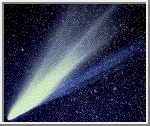 Comet West Each time a comet visits the Sun, it loses some of its volatiles. Eventually, it becomes just another rocky mass in the solar system. For this reason, comets are said to be short-lived, on a cosmological time scale. Many scientists believe that some asteroids are extinct comet nuclei, comets that have lost all of their volatiles.
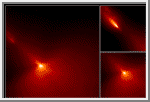
The left image is 2070 miles across (3340 km) and shows that most of the dust is being produced on the sunward-facing hemisphere of the comet. Also at upper left are three small pieces which have broken off the comet and are forming their own tails. Icy regions on the nucleus are activated as they rotate into sunlight, ejecting large amounts of dust in the jets that are faintly visible in this image. Sunlight striking this dust eventually turns it around and "blows" it into the tailward hemisphere. The bottom-right image is an expanded view of the near-nucleus region and is
only 470 miles (760 km) across. The nucleus is near the center of the frame, but
the brightest area is probably the tip of the strongest dust jet rather than the
nucleus itself. Presumably, the nucleus surface lies just below this bright jet.
The top-right image shows pieces of the nucleus that apparently broke off. The
image shows at least three separate objects that are probably made up of
coarse-grained dust. Large fragments of the nucleus would not be accelerated
into the tail, which appears to be the case in this image. (Credit: H. A.
Weaver--Applied Research Corp., HST Comet Hyakutake Observing Team, and NASA) Still another puzzle is the nature of the physical process that generates the
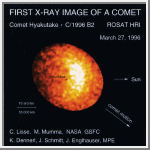
X-rays, but the ROSAT image may contain clues to this process. In the image, the
X-rays from the comet seem to come from a crescent-shaped region on the sunward
side of Comet Hyakutake. One preliminary theory is that X-ray emission from the
Sun was absorbed by a cloud of gaseous water molecules surrounding the nucleus
of the comet, and then were re-emitted by the molecules in a process physicists
call "fluorescence." According to this idea, the cloud is so thick
that its sunward side absorbs nearly all the incoming solar X-rays, so that none
reach the remainder of the cloud. This could explain why the cometary X-ray
emission has the form of a crescent, rather than that of a sphere around the
nucleus. A second possible explanation is that the X-rays are produced from the
violent collision between the comet material and the supersonic "wind"
of plasma and particles streaming away from the Sun. Although the "blob" is about 3.5 times fainter than the brightest
portion at the nucleus, the lump appears brighter because it covers a larger
area. The debris follows a spiral pattern outward because the solid nucleus is
rotating like a lawn sprinkler, completing a single rotation about once per
week. |