|
Jupiter is the fifth planet from the Sun and is the largest one in the solar
system. If Jupiter were hollow, more than one thousand Earths could fit inside.
It also contains more matter than all of the other planets combined. It has a
mass of 1.9 x 1027 kg and is 142,800 kilometers (88,736 miles) across
the equator. Jupiter possesses 28 know satellites, four of which - Callisto,
Europa, Ganymede and Io - were observed by Galileo
as long ago as 1610. Another 12 satellites have been recently discovered and
given provisional designators until they are officially confirmed and named.
There is a ring system, but it is very faint and is totally invisible from the
Earth. (The rings were discovered in 1979 by Voyager 1.) The atmosphere is very
deep, perhaps comprising the whole planet, and is somewhat like the Sun. It is
composed mainly of hydrogen and helium, with small amounts of methane, ammonia,
water vapor and other compounds. At great depths within Jupiter, the pressure is
so great that the hydrogen atoms are broken up and the electrons are freed so
that the resulting atoms consist of bare protons. This produces a state in which
the hydrogen becomes metallic.
Colorful latitudinal bands, atmospheric clouds and storms illustrate
Jupiter's dynamic weather systems. The cloud patterns change within hours or
days. The Great Red Spot is a complex storm moving in a
counter-clockwise direction. At the outer edge, material appears to rotate in
four to six days; near the center, motions are small and nearly random in
direction. An array of other smaller storms and eddies can be found through out
the banded clouds.
Auroral
emissions, similar to Earth's northern
lights, were observed in the polar regions of Jupiter. The auroral emissions
appear to be related to material from Io
that spirals along magnetic field lines to fall into Jupiter's atmosphere.
Cloud-top lightning bolts, similar to superbolts in Earth's high atmosphere,
were also observed.
Jupiter's Ring
Unlike Saturn's intricate and complex ring patterns, Jupiter has a simple
ring system that is composed of an inner halo, a main ring and a Gossamer ring.
To the Voyager spacecraft, the Gossamer ring appeared to be a single ring, but
Galileo imagery provided the unexpected discovery that Gossamer is really two
rings. One ring is embedded within the other. The rings are very tenuous and are
composed of dust particles kicked up as interplanetary meteoroids smash into
Jupiter's four small inner moons Metis,
Adrastea, Thebe,
and Amalthea. Many of
the particles are microscopic in size.
The innermost halo ring is toroidal in shape and extends radially from about
92,000 kilometers (57,000 miles) to about 122,500 kilometers (76,000 miles) from
Jupiter's center. It is formed as fine particles of dust from the main ring's
inner boundary 'bloom' outward as they fall toward the planet. The main and
brightest ring extends from the halo boundary out to about 128,940 kilometers
(80,000 miles) or just inside the orbit of Adrastea. Close to the orbit of Metis,
the main ring's brightness decreases.
The two faint Gossamer rings are fairly uniform in nature. The innermost
Amalthea Gossamer ring extends from the orbit of Adrastea out to the orbit of
Amalthea at 181,000 kilometers (112,000 miles) from Jupiter's center. The
fainter Thebe Gossamer ring extends from Amalthea's orbit out to about Thebe's
orbit at 221,000 kilometers (136,000 miles).
Jupiter's rings and moons exist within an intense radiation belt of electrons
and ions trapped in the planet's magnetic field. These particles and fields
comprise the jovian magnetosphere
or magnetic environment, which extends 3 to 7 million kilometers (1.9 to 4.3
million miles) toward the Sun, and stretches in a windsock shape at least as far
as Saturn's orbit - a distance of 750 million kilometers (466 million miles).
| Jupiter Statistics |
| Mass (kg) |
1.900e+27 |
| Mass (Earth = 1) |
3.1794e+02 |
| Equatorial radius (km) |
71,492 |
| Equatorial radius (Earth = 1) |
1.1209e+01 |
| Mean density (gm/cm^3) |
1.33 |
| Mean distance from the Sun (km) |
778,330,000 |
| Mean distance from the Sun (Earth = 1) |
5.2028 |
| Rotational period (days) |
0.41354 |
| Orbital period (days) |
4332.71 |
| Mean orbital velocity (km/sec) |
13.07 |
| Orbital eccentricity |
0.0483 |
| Tilt of axis (degrees) |
3.13 |
| Orbital inclination (degrees) |
1.308 |
| Equatorial surface gravity (m/sec^2) |
22.88 |
| Equatorial escape velocity (km/sec) |
59.56 |
| Visual geometric albedo |
0.52 |
| Magnitude (Vo) |
-2.70 |
| Mean cloud temperature |
-121°C |
| Atmospheric pressure (bars) |
0.7 |
Atmospheric composition
- Hydrogen
- Helium
|
90%
10% |
 Jupiter
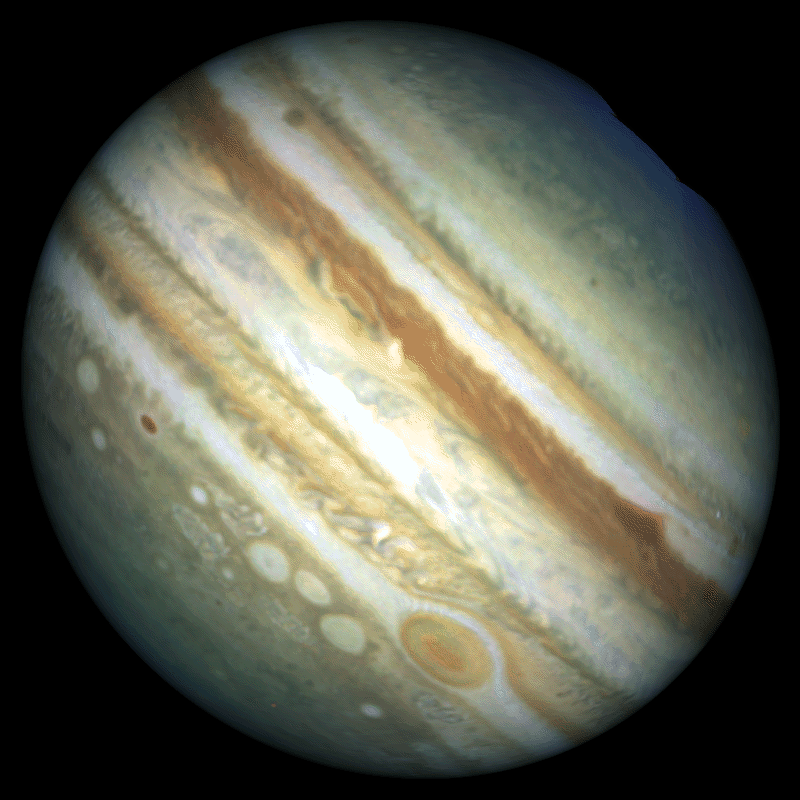
This image was taken by NASA's Hubble Space Telescope on February 13, 1995. The
image provides a detailed look at a unique cluster of three white oval-shaped
storms that lie southwest (below and to the left) of Jupiter's Great Red Spot.
The appearance of the clouds, in this image, is considerably different from
their appearance only seven months earlier. These features are moving closer
together as the Great Red Spot is carried westward by the prevailing winds while
the white ovals are swept eastward.
The outer two of the white storms formed in the late 1930s. In the centers of
these cloud systems the air is rising, carrying fresh ammonia gas upward. New,
white ice crystals form when the upwelling gas freezes as it reaches the chilly
cloud top level where temperatures are -130°C (-200°F). The intervening white
storm center, the ropy structure to the left of the ovals, and the small brown
spot have formed in low pressure cells. The white clouds sit above locations
where gas is descending to lower, warmer regions.
 The Interior
of Jupiter
The Interior
of Jupiter
This picture illustrates the internal structure of Jupiter. The outer layer is
primarily composed of molecular hydrogen. At greater depths the hydrogen starts
resembling a liquid. At 10,000 kilometers below Jupiter's cloud top liquid
hydrogen reaches a pressure of 1,000,000 bar with a temperature of 6,000° K. At
this state hydrogen changes into a phase of liquid metallic hydrogen. In this
state, the hydrogen atoms break down yeilding ionized protons and electrons
similar to the Sun's interior. Below this is a layer dominated by ice where
"ice" denotes a soupy liquid mixture of water, methane, and ammonia
under high temperatures and pressures. Finally at the center is a rocky or
rocky-ice core of up to 10 Earth masses. (Copyright Calvin J. Hamilton)
 Thin
Crescent Image of Jupiter
Thin
Crescent Image of Jupiter
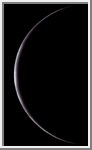
This thin crescent picture of Jupiter was created from a photomosaic of images
Galileo took on its C9 orbit. It is made from Near Infrared and Violet images,
with an artificial green image produced from the other two. (Courtesy of Ted
Stryk)
 Nordic
Optical Telescope
Nordic
Optical Telescope
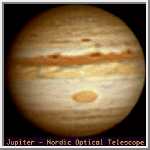
This image of Jupiter was taken with the 2.6 meter Nordic
Optical Telescope, located at La Palma, Canary Islands. It is a good example
of the best imagery that can be obtained from earth based telescopes. (c) Nordic
Optical Telescope Scientific Association (NOTSA).
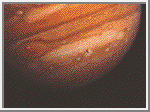 Jupiter with
Satellites Io and Europa
Jupiter with
Satellites Io and Europa
Voyager 1 took this
photo of Jupiter and two of its satellites (Io,
left, and Europa, right)
on Feb. 13, 1979. In this view, Io is about 350,000 kilometers (220,000 miles)
above Jupiter's Great Red Spot, while Europa is about 600,000 kilometers
(373,000 miles) above Jupiter's clouds. Jupiter is about 20 million kilometers
(12.4 million miles) from the spacecraft at the time of this photo. There is
evidence of circular motion in Jupiter's atmosphere. While the dominant large
scale motions are west-to-east, small scale movement includes eddy like
circulation within and between the bands. (Courtesy NASA/JPL)
 Satellite
Footprints Seen in Jupiter Aurora
Satellite
Footprints Seen in Jupiter Aurora
In this Hubble Space Telescope picture, a curtain of glowing gas is wrapped
around Jupiter's north pole like a lasso. This curtain of light, called an
aurora, is produced when high-energy electrons race along the planet's magnetic
field and into the upper atmosphere where they excite atmospheric gases, causing
them to glow. The aurora resembles the same phenomenon that crowns Earth's polar
regions. But this Hubble image, taken in ultraviolet light, also shows the
glowing "footprints" of three of Jupiter's largest moons: Io,
Ganymede, and Europa.
Courtesy of NASA/ESA, John Clarke (University of Michigan)
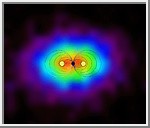 Jupiter's
Magnetosphere
Jupiter's
Magnetosphere
This image taken by the ion and neutral mass spectrometer instrument on NASA's
Cassini spacecraft makes the huge magnetosphere surrounding Jupiter visible in a
way no instrument on any previous spacecraft has been able to do. The
magnetosphere is a bubble of charged particles trapped within the magnetic
environment of the planet. A magnetic field is sketched over the image to place
the energetic neutral atom emissions in perspective. This sketch extends in the
horizontal plane to a width 30 times the radius of Jupiter. Also shown for scale
and location are the disk of Jupiter (black circle) and the approximate position
(yellow circles) of the doughnut-shaped torus created from material spewed out
by volcanoes on Io.
Some of the fast-moving ions within the magnetosphere pick up electrons to
become neutral atoms, and once they become neutral, they can escape Jupiter's
magnetic field, flying out from the magnetosphere at speeds of thousands of
kilometers, or miles, per second.
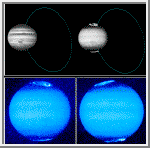 Jupiter's
Auroras
Jupiter's
Auroras
These HST images, reveal changes in Jupiter's auroral emissions and how small
auroral spots just outside the emission rings are linked to the planet's
volcanic moon, Io. The top
panel pinpoints the effects of emissions from Io. The image on the left, shows
how Io and Jupiter are linked by an invisible electrical current of charged
particles called a flux tube. The particles, ejected from Io by volcanic
eruptions, flow along Jupiter's magnetic field lines, which thread through Io,
to the planet's north and south magnetic poles.
The top-right image shows Jupiter's auroral emissions at the north and south
poles. Just outside these emissions are the auroral spots called
"footprints." The spots are created when the particles in Io's
"flux tube" reach Jupiter's upper atmosphere and interact with
hydrogen gas, making it fluoresce.
The two ultraviolet images at the bottom of the picture show how the auroral
emissions change in brightness and structure as Jupiter rotates. These
false-color images also reveal how the magnetic field is offset from Jupiter's
spin axis by 10 to 15 degrees. In the right image, the north auroral emission is
rising over the left limb; the south auroral oval is beginning to set. The image
on the left, obtained on a different date, shows a full view of the north
aurora, with a strong emission inside the main auroral oval.
Credits: John T. Clarke and Gilda E. Ballester (University of Michigan),
John Trauger and Robin Evans (Jet Propulsion Laboratory), and NASA.
 The
Great Red Spot
The
Great Red Spot
This dramatic view of Jupiter's Great Red Spot and its surroundings was obtained
by Voyager 1 on Feb. 25, 1979, when the spacecraft was 9.2 million kilometers
(5.7 million miles) from Jupiter. Cloud details as small as 160 kilometers (100
miles) across can be seen here. The colorful, wavy cloud pattern to the left of
the Red Spot is a region of extraordinarily complex and variable wave motion. (Courtesy
NASA)
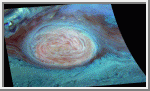 False Color
of Jupiter's Great Red Spot
False Color
of Jupiter's Great Red Spot
This image is a false color representation of Jupiter's Great Red Spot taken
with Galileo's imaging system through three different near-infrared filters.
This is a mosaic of eighteen images (6 in each filter) that were taken over a
period of 6 minutes on June 26, 1996. The Great Red Spot appears pink and the
surrounding region blue because of the particular color coding used in this
representation. The red channel is the reflectance of Jupiter at a wavelength
where methane strongly absorbs (889nm). Because of this absorption, only high
clouds can reflect sunlight in this wavelength. The green channel is the
reflectance in a wavelength where methane absorbs, but less strongly (727nm).
Lower clouds can reflect sunlight in this wavelength. Finally, the blue channel
is the reflectance in a wavelength where there are essentially no absorbers in
the Jovian atmosphere (756nm) and one sees light reflected from the deepest
clouds. Thus, the color of a cloud in this image indicates its height, with red
or white being highest and blue or black being lowest. This image shows the
Great Red Spot to be relatively high, as are some smaller clouds to the
northeast and northwest that are surprisingly like towering thunderstorms found
on earth. The deepest clouds are in the collar surrounding the Great Red Spot,
and also just to the northwest of the high (bright) cloud in the northwest
corner of the image. Preliminary modelling shows these cloud heights to range
about 50km in altitude. (Courtesy NASA/JPL)
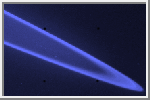 Ring
of Jupiter
Ring
of Jupiter
The ring of Jupiter was discovered by Voyager 1 in March of 1979. This image was
taken by Voyager 2 and has been pseudo colored. The Jovian ring is about 6,500
kilometers (4,000 miles) wide and probably less than 10 kilometers (6.2 miles)
thick. (Copyright Calvin J. Hamilton)
 The Jovian
System
The Jovian
System
The best of the Jupiter system is pictured in this collage of images acquired by
the Voyager and Galileo spacecraft. Jupiter is the largest planet in our solar
system. The four largest moons of Jupiter are known as the Galilean moons and
are named Callisto, Ganymede,
Europa, and Io.
Inside the orbits of the Galilean moons are Thebe,
Amalthea, Adrastea,
and Metis. At the lower
right is shown the Valhalla region of Callisto. Ganymede is toward the bottom
middle. Europa is a little above and to the right of Ganymede. Io is the top,
left-most moon. Between Io and Jupiter are four little moons. The top-most
little moon is Amalthea. Below and to the right of Amalthea are Metis and
Adrastea. To the left of Adrastea is Thebe. (Copyright Calvin J. Hamilton)
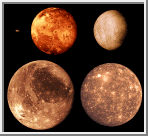 Moons of
Jupiter
Moons of
Jupiter
This image shows to scale Jupiter's moons Amalthea,
Io, Europa,
Ganymede, and Callisto.
(Copyright Calvin J. Hamilton)
| Name |
Distance* |
Width |
Thickness |
Mass |
Albedo |
| Halo |
92,000 km |
30,500 km |
20,000 km |
? |
0.05 |
| Main |
122,500 km |
6,440 km |
< 30 km |
1 x 10^13 kg |
0.05 |
| Inner Gossamer |
128,940 km |
52,060 km |
? |
? |
0.05 |
| Outer Gossamer |
181,000 km |
40,000 km |
? |
? |
0.05 |
*The distance is measured from the planet center to the start of the ring.
Nearly four centuries ago Galileo Galilei turned his homemade telescope
towards the heavens and discovered three points of light, which at first he
thought to be stars, hugging the planet Jupiter. These stars were arranged in a
straight line with Jupiter. Sparking his interest, Galileo observed the stars
and found that they moved the wrong way. Four days later another star appeared.
After observing the stars over the next few weeks, Galileo concluded that they
were not stars but planetary bodies in orbit around Jupiter. These four stars
have come to be know as the Galilean
satellites.
Over the course of the following centuries another 12 moons were discovered
bringing the total to 16. Another 12 satellites have been recently discovered
and given provisional designators until they are officially confirmed and named.
Finally in 1979, the strangeness of these frozen new worlds was brought to light
by the Voyager spacecrafts as they swept past the Jovian system. Again in 1996,
the exploration of these worlds took a large step forward as the Galileo
spacecraft began its long term mission of observing Jupiter and its moons.
Twelve of Jupiter's moons are relatively small and seem to have been more
likely captured than to have been formed in orbit around Jupiter. The four large
Galilean moons, Io, Europa,
Ganymede and Callisto,
are believed to have accreted
as part of the process by which Jupiter itself formed. The following table
summarizes the radius, mass, distance from the planet center, discoverer and the
date of discovery of each of the moons of Jupiter:
| Moon |
# |
Radius
(km) |
Mass
(kg) |
Distance
(km) |
Discoverer |
Date |
| Metis |
XVI |
20 |
9.56e+16 |
127,969 |
S. Synnott |
1979 |
| Adrastea |
XV |
12.5x10x7.5 |
1.91e+16 |
128,971 |
Jewitt-Danielson |
1979 |
| Amalthea |
V |
135x84x75 |
7.17e+18 |
181,300 |
E. Barnard |
1892 |
| Thebe |
XIV |
55x45 |
7.77e+17 |
221,895 |
S. Synnott |
1979 |
| Io |
I |
1,815 |
8.94e+22 |
421,600 |
Marius-Galileo |
1610 |
| Europa |
II |
1,569 |
4.80e+22 |
670,900 |
Marius-Galileo |
1610 |
| Ganymede |
III |
2,631 |
1.48e+23 |
1,070,000 |
Marius-Galileo |
1610 |
| Callisto |
IV |
2,400 |
1.08e+23 |
1,883,000 |
Marius-Galileo |
1610 |
S/1975 J1
S/2000 J1 |
|
4 |
? |
7,435,000 |
Sheppard et al |
2000 |
| Leda |
XIII |
8 |
5.68e+15 |
11,094,000 |
C. Kowal |
1974 |
| Himalia |
VI |
93 |
9.56e+18 |
11,480,000 |
C. Perrine |
1904 |
| Lysithea |
X |
18 |
7.77e+16 |
11,720,000 |
S.
Nicholson |
1938 |
| Elara |
VII |
38 |
7.77e+17 |
11,737,000 |
C. Perrine |
1905 |
| S/2000 J11 |
|
2 |
? |
12,654,000 |
Sheppard et al |
2000 |
| S/2000 J10 |
|
1.9 |
? |
20,375,000 |
Sheppard et al |
2000 |
| S/2000 J3 |
|
2.6 |
? |
20.733,000 |
Sheppard et al |
2000 |
| S/2000 J5 |
|
2.2 |
? |
21,019,000 |
Sheppard et al |
2000 |
| S/2000 J7 |
|
3.4 |
? |
21,162,000 |
Sheppard et al |
2000 |
| Ananke |
XII |
15 |
3.82e+16 |
21,200,000 |
S. Nicholson |
1951 |
| S/2000 J9 |
|
2.5 |
? |
21,734,000 |
Sheppard et al |
2000 |
| S/2000 J4 |
|
1.6 |
? |
21,948,000 |
Sheppard et al |
2000 |
| Carme |
XI |
20 |
9.56e+16 |
22,600,000 |
S. Nicholson |
1938 |
| S/2000 J6 |
|
1.9 |
? |
22,806,000 |
Sheppard et al |
2000 |
| Pasiphae |
VIII |
25 |
1.91e+17 |
23,500,000 |
P. Melotte |
1908 |
| S/2000 J8 |
|
2.7 |
? |
23,521,000 |
Sheppard et al |
2000 |
| Sinope |
IX |
18 |
7.77e+16 |
23,700,000 |
S. Nicholson |
1914 |
| S/2000 J2 |
|
2.6 |
? |
24,164,000 |
Sheppard et al |
2000 |
S/1999 J1
1999 UX18 |
|
2.4 |
? |
24,296,,000 |
Spacewatch |
1999 |
|