

History and Background
H. G. Wells wrote The Time Machine in 1895 as his first work of literary note, soon to be followed by The Island of Dr. Moreau and War of the Worlds. Wells came up with his idea for this novel from the students’ debating society at Imperial College, London, after which he wrote an article called “The Universe Rigid,” which was rejected by the edited he sent it to (Comments). Furthermore, The Time Machine was actually written as the sequel to a short story of Wells entitled “The Chronic Argonauts,” in which the Time Traveler had a name, Dr. Nebogipfel, whose travels into the future are mentioned but the details of which are never discussed, until Wells finished The Time Machine (Parridner 37).
The Story
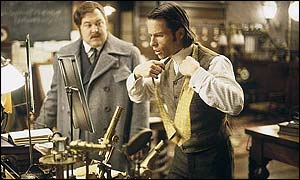
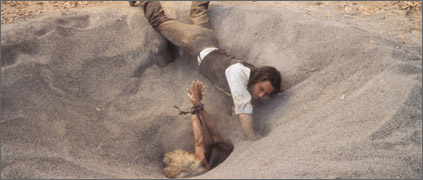
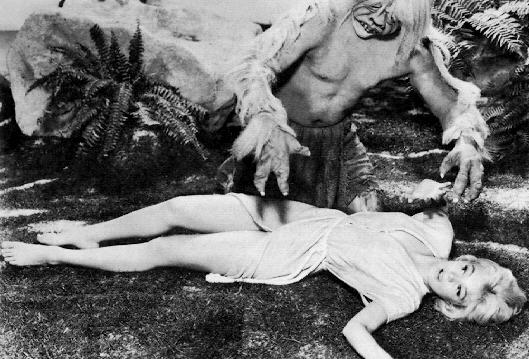
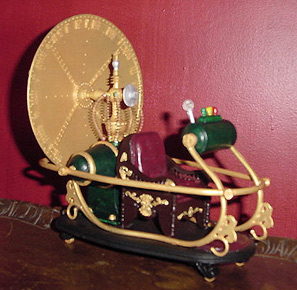
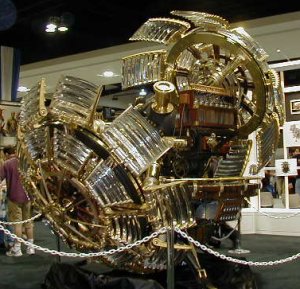
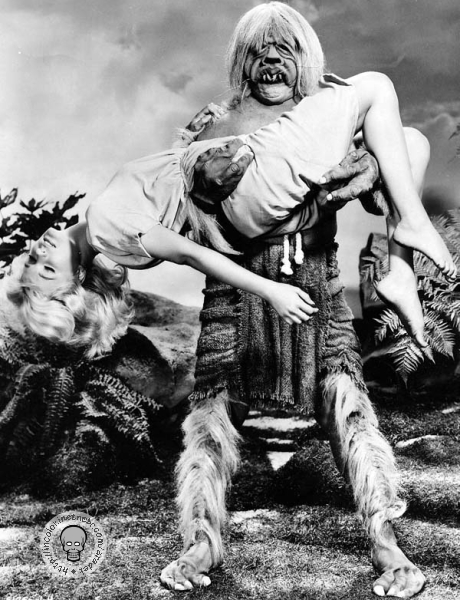
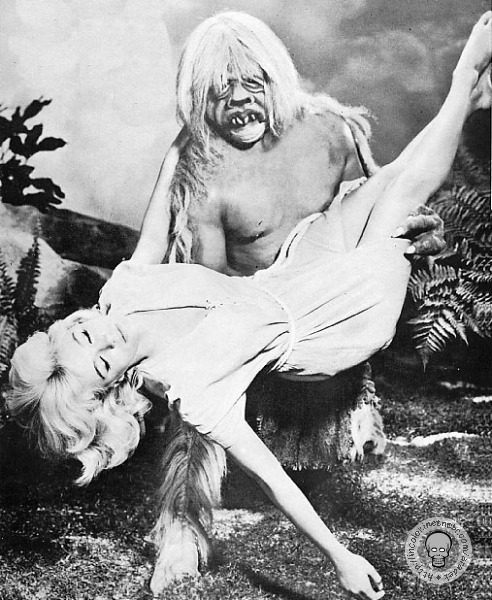
H.G. Wells’ The Time Machine takes place in the early 20th century, where a man known simply as the Time Traveler is having a meeting with friends and colleagues concerning the possibilities of time travel. Following this debate with his social circle, he instructs them to return for dinner in a week time before entering his laboratory and making his fateful journey into the future of 802, 701 AD—a date of great significance if one considers some critics’ view that the Time Traveler made his journey in 1901 which gives us the number 800,800 for the years he traveled, illustrating the duality in the novel of evolution of society, 800 years for the rise and fall of a civilization or two, and of nature, 800,000 years for the splitting of mankind into two separate species (Parrinder 42). Upon arriving in the future, the Traveler meets the Eloi, which he discovers to be an ignorant, apathetic species that are the food source for the equally unintelligent, beastlike Morlocks. The Time Traveler’s entire time in the future is spent trying to discover what led humanity to this state and leads up to a confrontation with the Morlocks, who then hunt him and his Eloi companion down, which leads to a battle in the forest which mortifies the Time Traveler because he feels sorry for the Morlocks and he loses Weena. The Time Machine concludes with the Morlocks setting a trap for the Time Traveler, which he escapes and sees the end of time before returning to the past to tell his story to his guests before taking another, his last, journey through time.
The Dystopian Aspect
Wells wrote The Time Machine as a social criticism
against the class division of the Victorian Era (Anonymous). In his futuristic
society, the division has gone beyond purely economic differences as the proletariats
end up living underground in factories and eventually evolving into the Morlock
race, while the wealthy factory owners form an aboveground society in which
they are provided with all their needs by their workers and evolve into the
race of the Eloi. Furthermore, this future of the Morlock and Eloi is termed
by Wells, through the Time Traveler’s narration, as the sunset of mankind.
This novel falls into the category of dystopias because it demonstrates a
failed society, in which neither the Eloi nor Morlocks have any knowledge
or any history and where the Eloi serve as cattle-like food for the Morlocks.
Every aspect of this novel is meant to warn against progress of the Victorian
Era which separates humanity into classes and which Wells imagined would eventually
lead to the end of humanity through their eventual evolution into the Morlock
and Eloi species. This grim feature is then made even grimmer by the Time
Traveler’s second journey into the future in which he witnesses the
end of the world, millions of years in the future, after devolution in nature
where the crustaceans rule the Earth once again.
Book Vs. Movies
