
A cartouche is an oval "rope" that surrounds a pharaoh's name to protect him from evil. It is an elongated form of the shen ring, a symbol of power that was sacred to the goddess Isis. The Ancient Egyptian word for cartouche is "shenu", which means "encircle". The circular shape of the cartouche spoke to everyone that the power of the king's rule was as vast as everything the sun shone upon or encircled. Cartouches were used in ancient Egypt were used beginning in the Fourth Dynasty. The pharaoh Sneferu was the first to use it.
The ancient Egyptian language had been spoken from about 4000 B.C. up until 11 A.D., though there were not many who knew how to read and write. Finally, the people of the Nile came up with a way of writing, which consisted of symbols and pictures. This form of writing was known as hieroglyphics. Hieroglyphics were the form of writing that the ancient Egyptians used. They were pictures and symbols instead of the letter-alphabet that we use today. Another word for hieroglyphics is "glyph". Thoth, the god of wisdom and writing, was the inventor of hieroglyphics. He was also the patron of scribes. When the Rossetta Stone was found in Egypt (Rossetta) by one of Napolleon Bonaparte's soldiers at the end of the 18th century when Napolleon invaded Egypt, the French general took it to a scholar and Egyptologist named Jean-François Champollion to see if he could decipher to writing on the tablet. Napolleon did this because no one in the modern world knew how to read ancient Egyptian (no one had cracked the code yet). Champollion slowly began to work through the alphabet, comparing it to each hieroglyphic and trying new ways to decipher the ancient Egyptian writing. He was finally able to decipher the hieroglyphics and so, thanks to him, we are now able to read the writing of the ancient Egyptians.

The word "carthouche" actually comes from the French word fro cartridge. This was because the shape of the cartoushe made Napoleon Bonaparte's soldiers of their gun cartridges. The cartouches surrounded the king's two names: his throne name, "User-ma'at-re", and his birth name.
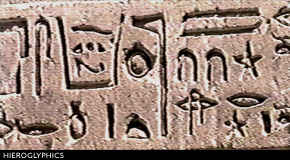
There are over six thousand known hieroglyphics in the Egyptian alphabet. They were used from 3100 BC until about 11 AD. The word "hieroglyphic" is Greek for "Sacred Carved Symbols". They consist not only of symbols but of sounds and syllables as well. Some hieroglyphics stand for more than one letter; they often stand for one word. Hieroglyphics can be very complicated to learn, and so that is why many highly trained scribes were hired to read and write them for people who didn't have as much experience or who couldn't read or write at all. Hieroglyphs can be divided into three classes: ideograms, determinatives, and phonograms. Ideograms, also called idea signs, are picture glyphs that showing the actual object they represent. Determinatives are glyph word endings that givings us clues as to what words are about. Phonograms are sound glyphs making up words. The letters are consonants, as Egyptians never used vowels. For example, the word HIEROGLYPHICS would look like HRGLFCS. Normally, hieroglyphics were written using both ideograms and phonograms, but sometimes a certain word would be written using only phonograms or only ideograms.
Hieroglyphics are usually read from top to bottom and are normally arranged into columns. They can also be read from side to side as well, depending on which way the pictures are facing or pointing. For example, if the pictures are facing left, then you would start reading from the left. If they were facing right, you would start reading from the right. Cartouches, sacred ropes that surrounded a pharaoh's name to protect him from evil, held hieroglyphics spelling out the king's name. If you were a woman, the picture of a woman would been at the end of your name. It was the same with a man, only with a man's picture.
Hieroglyphs were called by the Egyptians "the words of God" and were used mainly by the priests. These painstakingly drawn symbols were great for decorating the walls of temples but for conducting day to day business there was another script, known as hieratic This was a handwriting in which the picture signs were abbreviated to the point of abstraction.
 Hieroglyphs are written in rows or columns and are read from either left to right or right to left and from top to bottom. You can distinguish the direction in which the text is to be read because the human or animal figures always face towards the beginning of the line..
Hieroglyphic signs are divided into four categories:
Alphabetic signs:

A - as in apple - picture of an eagle.
B - as in 'bat' picture of a foot.
W or O -Two sounds - 'W' as in 'won' or 'OO' as in 'boot' - picture of a chick.
KH - ch as in 'loch' - picture of a placenta.
K - as in 'kitten' - picture of a basket.
N - as in 'no' - picture of water.
H - as in 'ha' picture of a twist of flax.
I - ee as in feet - picture of a reed flower.
G - as in 'gold' - picture of a stand.
P - as in 'puppy' picture of a mat.
F - as in 'fan' picture - horned snake.
TH - picture of rope.
M - as in 'mum' - picture of an owl.
S - as in 'sit' - picture of a fold of cloth.
J - dj as in 'edge' - picture of a snake.
Y - as in 'baby' - picture of two reed flowers.
SH - as in shop - picture of a pool.
D - as in 'dirt' picture of a hand.
Q - as in 'quick' picture of a hill or slope.
R - as in 'rat' picture of a mouth.
T - as in 'two' picture of a loaf.
L - picture of a lion.
