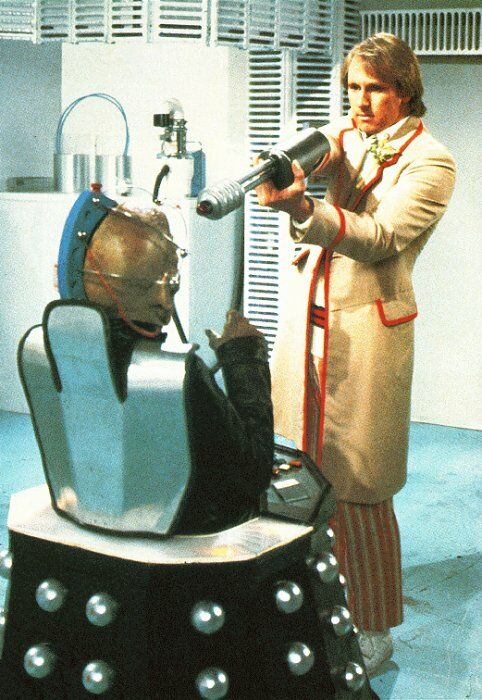
Yet Doctor Who was supposed to be a children’s show. Mary Whitehouse, guardian of the UK’s moral standards, often attacked the series for its violent content and maintained that watching it would warp impressionable young minds. The violence in the show, she reckoned, would foster violent impulses in its viewers.
Well, a couple of generations of Doctor Who viewers have grown up, and to my knowledge, no instances of Doctor Who-inspired violence have been reported. That doesn’t mean that violence in the media never inspires real-life violence; the movie Money Train apparently gave some very disturbed people the idea to set fire to a New York subway worker. Granted, the types of people who would commit such an act must’ve been deeply troubled before they watched Money Train, but the movie didn’t do much good by fueling their violent tendencies and giving them ideas about how to express them.
Doctor Who never provoked such a violent act because, despite its content, it was always a very moral show. The acts of violence were almost exclusively committed by the villains, and the show’s young viewers caught on fast that such actions were not supposed to be imitated. When we watch Sutekh turn the Scarman brothers against each other in Pyramids of Mars, we don’t think, "hey, it would be cool to kill my own brother." We think instead that Sutekh is one evil jerk, and we look forward to the moment when our kindly hero the Doctor will defeat him.
The Doctor’s hands are not unstained, though; he does use force on many occasions. But he never descends to the level of his opponents. After a skirmish with the Robomen in The Dalek Invasion of Earth, Hartnell’s Doctor claims that he only uses violence in self-defense, and his statement generally holds true. The Doctor’s violent acts are always provoked; he fights to defend himself or his friends.
The Doctor’s moral standards are put to the test in several episodes, and though he is essentially a pacifist, his responses to these tests vary in interesting ways. When faced with the opportunity to shoot a helpless Davros in Resurrection of the Daleks, Peter Davison’s Doctor refuses to pull the trigger and allows Davros to escape (this is, by the way, a much underrated scene – it got me hooked on the show). By contrast, Sylvester McCoy’s Doctor doesn’t seem to lose any sleep over trying to blow up Davros with a Gallifreyan super-weapon.
Doctor Who was, in some respects, the most violent show in the history of television. Not in terms of gore, mind you, but in terms of deaths. Because the series had a constantly revolving cast, the writers could kill off countless guest stars and extras who wouldn’t be returning in the next episode anyway. Many of the most famous serials – like Pyramids of Mars and The Caves of Androzani – are bloodbaths that end with only a few characters left standing.
The TV Movie, flawed though it was, did a good job of preserving our hero’s moral standards. McGann apologizes for stealing the highway patrolman’s gun, and he points it at himself instead of threatening anyone else. In the last reel, as the Master blunders into the Eye of Harmony, McGann extends his hand in an effort to save his archenemy from death. The Master might spend his time happily snapping people’s necks, but the Doctor remains his nice, gentlemanly self.
So despite its body count, Doctor Who was...and still is...a good series for children to watch. The show doesn’t try to hide that the world is full of violent people; it confronts the issue directly and exposes violence for what it is, a last resort for good people and the hallmark of evil people. Why Mary Whitehouse had a problem with this message is beyond me. Doctor Who was never like From Dusk Till Dawn, where George Clooney could set fire to an innocent convenience store clerk and still be considered the "good guy." Doctor Who was also never like Star Trek, wherein pacifism is adhered to in a ludicrous, self-destructive manner ("Let's not destroy the Borg - that wouldn't be nice. We'll let them destroy us instead...").
Perhaps my favorite expression of the Doctor’s moral philosophy comes in The Face of Evil. As Tom Baker’s Doctor and Leela flee from the Sevateem tribe, Leela pauses to kill one of their pursuers with a poisonous Janis thorn. The Doctor grabs Leela and growls, “Who licensed you to slaughter people? No more Janis thorns – ever.” The Doctor is taking a potshot at James Bond here; the secret agent, granted a “license to kill” by the British government, is notorious for slaying people by the dozens without a whit of remorse. That doesn’t mean that James Bond is morally bankrupt; he’s just morally oblivious. The Doctor is a much more morally aware character, and he never commits acts of senseless violence...nine times out of ten.