 THE
AFRICAN LION
THE
AFRICAN LION
(Panthera
Leo)
CLASS: Mammalia
ORDER:Carnivora
FAMILY:Felidae
GENUIS: Panthera
SPECIES: Leo
The lion is very different from
other members of the cat family. It is the only social cat and lives in
groups called prides. The basis of a resident pride is a group of related
females and their young. The pride hunts and eats collectively. There may
be as many as forty lions in a pride, including 2-18 adult females and
up to 7 adult males, but it is rare that all are assembled in one spot.
The basis of a resident pride is a group of related females and their young.
Several females may give birth in the same month and not only rear their
young together, but also suckle cubs other than their own.Another unusual
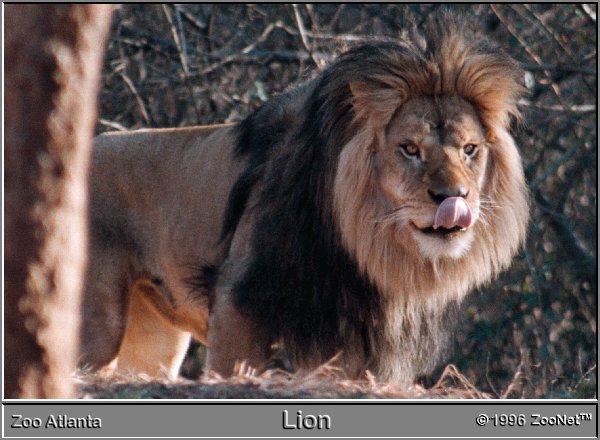
characteristic of lions is that not only are adult males considerably larger
than females (adult males 415 lbs., females 277 lbs.), they possess manes.
The mane provides protection from the claws and teeth of other males. Males
are so largethat it actually hinders their ability to hunt. Females are
responsible for 85%-90% of the kills.An experienced lion will rarely charge
unless within 100 feet. They rely on stalking and use any available cover.
Lions may gorge until they have eaten up to one-quarter of their weight,
but daily consumption is normally 10-15 pounds. Most hunts fail with only
one in six being successful. They eat anything they can catch and kill,
but depend mostly on animals weighing 100-600 pounds. Wildebeest,
impala, other antelopes, giraffe, buffalo, wild hogs, and zebra are important
prey species for lions. Coalitions may be formed by littermates, but also
can include nonrelatives. Most adult male lions remain with a pride for
only two years. The prime years are during ages 5-9 and males are biggest
and fittest between five and six. Larger coalitions are likely to maintain
tenure longer than small ones.Lion cubs are born in a well-hidden lair
after a gestation period of 14-15 weeks. They are small (2-4 pounds) and
completely helpless. Their eyes open at 3-11 days; they can walk at 10-15days
and run at 25-20 days. Their milk teeth erupt at 21-30 days. They are led
to kills by their mother at 4-8 weeks. By the age of 7 weeks, they can
keep up with the pride. Cubs don't participate in kills until eleven months
and are fully dependent upon adults for food until 16 months. They probably
cannot survive on their own until the age of 2 1/2. At birth cubs have
a spotted coat and begin obtaining adult coloration at three months. Spotting
may persist in adults. The population of lions has declined primarily from
the expansion of human activity and domestic livestock, and the consequent
persecution of the lion as a predator. number of lions in Africa
may have been reduced by a half, to as few as 200,000 or less By the end
of this century they may survive only in major parks and reserves.


SAN ANTONIO ZOO
CYBER LION
GALLERY
SEA WORLD

 morepictures