
| ...=/\= Nova Class Starship =/\= |
|
|
Class: Nova Type\Role: Planetary Survey & Short-Range Science vessel Commissioned: 2369-Present Hull Dimensions Length: 165 m Beam: 62 m Height: 34 m Decks: 9 Mass: 75,000 tons Crew Info Standard Crew: 80 Diplomatic Capacity: Grade 1 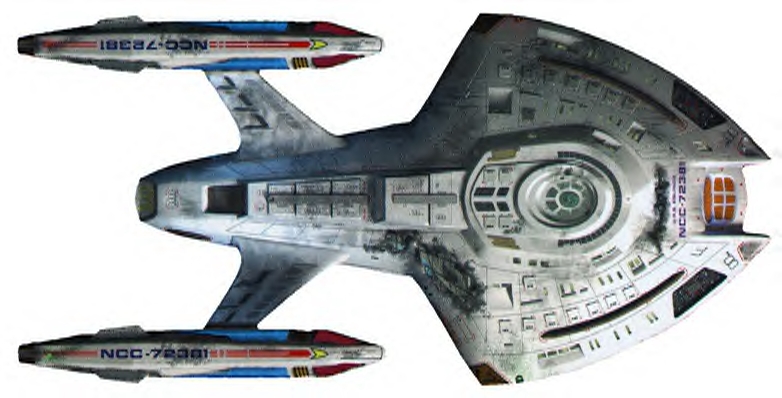 Tactical\Defence 5 Type IX Phaser arrays- 4.1 MW per segment 2 Type II Teryon beam arrays 2 Rapid-fire Torpedo tubes(fore and aft) + 25 torpedos 10 Quantum torpedos 10 Photon Torpedos with bilitrium warhead enhancement 5 Graviton Torpedos Shield Sustainable Load: 4,400 MW -Metaphasic shields -EM regenerative shield systems Hull Silicon carbide fibers in a carbotanium\cortanium matrix. Further support is provided by 2m multiaxis Duratanium\steel trusses Radiation protection is provided by a 2cm layer of lead infused with rhodinium fibers. Below this is the nano-carbon tubule layer, consisting of .5cm wide braided fibers of this substance, welded together. The outer hull is made of alternating layers of allithium(aluminum, lithium, magnesium, zinc high-temp alloy) and nanocrystalline duranium. Warp Propulsion Warp Reactor M/ARA Mk V Normal Cruise Speed: Warp 6.5 Maximum Cruise Speed: Warp 7.8 Emergency Speed: Warp 8.8 (for 18 hours) Fuel (MRI) Supercritical Cryogenic Deuterium Fuel (ARI) Supercritical Cryogenic AntiDeuterium M/A Reaction Moderating Element: 5th-phase Crystalline Dilithium Emergency Fuel Replenishment: Bussard Ramscoop 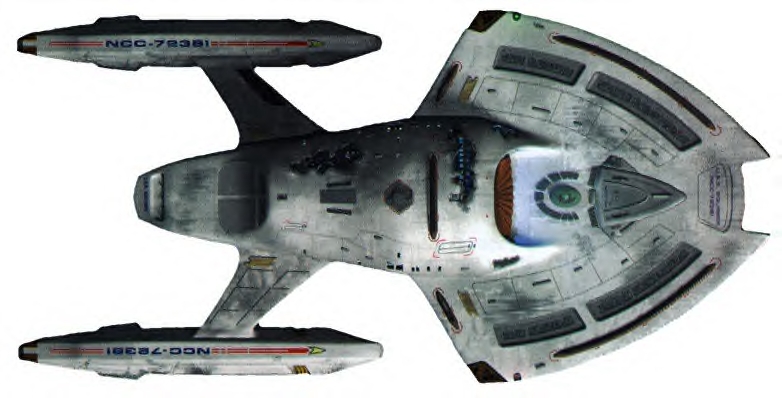 Impulse Propulsion Fuel: Slush Cryogenic Dueterium and Slush Cryogenic He3 Impulse Reactors: 7 Drive Coil Assemblies: 8 Vectored Exhaust Direc.(VED): 8 Expected Hull Life: 230 years SIF: Standard level Computer Systems Type: Nanocomp Core Computer System Network Data Transfer Rate: 5000 kiloquads/second Standard Core Memory: 3.6 million kiloquads Backup Core: 865,000 kiloquads  Sensor Systems Navigational Sensors: Standard: 2 primary, 3 secondary Basic Lateral Sensors: Forward/Port/Starboard/Aft Array. Setup includes 100 sensor pallets: 40 upper, 40 lower and 20 middle. High Resolution: 7 lightyears range Medium and Low Resolution: 21 lightyears range Advanced Sensors: Wide angle EM radiation imaging scanner Quark population analysis counter Z-range particulate spectrometry sensor High energy proton spectrometry cluster Gravimetric distortion mapping scanner Magnetic interferometry scanner Low frequency EM-flux scanner Localized subspace field stress sensor Parametric subspace field stress sensor Alpha X-ray multi-spectrum scanner High-band forced gravity wave sensor Low-level maser beam scanners Multifrequency subspace imaginging clusters Variable band optical imagine cluster Real-aperture graviton flux spectrometer High resolution graviton flux spectrometer, Low-resolution graviton spin polarimeter Passive imaging high-energy photon sensor Low-level thermal imaging sensor Fixed angle gamma frequency counter Virtual particle mapping camera Transwarp-based high focus particle imaging array 
Probe Loadout: Class I Short-Range Sensor Probes Class II Multimission Sensor Probes Class III Planetary Survey Probes Class IV Stellar Encounter Probes Class V Medium-Range Reconaissance Probes Class VI Communications Relay/Emergency Probes Class VII Remote Culture Study Probes Class VIII Medium-Range Multimission Warp Probes with Multispatial shielding. Class IX Long-Range Warp Probes Shuttlebays Main Shuttlebays: 1 Shuttle Loadout: 2 Type 12 shuttlecraft 1 Type 9 shuttlecraft 2 Sphinx Type M1 workbees Spider Work Drones Holographic Systems Holographic Programs: 1 Emergency Medical Holographic Program 1 Emergency Engineering Hologram |
