
| ...=/\= Akira Class Starship =/\= |
|
|
Akira Class Cruiser Commissioned: Stardate 52602.7 Construction site: Antares Fleet Yards, Andor Design life: 50 years DIMENSIONS: Saucer Primary Hull, Catamaran Secondary Hull, 2 Warp Nacelles Length / Width / Draft: 464 m / 317 m / 87 m Standard cruise mass: 2.2 million metric tonnes Number of decks: 24 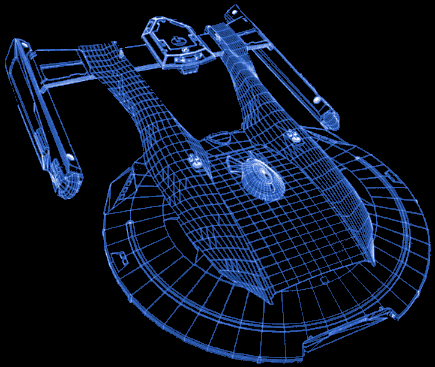 All Akira class starships consist of a primary saucer section, a catamaran secondary hull, and two warp nacelles mounted on variable geometry struts. Note the detachable aft pod -- this allows the Akira class ships to be reconfigured for multiple mission profiles. Warp field geometry is set "forward-heavy," allowing the Akira class, like the Miranda class before her, to maintain very high warp speeds despite an overall lower power output than many larger ships. HULL: Three layer suspension "sandwich" Outer layer: Type-3 ablative armor matrix Middle layer: Self-sealing tripolymer/duranium suspension Inner layer: Duratanium/carbotanium alloy, nanocarbon fiber reinforcement ENVIRONMENT: Standard crew compliment of 500 officers and crew Able to sustain up to 4500 personnel; Class H-N environments Class H/K environments: Sustainable for 450 persons maximum Class L environment: Sustainable for 150 persons maximum Class M environment: Sustainable indefinitely Class N environment: Sustainable for 120 persons maximum, only in Shuttlebays COMPUTER: LCARS-II Interface software Main core location: Decks 3 through 11, centerline Secondary core locations: Decks 9 through 11, starboard Decks 9 through 11, starboard Hardware/software design: Biolinear circutry, nanonic enhancements Phase-replication of main, secondary cores Data transfer rate: 4,110 kiloquads / second Maximum storage capacity: 6,127,320 kiloquads average 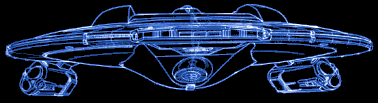 PROPULSION/HYPERLIGHT: Cryogenic Matter/Antimatter Reaction propulsion, Variable Warp Field Geometry, Keltrinium crystal moderation Sustainable warp cruise: Warp 9.5 Emergency cruise: Warp 9.91, for up to 12 hours Emergency speed: Warp 9.998, for up to 5 minutes PROPULSION/SUBLIGHT: Tandem twin impulse/muon-fusion reactor system, MHD Reaction Control Thrusters Sustainable impulse cruise: 0.25 c Emergency speed: 0.85 c TACTICAL/SHIELDS: Number of field generators: 12 Sustainable load: 4,200 MW Peak momentary load: 6,650 MW for 240 ms Maximum recharge rate: 48.1 MW/s Field generator locations: Deck 2 (two), Deck 5 (two), Deck 9 (three), Deck 12 (three), Deck 15 (two) Auxiliary systems output: 68% of primary TACTICAL/PHASERS: Number of emitters: 10 Main phaser arrays: 8 Type X Maximum emitter output: 6,400 kW Emitter locations: Saucer section, dorsal and ventral Secondary phaser arrays: 2 Type VIII Maximum emitter output: 4,200 kW Emitter locations: Catamaran dorsal and ventral, aft Warp pylons, port and starboard TACTICAL/TORPEDOES: Torpedo types: Standard Quantum, Standard Photon, Standard Graviton Torpedo launchers: 5 "twins" (2 fore, 1 aft, 1 port, 1 starboard) Launcher location: Saucer, decks 9 and 13 forward Saucer, deck 10 aft Saucer, deck 10 port and starboard Torpedo load-out: 200 casings and warheads Quantum torpedoes: 150 (50 launch-ready, 100 stored) Photon torpedoes: 25 (10 launch-ready, 15 stored) Graviton Torpedos: 25 Maximum volley per launcher: 5 torpedoes TACTICAL/EXPERIMENTAL: Incorporoates the experimental external holographic defense system Electro-Plasma "Lance": 1 emitter Maximum emitter output: 105,000 MW One 10-second burst per 4 hour charge Emitter locations: Main deflector array, Upper DEM NAVIGATIONAL DEFLECTOR: Redundant high-power graviton polarity source generators Number of emitters: 4 Emitter locations: Saucer, deck 7 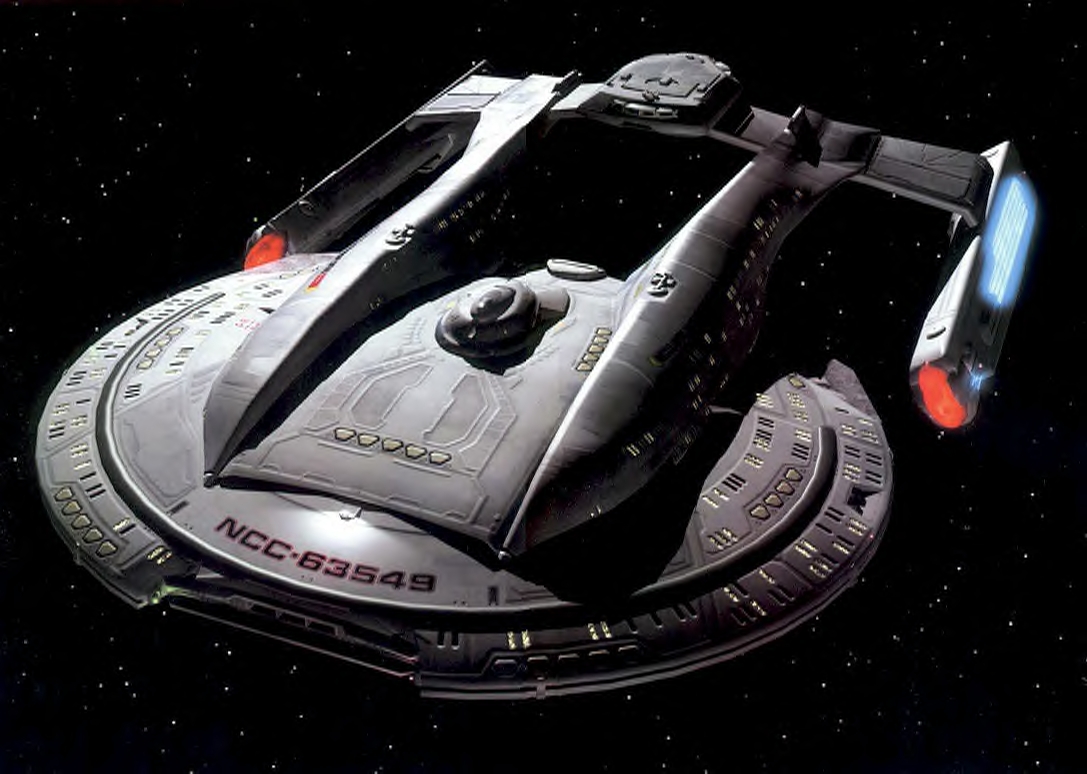 SENSORS/LONG RANGE: Behind main deflector array, deck 14 High resolution mode range: 24 light years (with LORASON; 7 without) Low resolution mode range: 60 light years (with LORASON; 21 without) Primary instruments: Wide-angle active EM scanner Narrow-angle active EM scanner Pinpoint active EM scanner 2.5 meter diameter gamma ray telescope Variable frequency EM flux sensor Lifeform analysis instrument cluster Parametric subspace field stress sensor Gravimetric distortion scanner Passive neutrino imaging scanner Thermal imaging array Proximity sensor array type 11-A SENSORS/NAVIGATIONAL: Number of pallets: 3 (1 primary, 2 secondary) Pallet locations: Primary: Saucer, deck 7 Secondary: Saucer, deck 15; LORASON, deck U3 Primary instruments: Quasar telescope Wide-angle IR Source Tracker Narrow-angle IR-UV-Gamma Ray Imager Active subspace multibeacon receiver Stellar graviton detectors High-energy charged particle detectors Galactic plasma wave cartographic processor Federation timebase beacon receiver Impulse time-distortion corrector Stellar pair coordinate imager SENSORS/LATERAL: Number of arrays: 12 Array locations: Primary: Lateral edges of the saucer section Secondary: LORASON Sensor Pod, deck U3 Array compositions: 6 sensor pallet clusters per array Pallet 1: Wide-angle EM radiation imaging scanner Quark population analysis counter Z-range particulate spectrometry sensor Pallet 2: Active magnetic interferometry scanner High-energy proton spectrometry cluster Gravimetric distortion mapping scanner Isometric phase matrix imager Pallet 3: Steerable lifeform analysis instrument cluster Pinpoint EM flux sensor Weapons and sensor targeting scanner ACB relay booster array Pallet 4: Low-frequency EM flux sensor Localized subspace field stress sensor Parametric subspace field stress sensor Hydrogen-filter subspace flux scanner Linear calibration subspace flux sensor Pallet 5: Variable band optical imaging cluster Virtual aperture gravitron flux spectrometer High-resolution graviton flux spectrometer Very low energy graviton spin polarimeter Pallet 6: Active matrix gamma interferometry sensor Low-level thermal imaging sensor Multi-angle gamma frequency counter Virtual particle mapping camera 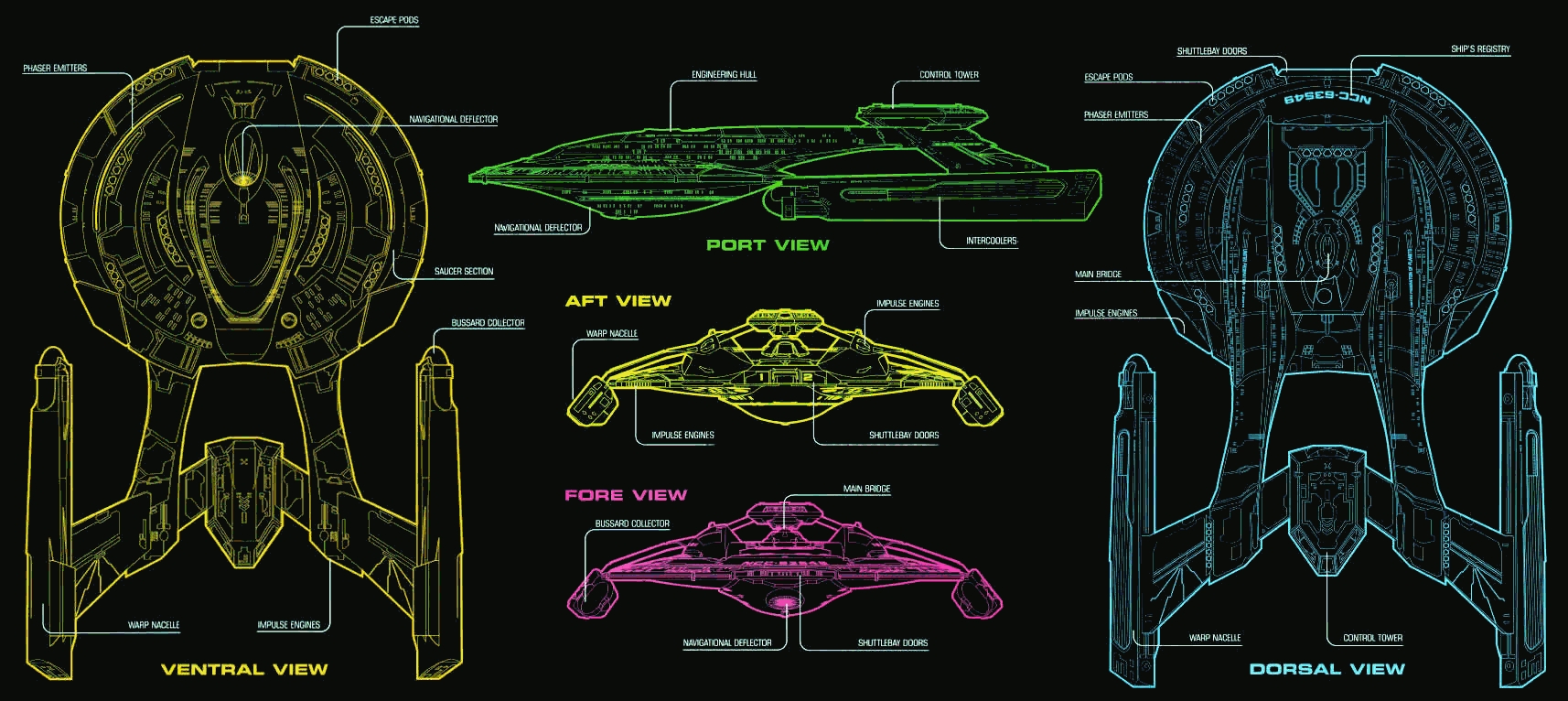 SENSORS/OTHER: Standard complement of Class I through Class IX probes Number of sensor relay pods: 8 Maximum range: 75 light-years Endurance: Warp 9.5 for 20 minutes TRANSPORTERS: Does not include the Sickbay microtransporter cluster on Deck 8 Personnel transporter rooms: 6 Capacity: 7 persons to 40,000 km Locations: Deck 5, port and starboard (2) Deck 7, port and starboard (2) Deck 9, port and starboard (2) Cargo transporters: 3 Capacity: 15,000 mt to 40,000 km Locations: Deck 11, in Main shuttlebay Deck 2, in Cargo bay 1 Deck 12, in Cargo bay 3 Emergency transporters: 6 Capacity: 20 persons to 15,000 km Locations: Deck 2, port and starboard (2) Deck 5, port and starboard (2) Deck 11, port and starboard (2) Transporter emitter pads: 12 AUXILIARY SPACECRAFT: Main Shuttlebay location: Decks 10 through 12 Type 16 shuttlepods: 12 Type 7 shuttlecraft: 4 Type 9 cargo shuttles: 6 Type 12 shuttlecraft: 2 Class 2 warpshuttles: 2 Spectre-class fighters: 12 Danube-class Runabouts: 1 HOLODECKS: Large holodecks: 3, on Deck 9 Medium holodecks: 6, on Deck 9 Personal holodecks: 9, on Decks 8 and 9 Emergency Medical Holographic System Emergency Engineering Holographic System |
