
| ...Reactant Injectors | |
|
The reactant injectors prepare and feed precisely controlled streams of matter and antimatter into the core. The MRI accepts supercold deuterium from the primary deuterium tankerage in the upper bulge of the Engineering Hull and partially preburns it in a continuous gas-fusion process. It then drives the resulting gases through a series of throttleable nozzles into the upper magnetic constriction segment. The MRI consists of a conical structual vessel 5.2 x 6.3 meters, constructed of dispersion-strengthened terinium carbimolybdenide. Twenty-five shock attenuation cylinders connect it to the PDT and the major spacecraft framing members on deck 30, maintaining 98% thermal isolation from the remainder of the section. In effect, the WPS floats within the hull to withstands 3x theorectical operational stresses. Within the MRI are six redundant cross-fed sets of injectors, each injector consisting of twin deuterium inlet manifolds, fuel conditioners, fusion preburner, magnetic quench block, transfer duct\gas combiner, nozzle head and related control hardware. Slush deuterium enters the inlet manifolds at controlled flow rates and passes to the conditioners, where heat is removed to bring the slush to just above the solid transition point. Micropellets are formed, preburned by standard magnetic pinch fusion, and sent down into the gas combiner, where the ionized gas products are now at 10^6K. The nozzle heads then focus, align and propel the has streams into the constriction segments. Should any of the nozzles fail, the combiner would continue to supply the remaininh nozzles, which would dilate to accomodate the increased supply. Each nozzle measures 102 x 175 cm and is constructed from lanthanum-copper-yttrium alloy. At the opposite end of the M\ARA lies the ARI. The internal design and operation of the ARi is distinctly different from that of the MRI, owing to the dangerous nature of antimatter. Every step in manipulating and injecting antideuterium must be undertaken with magnetic fields to isolate the fuel from the spacecraft structure. In some respects the ARI is a simpler device, requiring fewer moving parts. However, the dangers from handling antimatter necessitate uncompromising reliability in the mechanism. The ARI employs the same basic structual housing and shock attenuation struts as the MRI, with adaptions for magnetic-suspension fuel tunnels. The housing contains three pulsed antimatter gas flow separators, which break up the incoming antideuterium into small manageable packets to boost up into the lower constriction segments, Each flow separator leads into an injector nozzle, and each nozzle cycles open in response to computer control signals. Nozzle firing can follow complex sequences governing reaction pressures, temperatures, and desired power output. 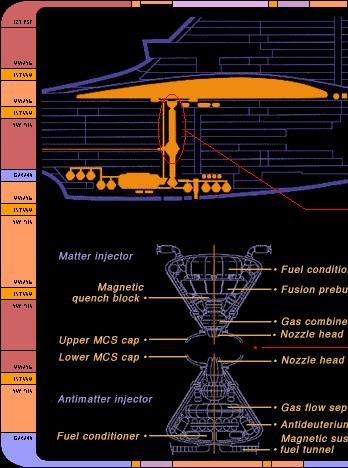
|
