A. 3D animation vocabulary
1.
Primitives – The simplest, most basic objects like sphere,
cylinder, and box. Can be used as-is or you can reshape them to create more
complex object.
2.
Resources – fully constructed 3D objects, unfinished materials,
lighting schemes, animations and deformations.
3.
Catalog – an easy method for adding resources to a scene and
especially to group them.
4.
Scene explorer – another way to add resources to a scene and
especially to group them.
5.
Transformation – the moving of an object from one place to
another over time.
6.
Deformation – the changing of an objects shape over time.
7.
Material – the texture that covers an object also could be referred
to as the “skit” of an object.
8.
Tiling – one way you can map a material to an object also sometimes
referred to “mapping” a “skin” to an object.
9.
Wire frame – a structural outline of an animation object.
10.
Frames – an animation holder in a timeline (one picture in an
animation sequence).
11.
Ray tracing – Computer process that calculates the path, color, and
other characteristics of each light ray as it is reflected by the objects in
the scent.
12.
Group – putting together two or more primitives to create a new
object.
13.
Non-perspective – a view that only shows two of the axes at once.
14.
Aiming Point – the point that the camera always looks at when you
change or move view around.
15.
Large lens angles – wide-angle effects with increased perspective.
16.
Small lens – angle produced a telephoto effect.
17.
Point light – a light that shines in all directions
18.
Spot light – a cone of light used to illuminate specific areas.
19.
The four camera views – camera view, top view, side view, and front
view
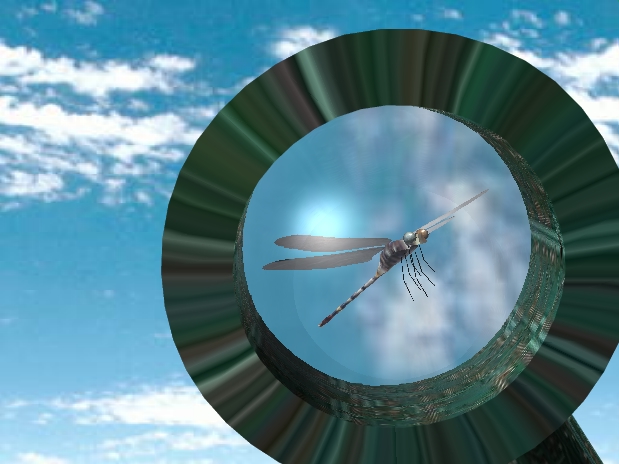
B. Here is an example animation I made in Simply 3D.
mailto:scary_oldman@yahoo.com


