Plate Tectonics
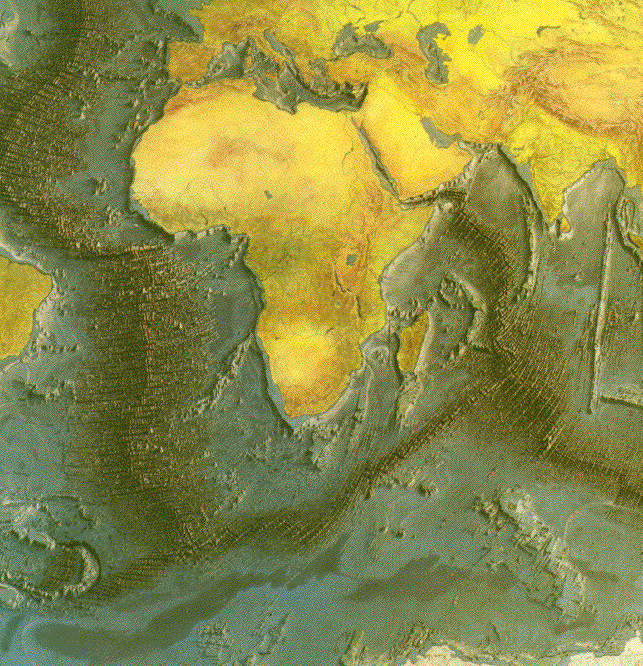
Mid-atlantic Ridge System
Mid-atlantic Ridge System
The seeds of Plate Tectonics were planted when a German astronomer, Alfred Wegener, noticed that the continents would fit together like puzzle pieces when cut from a map. He also noticed that fossil distribution on the different continents seemed to correspond with each other, as did lithology (strata).
Wegener called his theory Continental Drift. Unfortunately, he was almost universally ignored by his scientific colleagues.
Paleomagnetism also seemed to support Wegener’s theory. In igneous lava or unlithified sediments (those sediments that have not turned into rock), magnetic particles will align themselves with Earth’s magnetic field. This record is found in the igneous rocks when they cool and the sediments when they harden and become rock. These magnetic records show that the continents have moved.
In the 1960’s, Drummond Matthews and Fred Vine discovered magnetic anomalies on both sides of the Mid-Atlantic Ridge. Strips of oceanic crust showed alternating changes of magnetic alignment that indicated that the seafloor has been spreading. This led to the Plate Tectonics Theory, which states that all of Earth’s continents started as one super-continent, called Pangea, which broke up into many smaller landmasses. These masses have slowly moved from their original positions over millions of years and will continue to do so.
Continental plates are moving at different rates. The African plate moves about 25 mm per year and the Australian plate moves at the rate of 60 mm per year. The rate of movement can be determined by the pattern of magnetic anomalies on either side of a spreading oceanic ridge. The Earth’s polarities have reversed themselves at regular intervals throughout its history. Thus, crust formed during these reversed polarity periods show this through their magnet orientation.
Where two plates meet, one will slide under the other at an approximate 45-degree angle and will become part of the Earth’s mantle. This is called a subduction zone. This zone can be seen as a deep ocean trench, and the path of the descending plate can be seen through deep earthquakes. When two oceanic plates collide, a volcanic island arc may form. The descending plate melts at a depth of 90-150 km and the magma rises to form volcanic island chains.
The HartRAO website gives a very good, basic explanation of Plate Tectonics.
Another good site is The Life in Universe Organization website, which states “If plate tectonics were to cease, then so would this mountain building activity. Erosion would then, eventually, abrade down the mountains. Sediments removed by erosion, carried into the oceans by rivers and streams, would eventually lead to a rise in sea level. If the process continued, it is calculated that eventually a global ocean would cover the earth completely, resulting in catastrophic extinction of all land-based species.
You can view a 3D Paleographic map of the Cretaceous
There are several animations here that are worth the wait to view. They have also put together the following maps, which are worth seeing:
Pre-Cambrian
Cambrian
Ordovician
Silurian
Devonian
Early Carboniferous
Late Carboniferous
Permian
Triassic
Jurassic
Late Jurassic
Cretaceous
K/T Boundary(the period of mass extinctions)
Eocene
Miocene
Last Ice Age
Modern World
Future World (+50 million years)
Future (+100 million years)
Future (+ 250 million years; Pangea Ultima)
These maps show the progression the movement away from Pangea. The future maps show a return to one great landmass.
Another site of interest is This Dynamic Planet, which has a GPS map of the Earth’s physiographic features, the current movement of its major tectonic plates, and the location of its volcanoes (over 1500), earthquakes, and impact craters. WARNING The map can take up to 25 minutes to download.
Volcanoes Online is an excellent site which deals with this subject as well as many others.
There are several websites, which offer different theories. A lot of them are very technical, but we found the following enjoyable:
The Expanding Earth Organization offers evidence rebutting Plate Tectonics Theory. They believe that the earth is expanding.
Gonzo Science: Down With Plate Tectonics also offers rebuttals of Plate Tectonics Theory.
The following sites offer evidence for or against Catastrophic Plate Tectonics, which states that the crustal plates have shifted, but at a much more rapid pace, due to runaway subduction, which also caused global flooding.
"Creation in the Crossfire" offers a model of plate movement due to catastrophic flooding.
Institute for Creation Research Organization – Computer Modeling of the Large-scale Tectonics Associated With the Genesis Flood. This site is fairly technical.
Interview with plate tectonics expert, Dr. John Baumgardner (Answers in Genesis) discusses catastrophic Plate Tectonics caused by Runaway Subduction. This site is very easy to understand.
Creation Science surprisingly rejects Catastrophic Plate Tectonics, as well as the Global Canopy Theory as causes of global flooding.
Project Creation Organization is a site mainly for kids, but can be enjoyed by all. Very well done.
"Runaway Subduction vs. the Laws of Physics" presents rebuttal arguments to Runaway Subduction.