

Physiology Topics
Muscle is 40% of body weight. The functions of muscle include:
Heat is produced as a result of voluntary muscle contraction and shivering (involuntary skeletal muscle contractions). There are three types of muscle: skeletal, smooth and cardiac. Skeletal muscle is mostly under voluntary control. A skeletal muscle is often attached to two bones: contraction of the muscle exerts a force that moves one of the bones using a fulcrum. For example, when the biceps contracts it moves the forearm using the elbow as a fulcrum. Smooth muscle and cardiac muscle are under involuntary control by the autonomic nervous system.
 Each
skeletal muscle is a separate organ composed of cells called fibers.
They contain small threat-like structures called myofibrils that are
the contractile elements of skeletal muscle. A fluid system of membranous sacs
called the sarcoplasmic reticulum (analogous to the endoplasmic reticulum
of other cell types) encircles each myofibril. Myofibrils and the sarcoplasmic
reticulum are contained in the sarcoplasm (analogous to the cytoplasm)
of the muscle fiber, which also contains mitochondria. Each muscle fiber has
multiple nuclei and is contained by the sarcolema (plasma membrane).
Small invaginations of the sarcolema called T-tubules tunnel from the
surface towards the center of each muscle fiber, thus are filled with extracellular
fluid. A bundle of muscle fibers forms a fascicle.
Each
skeletal muscle is a separate organ composed of cells called fibers.
They contain small threat-like structures called myofibrils that are
the contractile elements of skeletal muscle. A fluid system of membranous sacs
called the sarcoplasmic reticulum (analogous to the endoplasmic reticulum
of other cell types) encircles each myofibril. Myofibrils and the sarcoplasmic
reticulum are contained in the sarcoplasm (analogous to the cytoplasm)
of the muscle fiber, which also contains mitochondria. Each muscle fiber has
multiple nuclei and is contained by the sarcolema (plasma membrane).
Small invaginations of the sarcolema called T-tubules tunnel from the
surface towards the center of each muscle fiber, thus are filled with extracellular
fluid. A bundle of muscle fibers forms a fascicle.
Myofibrils contain two types of fibers: thin filaments made of actin and thick filaments made of myosin. The filaments do not extend the entire length of the myofibril, but are arranged in compartments called sarcomeres, the basic functional units of the myofibbril. Narrow plate-like regions of dense material, Z disks, separate one sarcomer from the next.
 The
thin and thick filaments overlap more or less depending on whether the muscle
is contracted or relaxed. The pattern of overlap creates bands. The darker middle
portion of the sarcomere, the A band, extends the entire length of the
thick filaments. A narrow H zone in the center of each A band contains
thick but no thin filaments, supported at the center by myomesin forming a structure
called the M line.
The
thin and thick filaments overlap more or less depending on whether the muscle
is contracted or relaxed. The pattern of overlap creates bands. The darker middle
portion of the sarcomere, the A band, extends the entire length of the
thick filaments. A narrow H zone in the center of each A band contains
thick but no thin filaments, supported at the center by myomesin forming a structure
called the M line.
Towards each end of the A band, the
tick and thin filaments lie side by side. Six thin filament surround each thick
filament and three thick filaments surround each thin filament. The I band
is a lighter, less dense area that contains the rest of the thin filaments.
A Z disc passes through the center of each I band. Titin extends from Z disc
to M line and anchors thick filament myosin to Z disks. Nebulin attaches to
Z disks and lies alongside 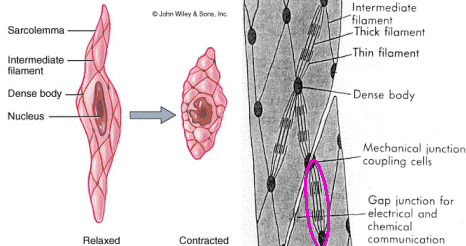 thin
filaments actin, maintaining their alignment. Dystrophyn links thin filaments
to integral membrane proteins of the sarcolema.
thin
filaments actin, maintaining their alignment. Dystrophyn links thin filaments
to integral membrane proteins of the sarcolema.
Smooth muscle is found in wraparound sheets that form part of the walls of arteries, veins and hollow visceral organs. Filaments are arranged in a web-like pattern rather than in parallel like skeletal muscle. Smooth muscle fibers connect to one another by mechanical junctions (allow mechanical coupling) and gap junctions (allow electrochemical communication between cells.
Continue to "Muscle Contractions" or take a quiz: [Q1] [Q2].
Need more practice? Answer the review questions below.
Questions not yet available.