

| Table 1. Mitogenic Signaling Molecules Growth factors Tyr kinases
SH-2 containing proteins
GTP binding proteins
(G proteins) Ser/Thr kinases
Transcription factors
|
Molecular BIology of Cancer Topics
Protein Phosphorylation
Protein phosphorylation is a common mechanism in signal transduction. It is a is a reversibe post-translational modification that occurs rapidly (seconds, minutes vs. protein synthesis & degradation which takes hours or days). Protein phosphorylation can affect several properties of the protein: conformation, enzymatic activity and binding ability.
Two types of enzymes control the phosphorylation status of proteins: kinases and phosphatases. Kinases are enzymes that transfer a phosphate group from ATP to another molecule (e.g. another protein), while phosphatases are enzymes that remove a phosphate group.
Kinases can be classified as either serine/threonine kinases, tyrosine kinases or dual specificity kinases according to the amino acid residue that they phosphorylate. The majority of cellular protein kinases are Ser/Thr.
Similarly to kinases, phosphatases can be classified as Ser/Thr phosphatases, Tyr phosphatases or dual specificity phosphatases
Mitogenic Signaling
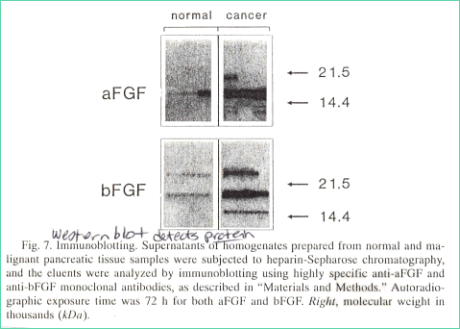
Many proteins relay mitogenic, i.e. growth stimulatory, signals (see Table 1). Nearly all of the signal-transducing proteins are encoded by proto-oncogenes. Conversely, nearly all known proto-oncogenes encode signal transducing proteins. Human cancers often exhibit autocrine growth signaling, with both the growth factor and its receptor being overexpressed. Overexpression of growth factors or their receptors can be detected by Western blot analysis of cancer vs. normal tissues, using antibodies especific to either the growth factor or its receptor.
Fibroblast Growth Factor (FGF) staining is associated with greater malignancy. FGF staining was more common in advanced, late stage pancreatic cancers (stage IV) than in small nonmetastatic cancers (stage I ). Patients with high tumor bFGF expression had shorter survival times while no significant relationship between aFGF expression and cancer survival.
Kobrin et al. Aberrant
expression of Type I fibroblast growth factor receptor in human pancreatic
adenocarcinomas. Cancer Res. 53; 4741-4744, 1993. |
 The
general structure of a growth factor receptor includes an extracellular ligand
binding domain, single transmembrane domain, and cytoplasmic (intracellular)
domain. The cytoplasmic domain has tyrosine kinase activity plus a Tyr residues
within or near the tyrosine kinase domain. Upon binding the growth factor, the
receptor dimerizes with another ligand-bound receptor, resulting in cross-phosphorylation
of the tyrosine residue. In other words, the tyrosine kinase domain of one receptor
phosphorylates the Tyr residue on the other receptor.
The
general structure of a growth factor receptor includes an extracellular ligand
binding domain, single transmembrane domain, and cytoplasmic (intracellular)
domain. The cytoplasmic domain has tyrosine kinase activity plus a Tyr residues
within or near the tyrosine kinase domain. Upon binding the growth factor, the
receptor dimerizes with another ligand-bound receptor, resulting in cross-phosphorylation
of the tyrosine residue. In other words, the tyrosine kinase domain of one receptor
phosphorylates the Tyr residue on the other receptor.
Several proteins can bind
the receptors' phosphotyrosine residues via SH2 or SH3 domains. SH2 (Src homology
2) domains bind phosphotyrosine and the 3 amino acids that follow (P-YXXX).
Proteins with SH2 domains include signal transmitters like Phospholipase C and
Phosphoinositol 3’ phosphate kinase (PI3 kinase), and adapter proteins
(that bridge to other signal transmitters) like GRB2 and Shc. SH3 (Src homology
3) domains bind proline-rich regions of other proteins. 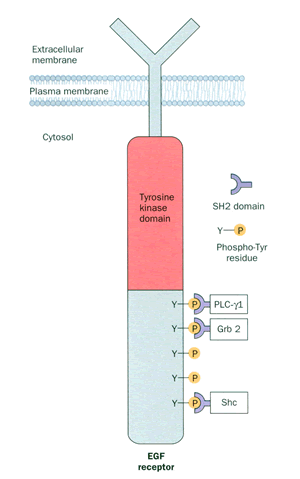 Each
SH2 domain differs slightly in sequence and recognizes a different amino acid
sequence following phosphotyrosine. A protein such as the PDGF receptor with
multiple phosphotyrosine residues can bind more than one SH2-containing protein
at a time, thus it is capable of activating multiple signaling cascades. After
binding the receptor's phosphotyrosine residues, the signal transmitters are
activated through Tyr phosphorylation by the receptor tyrosine kinase.
Each
SH2 domain differs slightly in sequence and recognizes a different amino acid
sequence following phosphotyrosine. A protein such as the PDGF receptor with
multiple phosphotyrosine residues can bind more than one SH2-containing protein
at a time, thus it is capable of activating multiple signaling cascades. After
binding the receptor's phosphotyrosine residues, the signal transmitters are
activated through Tyr phosphorylation by the receptor tyrosine kinase.
Many mitogenic signaling proteins are in the signaling pathway downstream of tyrosine kinase receptors. The Ras GTP-binding protein is an important protein that transduces signals from SH2 homology porteins activated by tyrosine kinases, for example Grb-2, to a kinase cascade that changes the phosphorylation status of transcription factors and other important proteins.

Continue to "Tyrosine Kinase" or take a quiz: [Q1].
Need more practice? Answer the review questions below.
Questions under construction
Continue scrolling to answers below.
Hey! DON'T PEEK!!! Finish the questions fist!
Answers under construction
 Experimental
Results:
Experimental
Results: