

Molecular Genetics of Development Topics
Vulval Development: Overview
bla blah
Take Quiz: [Q1] [Q2] [Q3]
Back to Basics: Topic 1
Topic 2
Advance Topics: Topic 1
Topic 2
Vulval Develpment: The experimental model
Caenorhabditis elegans has all the common characteristics you want in a model organism: short lifespan, easy to grow, simple anatomy, etc. It can be a hermaphrodite or male.
C. elegans has a very specific pattern of cell development. The origins of all 959 cells can be traced and have been mapped: extensive genetic information is known, the genome has been sequenced.
Several important types of experiments can be done with C. elegans to provide key information: ablation experiments, mosaic experiments, and Mul or Vul phenotype experiments. Mosaic experiments allow the worm to develop with some cells expressing certain proteins while others cells do not. Ablation experiments use a laser to kill a specific cell while the rest of the animal is unharmed, so development continues. The only reason we can do mosaic and ablation experiments is that we know the worms development is invariant.
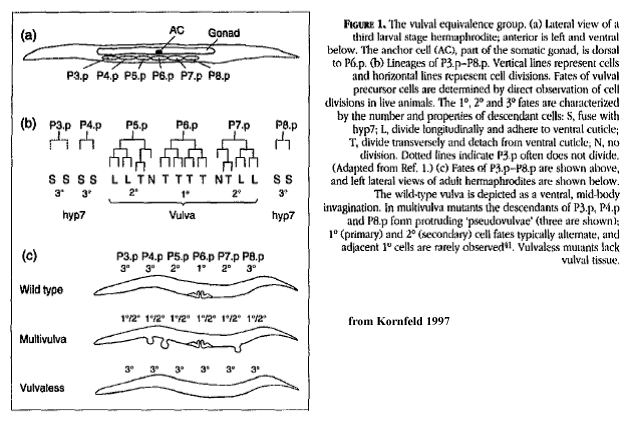 Vulva
development in C. elegans is a good developmental model because it is precise,
invariant and highly reproducible. No vulva (Vul) or multiple vulva (Mul) mutants
have been shown to be important in elucidating cell fate determination. Vulva
organogenesis happens from L3 stage to adult in three phases:
Vulva
development in C. elegans is a good developmental model because it is precise,
invariant and highly reproducible. No vulva (Vul) or multiple vulva (Mul) mutants
have been shown to be important in elucidating cell fate determination. Vulva
organogenesis happens from L3 stage to adult in three phases:
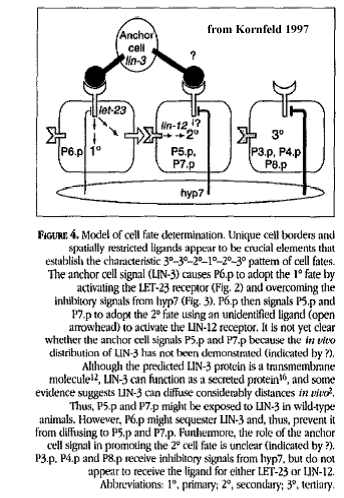
Lets look at Phase I in more detail. The fate of six vulval precursor cells (VPCs), P3.p to P8.p, to either fate 1°, 2° or 3° is determined by signaling from two sources: the Anchor cell and neighboring cells. The cell closest to the Anchor cell becomes 1°, the two cells on either side of 1° become 2°, and the next cells by the 2° cells become 3° .
In an ablation experiment were the Anchor cell is killed, the vulval precursor cells all become 3° and no vulva develops (Vul phenotype). If the Anchor cell is moved one cell over in any direction, the order of 1°, 2° and 3° cells also moves so the new cells closest to the Anchor cell is 1°. If all VPCs are killed except one, that cell will still acquire the fate according to its position relative to the Anchor cell. Thus there is some kind of morphogenic signaling originating from the Anchor cell that controls the fate of VPCs.
Take Quiz: [Q1] [Q2] [Q3]
Back to Basics: Topic 1
Topic 2
Advance Topics: Topic 1
Topic 2
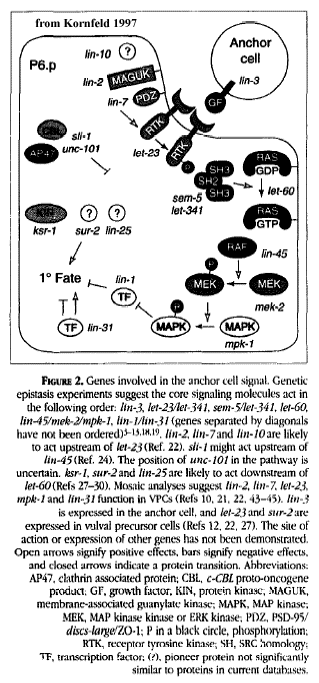 Vulval
Develpment: EGF and lin-12/Notch Signaling
Vulval
Develpment: EGF and lin-12/Notch Signaling
Looking at developmental mutants has led to the discovery of many developmental
pathways, most notable the EGF (Epidermal Growth Factor) and lin-12/Notch pathways.
cont...
Take Quiz: [Q1] [Q2] [Q3]
Back to Basics: Topic 1
Topic 2
Advance Topics: Topic 1
Topic 2
Apoptosis: Overview
Take Quiz: [Q1] [Q2] [Q3]
Back to Basics: Topic 1
Topic 2
Advance Topics: Topic 1
Topic 2
Apoptosis:
C. elegans development generates 1090 somatic cells but the adult organism has only 959 somatic cells, the rest are removed by apoptosis. Specific cells always die.
 The apoptosis pathway has similar elements in nematodes and vertebrates. Executioner
proteins (CED-3 in nematodes, caspases in vertebrates) chop-up the cell after
being activated by adaptor proteins (CED-4 or Apaf-1). Inhibitor proteins like
CED-9 or Bcl-2/Bcl-XL prevent the adaptor and executioner from interacting.
A thanatin (?) protein (EGL-1 or BH-3 proteins) prevents the inhibitor proteins
from acting.
The apoptosis pathway has similar elements in nematodes and vertebrates. Executioner
proteins (CED-3 in nematodes, caspases in vertebrates) chop-up the cell after
being activated by adaptor proteins (CED-4 or Apaf-1). Inhibitor proteins like
CED-9 or Bcl-2/Bcl-XL prevent the adaptor and executioner from interacting.
A thanatin (?) protein (EGL-1 or BH-3 proteins) prevents the inhibitor proteins
from acting.
etc...
Take Quiz: [Q1] [Q2] [Q3]
Back to Basics: Topic 1
Topic 2
Advance Topics: Topic 1
Topic 2
Continue
to "nest topic" or take a test: [T1] [T2] [T3].
Need more practice? Answer the following review questions:
Questions not yet available