Human Anatomy
 The Skeletal System
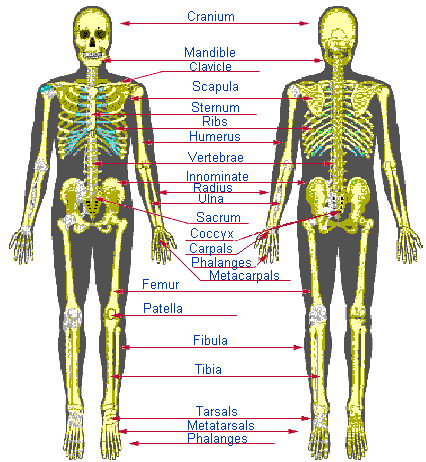
The Skeletal System is one of the most important organ systems. We have 206 bones in our body each having a different function.
We need our skeletal systems to live. Bones give you shape and protect your vital organs such as, your heart, brain, and lungs. Without our bones we would just be a blob of blood and tissue. The muscle in our body is attached to the bones.
We have 206 bones in our body. We have 21 bones in our skull or upper jaw. You have 3 tiny bones in each ear. There are 32 bones in your upper limb, 31 in your lower limb, and 26 in your backbone and spine.
There are many different layers in each bone. The outer part of the bone is hard, compact, dense and strong. Inside is a spongy layer, like honeycomb. It is lighter than the outside layer and is slightly more flexible. Also in the center of the bone there is the bone marrow. It produces new blood cells.
At the end of each bone is cartilage so that the bones don’t scratch and bump against each other. Old bones become dead, dry, and brittle.
 The Digestive System
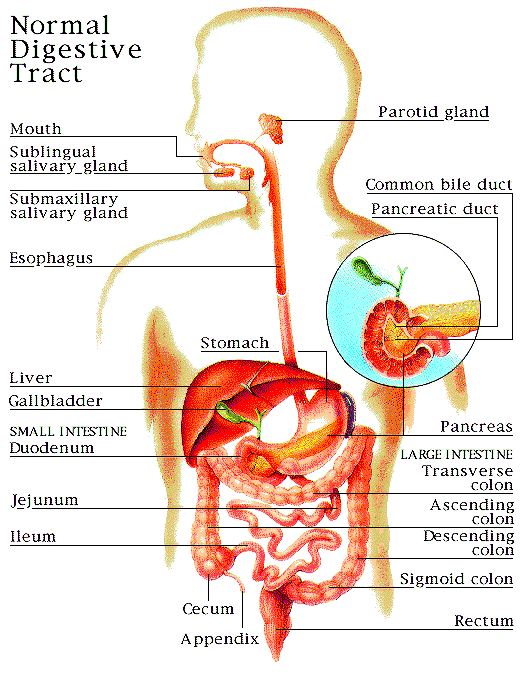
The digestive system is a sequence of connected organs whose purpose is to break down, or digest, the food we eat. There are 11 organs to the digestive system, the process goes like this: The mouth (teeth) chews up the food, then it’s the salivary gland, Epiglottis, the esophagus comes next with the chewed food. The liver, stomach, gallbladder, and pancreas come after the Esophagus. The Large intestine, small intestine, the rectum and wastes goes out of the body. In other words, first, it chews down molecules are absorbed into the blood and carried throughout the body. Then, the wastes are eliminated from the body. The simple molecules travel through the bloodstream to all of the body’s cells, which use them for growth, repair, and energy.
The digestive system helps your body in many ways! One way is that the digestive system helps a human’s body to get the nutritious parts out of foods that you eat. Every part of the digestive system has an important function that will help you digest the food and become strong! If we don’t have the digestive system, we’ll be tremendously skinny and very small; in fact we’ll be dead! The digestive system is one of the most important parts of the human body, but not that complicated, so we have to take care of our stomach, throat, and all of your inner parts!
The digestive system utilizes the levels of organization by cell, tissue, organ, and then the organ system. It isn’t that complicated, so you can figure out the digestive system very easily. Here is the level of organization more specifically: the cells in the organs, the organ tissue, organs such as the stomach, liver, etc… And the biggest of all is the organ system (the digestive system
of an adult’s digestive region was stretched out, it would be 6 to 9 m (20 to 30 ft) long. In humans, digestion begins in the mouth, where both mechanical and chemical digestion occurs. The mouth quickly converts food into a soft, moist mass. The muscular tongue pushes the food against the teeth, which cut, chop, and grind the food. Glands in the cheek linings secrete mucus, which lubricates the food, making it easier to chew and swallow. The esophagus is a powerfully built tube around 25 cm (10 in) long, passes behind the trachea and heart and accesses the diaphragm (wall in middle of the chest and abdomen) before getting to the stomach. The process begins when rounded muscles in the esophagus wall pact and loosen up (widen) one after the other, squeezing the chewed food down to the stomach. Food travels the length of the esophagus in two to three seconds. The stomach is placed in the upper abdomen just below the diaphragm; it is a sac-like formation with strong and well-built walls. The stomach can inflate drastically to store up all the food from a meal for both mechanical and chemical processing. The large intestines and the small intestines are the last section of the digestive system. They have villi (villus) that take nutrition into the body needs.
This is how the digestive system relates to other organ systems: The body coordinates the various steps of digestion so that the process proceeds smoothly and cells obtain a steady supply of nutrients and energy. The central nervous system and some various glands control activities that control the digestive procedure, such as the emission of enzymes and liquids. This is why you get hungry, the mechanism of hunger is more complicated than this, however, and is only incidentally related to the stomach.
I think that the digestive system isn’t that difficult to memorize and that the digestive system isn’t that difficult to figure out! There are little parts (organs) and big parts (organs) to the digestive system. Some organs such as the gallbladder don’t have to be in the body, even though it helps the stomach digest the food. Each organ in the digestive system has a specific function and each organ is very important to the human body! So I especially recommend you take care of your organs in the digestive system!
 The Muscle System
The muscles are very important to the human body. Without muscles the body could not function Properly. In order for the muscles to work they need to use other organ systems. Now we're going to tell you all about muscles
Muscles help you to do exercises and sports. Without muscles the body would not be strong
enough to move. A lot of muscles are connected
to your jaw making your jaw strong enough to
chew hard food. Every time you type on a
Computer keyboard shoot a basketball or walk
across your room you are using your skeletal
Muscles.
There are three types of muscles. One type of muscle is cardiac. Cardiac is got its
Name because it’s found in the heart. Also cardiac
Muscles are branched and allow the heart to beat.
The second type of muscles is the skeletal. These
Muscles are not branched and are attached to
bones, allowing them to move. The final type of
Muscle is visceral. This found in the bladder and
Arteries.
The muscles of our body do many things for us. The chest muscles pull the arm toward the body. The shoulder muscle moves the arm wherever else you want it to move. The chest muscle also moves the scapula. The diagonal muscles tighten the abdomen. A back muscle pulls the arm up and down.
Muscles work with other systems of the body too. The cardiac muscle makes a wall for the heart
protecting it. The muscles also help protect the skeletal system. The muscles also work with your digestive system to help you swallow food.
In conclusion the muscle system does a lot for the body. Without it you couldn’t play sports, walk or even move. Without the muscle system it would be impossible to live.
 The Circulatory System and the Heart
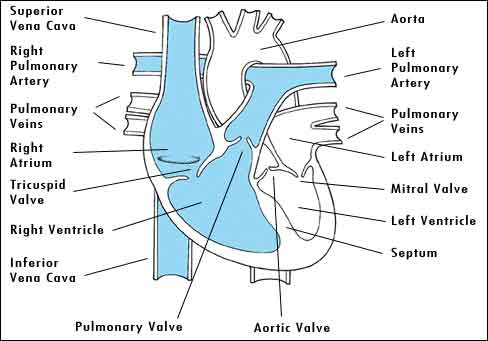
The heart is a pumping system which intakes deoxygenated blood through the veins. It also pumps blood into various arteries to be transmitted where it needs to be. The heart is about the size of a fist. The heart has two sides. A left side and a right side. Each side has two compartments, or chambers-an upper and a lower chamber. Each of the two upper chambers, called an atrium receives blood that comes into the lower chamber called the ventricle, pumps blood out of the heart. The atria are separated from the ventricles by valves. A valve is a flap of tissue that prevents blood from flowing backwards. Valves are also located between the ventricles and the large blood vessels that carry blood away from the heart. The action of the heart has two main phases. In one phase the heart muscle relaxes and the heart fills with blood. In the other phase, the heart muscle contracts and pumps blood forward. A heartbeat, which sounds something like lub-dup, can be heard during the pumping phase. When the heart muscle relaxes, blood flows into the chambers. Then the atria contracts. This muscle contraction squeezes blood out of the atria, through the valves, and then into the ventricles. Next the ventricles contract. This contraction closes the valves between the atria and ventricles, making the lub sound and squeezing blood into large blood vessels. As the valves between the ventricles and the blood vessels snap shut, they make the dup sound. All of this happens in less than a second. Every second of your life, your heart pumps blood through your body. The right side of the heart pumps blood to the lungs, while the left side pumps blood through the rest of the body.
Return to homepage