 |
|
|
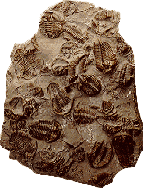
Trilobite Fossils
|
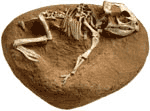
Baby Protoceratops
|
|
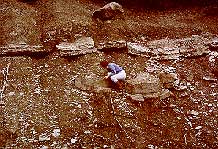
Fossils are found in the Sedimentary Rock layer which is the result of the deposition of mud, silt, sand etc then compressed by the extremely high pressures caused by the increasing density of the layer, as more and more sediment built up over millions of years. (see my page on The Earth's Crust). These fossils are found by Paleontologists in exposed areas of sedimentary rock which may be found along river banks, or cliff faces
|
|
|
|
Fossil Hunting
|
|
as depicted above, or where uncovered by man, as the result of the excavation of quarries, road building, or as the result of the preparation of large builing developments etc.
|
|
Paleontologists often face real problems in extracting fossils from the surrounding rock. We often see them in films unearthing amazing finds, with nothing but a small brush, but the reality is somewhat different. Although the brush is a very useful and much used piece of equipment, they often have cause to use mechanical methods to extract the fossil, such as electric drills and air pressure shot blasting equipment. They also have problems at the other end of the scale, where the rock surrounding the fossil is so fragile that it's removal may cause the fossil to disintegrate. In these situations they have to consolidate the surrounding crumbly rock by the use of weak forms of adhesive, until they can deal with it in the lab. The fossils are not only the skeletal remains of dinosaurs and other animals that happened to fall into pitch pools or swamps, the majority of fossils are of insects, shells, leaves, seeds etc, or even the tracks, burrows, or the impressions of what was once there. The fossils found are but a tiny percentage of the remains of dead insects, animals, and plant matter. The majority of such things usually decay, or are eaten by other animals or insects. Those fossils that have been created are the result of a quick burial by mud slides or swallowed up in swamps etc.
|
|
|
|
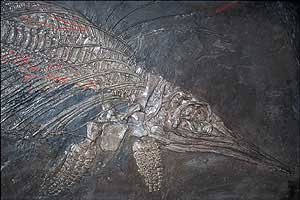
Ichthyosaur
|
| Few discussions in geology can occur without reference
to geologic time. Geologic time is often dicussed in two forms:
|
|
|
|
The Geologic Time Scale
|
|
The geologic time scale is mainly the result of work done in Europe during the eighteenth and nineteenth centuries. The history of the Earth was sub-divided into eons, then, eras, periods, and epochs, as shown in the above table. The names of these sub-divisions may look a bit daunting to the uninitiated, but geologists know that paleo means ancient, meso means middle, ceno means recent, and zoic means animal life, Therefore Paleozoic is the oldest, then comes Mesozoic, and finally Cenozoic the latest era. |
 |
 |
 |
|
Coleopteran, Curuliondae
|
Fern, Unidentified
|
Diptera, Tipulidae
|
|
Dinosaurs
|
|
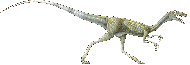
Solely based upon the discovery so far of complete skeletal remains, the smallest dinosaur was Compsognathus this dinosaur was 1m (3ft) long and an estimated weight of 2.5kg (6.5lb).
|
 |
|
Compsognathus (Pretty Jaw)
|
|
I have seen this small dinosaur of the jurassic period, described in many places as being "the size of a chicken". Although small, this dinosaur was a carnivore, and one fossil shows the remains of a lizard, it's last meal, in the stomach area.
|
|
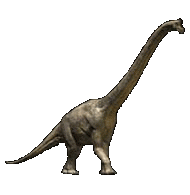
The largest would be Brachiosaurus
30.5m (100ft) long and 15.2m (50ft) high, and weighing between 30-70
tons.
|
|
|
|
Brachiosaurus (Arm Lizard)
|
|
Also of the same jurassic period this dinosaur as so often found in large animals, was a herbivore. With it's head 15m above ground level, and it's close cropping teeth, it was able to graze conifer leaves and fruit, well above the reach of any other species.
|
| Quite large bones of incomplete dinosaurs ( vertebrae and leg bone fragments) such as Amphicoelias and Argentinasautus point to dinosaurs up to two times larger than Brachiosaurus. |
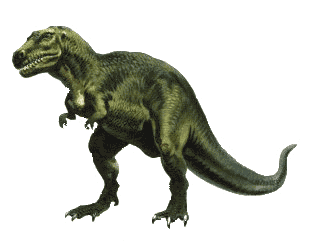
| No discourse on dinosaurs would be complete without mention of possibly the best known of all, the dinosaur that lived at the end of the cretaceous period - |
 |
|
Tyrannosaurus Rex (Tyrant Lizard King)
|
| Tyrannosaurus Rex (T Rex). 14m (46ft) long, 5.5m (18ft) tall and weighing in at 6 tons, with a head 1.2m (4ft) in length, and it's jaw bones filled with curved serrated teeth 15mm (six inches) long, and a gape of 1m (3ft), this was the most formidable carnivore to have ever walked the planet. |
|
Dating of fossils
|
|
I acknowledge that there is not one single valid scientific method of determining the date of a fossil, but I will not enter into the arguments of the accuracy or otherwise, of the various methods of dating, other than to point out that an error of 1 percent, on age determination of 100 million years, would give a million year error up or down. You may find that the radiometric dating methods with half-life and parent, daughter references a little difficult to get your head around. I offer this analogy, in the hope that it may make it a little easier for you to understand the basic theory: Imagine filling a glass with lemonade. You watch the bubbles fizz (no puns please) to the top and after some time they decrease in number, until they almost stop. Now if you could count those bubbles at the beginning, and at timed stages until the end, you would be able to calculate how long ago a similar glass of lemonade had been poured, simply by counting the bubbles in the glass. Replace the bubble count, with a radioactivity count, and you have it. |
|
As an example, let us take Carbon-14 . Almost everyone has heard of 'Carbon dating' from films, TV or reports of some artifact having been aged by that method. The half-life of carbon-14 is 5,568 years. This means that half of the bubbles - sorry, C-14 decays (into nitrogen-14) in 5,568 years. Half of the remaining C-14 decays in the next 5,568 years, and so on. This method is quite ok for dating ice-age animals, neanderthal man, organisms etc, but when it comes to dating dinosaur fossils, this is no good, as we need to go back further than the 50,000 year limit of C-14. Potassium-Argon and Rubidium-Strontium have isotopes with slower decay rates (longer half-lives). These isotopes are rarely found in fossils themselves, but they do occur in the surrounding rock strata. Scientists are therefore able to arrive at a reasonably accurate dating, by the 'above and below' method. That is, they date the igneous layer immediately below and above the fossil, giving a time span of the dinosaur's life. Scientists are well aware of the others factors that can cause false readings, so they always try to use more than one method in an attempt to increase the accuracy of the dating. One very useful aid is the existence of index fossils. These are fossils with a short, well defined life span, and are widely distributed throughout the world.
|
 |
|
Examples of Index Fossils
|
| There are of course many other index fossils, but the above examples clearly illustrate the limited life span of these fossils, and when found in the same vicinity of the dinosaur or whatever fossil is being dated, they are a very welcome additional form of evidence. |
 |
| "Never lend palaeontologists money. They consider a million years ago to be Recent". |

 |
|
|
Office
|
Quiz
|


 Relative time ("chronostratic") -- subdivisions of the
Earth's geology in a specific order based upon relative age relationships
(most commonly, vertical/stratigraphic position). These subdivisions
are given names, most of which can be recognized globally, usually on
the basis of fossils.
Relative time ("chronostratic") -- subdivisions of the
Earth's geology in a specific order based upon relative age relationships
(most commonly, vertical/stratigraphic position). These subdivisions
are given names, most of which can be recognized globally, usually on
the basis of fossils.