|
Most of us at one time or another, have dropped a stone or other object into water, and watched the ripples radiate out from the centre. This visual picture gives us a simplified example of how sound travels through the air, or other elements. Air is made up of particles, and it is the movement of these that make the sound waves. When you speak, your vocal chords vibrate, and these vibrations, like the ripples in the pond, radiate in all directions as air waves. When they reach our eardrums they vibrate at the same frequency and we hear the sound. Sound can travel through mediums other than air, for instance, metal, water, wood etc. It relies upon exciting (vibrating) particles in the object to enable it to travel through the medium. Particles in the object move back and forth quickly, sending out energy. This wave of energy moves through the air, setting air particles vibrating. Sound cannot travel in a vacuum, as there are no particles to excite. Sound travels more quickly through liquids and solids, than it does through gaseous elements. Given the same temperature, say 0 degrees Celsius (32 degrees Fahrenheit) the speed of sound through a block of steel would be 4,877 metres (16,000 ft) per second, whereas through the air it would be 332 metres (1,088 ft) per second. The more densely packed particles in a solid transmit the vibrations more efficiently that the loose nature of air. A graphic example of this is the old kids trick of making a telephone with a length of string and two empty cans. You can stand too far apart to hear normal speach, yet using the tin can phone with the string pulled taut, you are able to hear, even if it is not too clearly.
|
|
|
|
The speed of sound depends upon the material the sound travels through. In solids and liquids, the particles are more dense than in a gas. This allows the sound to travel faster through liquids and solids than through gas. When sound waves hit a material, three things can happen:
Hard compact materials like brick, glass, and wood, reflect about 99% of the sound energy that hits them. Loose, soft materials like carpets, curtains, foam, and polystyrene, reflect 50% or less of the sound energy that hits them. The rest is absorbed. Because of this, these types of materials are useful in soundproofing. |
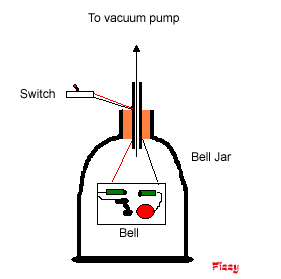
| The experiment shown below proves that sound cannot travel through a vacuum. As the air is pumped out of the bell jar, the sound gets softer and softer, until eventually you cannot hear the bell ringing at all, even though you can see the striker continuing to strike the bell. |
|
|
|
Sound waves are transmitted by particles vibrating and knocking into one another. In a vacuum there are no particles so sound cannot be transmitted.
|
|
How our ears hear Our ears are very sensitive to sound. They have three main sections: the outer ear, the middle ear, and the inner ear. As sound waves reach our ears, they pass down the ear canal. The waves cause the membrane of the ear drum to vibrate, and this moves the ear bones back and forth. These vibrations pass to the membrane in the oval window, causing the liquid in the cochlea to move. Delicate sensitive cells pick up the vibrations in the cochlea. These cells then send the messages to the brain via the auditory nerve. |
 |
| The inner ear also contains three semi-circular canals at right angles to each other. These organs are filled with liquid like the cochlea. Unlike the cochlea which is concerned with hearing, the semi-circular canals are concerned with our sense of balance. As we move around, the liquid in the canals also moves. This stimulates nerves attached to the canals which pass messages to the brain, helping us to keep our balance. |
 |
| "Things that don't make a noise..... a banana, paint, pickled herrings, one hand clapping". |

 |
|
|
Office
|
Quiz
|



 The
sound wave can be relected off the material.
The reflected noise is called an echo.
The
sound wave can be relected off the material.
The reflected noise is called an echo.