Multiplexers
Objective: The objective of this lab was to introduce and observe the behavior of various types of multiplexers, and decoders as examples of combinatoric logic.
Part 1, Digital Multiplexer: In the first part I set up the digital multiplexer seen below Next I set the data switch so that for D7-D0 it had a binary pattern of 10101100, with a 1 being an open switch and a 0 being a closed switch. After setting the data switch I set up truth table for each possible set address of A2-A0 and the output Q. The results are recorded in the table below.

| A2 | A1 | A0 | # | Voltage | 0 or 1 |
| 0 | 0 | 0 | 0 | 0.204 | 0 |
| 1 | 0 | 0 | 1 | 0.204 | 0 |
| 0 | 1 | 0 | 2 | 4.41 | 1 |
| 1 | 1 | 0 | 3 | 4.41 | 1 |
| 0 | 0 | 1 | 4 | 4.41 | 1 |
| 1 | 0 | 1 | 5 | 0.204 | 0 |
| 0 | 1 | 1 | 6 | 4.41 | 1 |
| 1 | 1 | 1 | 7 | 4.41 | 1 |
Part 2, 7 segment display: In part 2 I set up the circuit below using a seven segment display, then by switching the data switches on and off you could create different numbers on the display. Each switch controlled one individual light segment on the display, for instance the first switch, a controlled the top middle segment, the second switch, b controlled the top right light segment, and the third switch, c controlled the bottom right light segment, so if you only had the first three switches on you would see the number seven on the display.

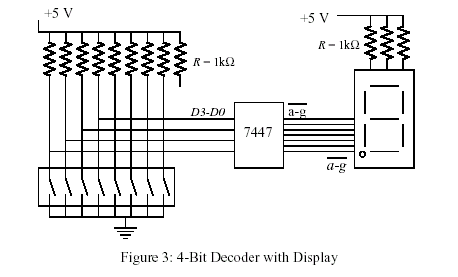
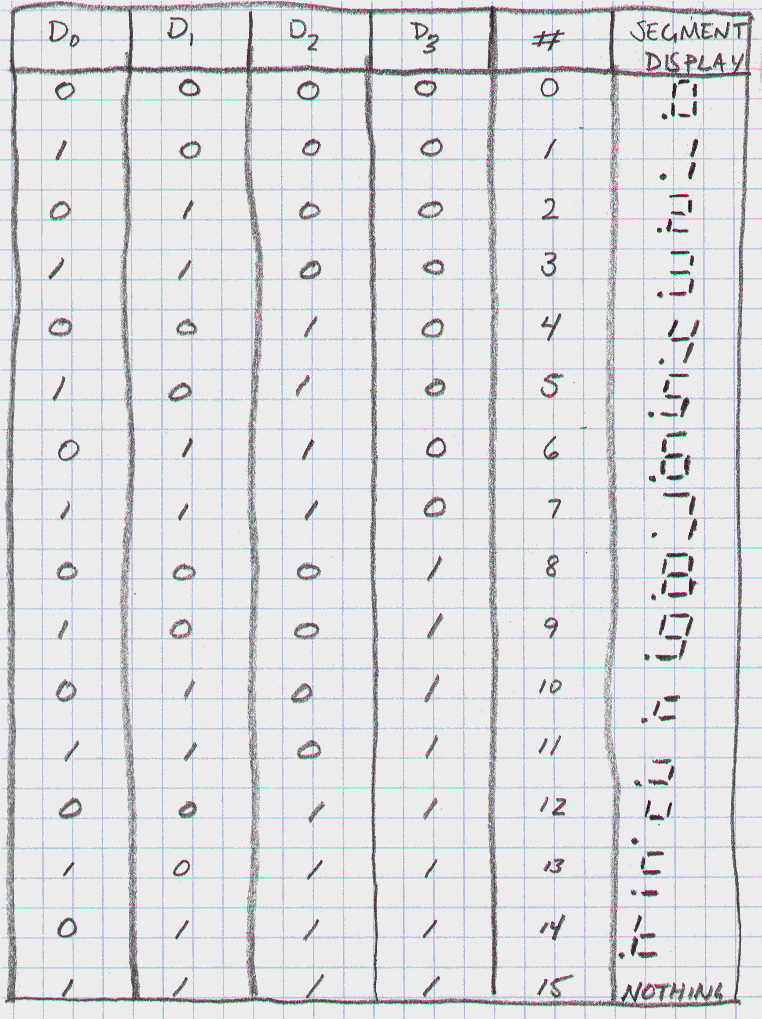
Part 3, 4 bit decoder: In the final part I set up a four bit decoder. A four bit decoder uses the binary system to create numbers and symbols. for al four switches there was a total of 16 possibilities, all of which are listed in the table below.