DIODES
Objective: the objective of this lab was to observe the principles of different types of diodes and how to use them in circuits like a diode rectifier, or a diode clamp.
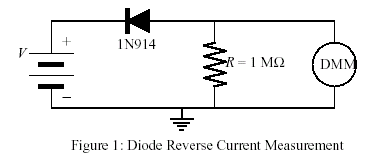
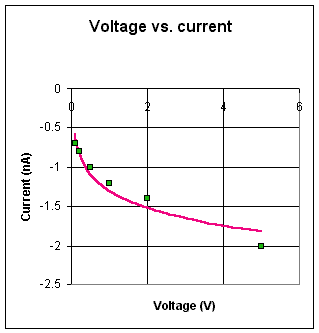
Part 1 Diode reverse current: In part one I connected the circuit below and measured the voltage drop across the resistor for various supply voltages. From this information we calculated the current through the resistor (equal to the reverse current through the diode), and the voltage across the diode.
| Supply Voltage (V) | Voltage Across Resistor (mV) | Voltage Across Diode (V) | Current Through Resistor (nA) | Current Through Diode (nA) |
| 0.1 | 0.7 | 0.0993 | 0.7 | -0.7 |
| 0.2 | 0.8 | 0.1992 | 0.8 | -0.8 |
| 0.5 | 1.0 | 0.499 | 1 | -1.0 |
| 1.0 | 1.2 | 0.9988 | 1.2 | -1.2 |
| 2.0 | 1.4 | 1.9986 | 1.4 | -1.4 |
| 5.0 | 2.0 | 4.998 | 2.0 | -2.0 |
Part 2 Zener diode: In part 2 I connected the same circuit from part one except we used a zener diode (1N750) instead of the other diode and a 1 KΏ resistor instead of the 1 MΏ resistor. The Voltage drop across the diode is equal to the input voltage minus the Voltage across the resistor. The objective of this part was to find the percent change of VZ from IZ = 5mA to IZ = 15mA. The percent change for a zener diode in this circuit is equal to [(V15mA - V5mA)/V15mA]*100%. For this circuit is 2.1% the expected value is about 1%.
| Current Through Zener Diode (mA) | Input Voltage (V) | Voltage Across Resistor (V) | Voltage Across Zener Diode (V) |
| 1.0 | 5.1 | 1.0 | 4.1 |
| 2.0 | 6.3 | 2.0 | 4.3 |
| 5.0 | 9.5 | 5.0 | 4.5 |
| 10.0 | 14.6 | 10.0 | 4.6 |
| 15.0 | 19.6 | 15.0 | 4.6 |
Part 3 Forward Diode Current: In part three I connected the circuit below and measured the voltage across the diode and the voltage across the Resistor for various Currents through the Resistor. To find how much input voltage to use I used ohms law. Then to solve for the current through the diode we used the formula ID = -VR/R.
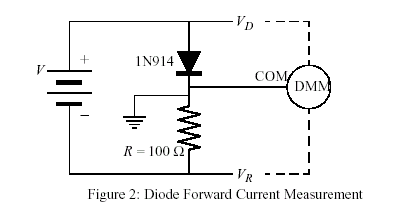
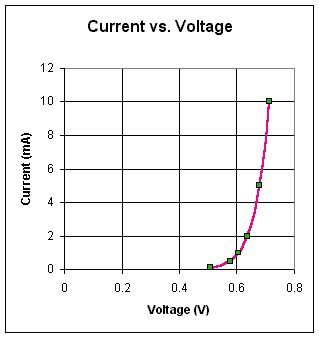
| Voltage Across Resistor (mV) | Input Voltage (V) | Voltage Across Diode (V) | Current Through Diode (mA) |
| 10.0 | 0.5 | 0.508 | 0.1 |
| 50.0 | 0.6 | 0.578 | 0.5 |
| 100.0 | 0.7 | 0.607 | 1.0 |
| 200.0 | 0.8 | 0.638 | 2.0 |
| 500.0 | 1.2 | 0.680 | 5.0 |
| 1000.0 | 1.7 | 0.715 | 10.0 |
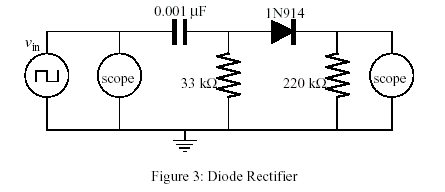
Part 4 Diode Rectifier: In this part we connected the diode rectifier circuit seen below. With the input signal from the function generator set at 1 KHz and amplitude 1 V, I observed the signal pictured below (output signal) with the resistor in place the output signal appears similar to a pure differentiated signal, but when the resistor is removed the signal lines start to straighten out. With larger resistors placed in the circuit the signal appears more an more like the pure differentiating signal, but with smaller resistors the signal begins to straighten out, and starts to look more like the third signal pictured, when the the resistor was removed from the circuit.


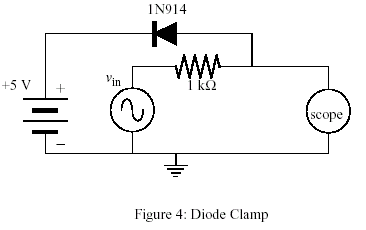
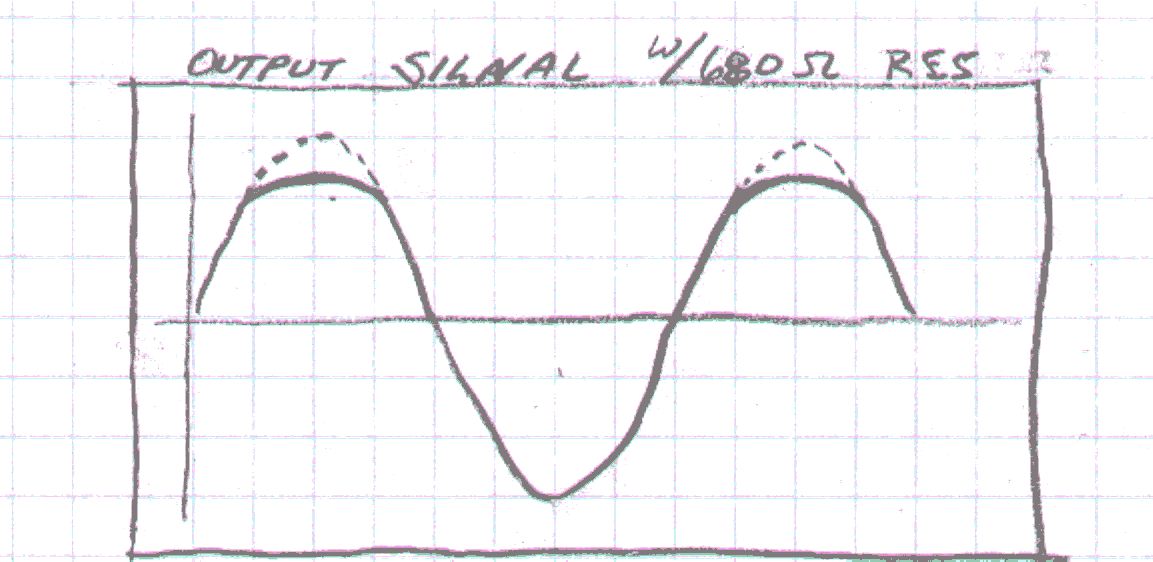
Part 5 Diode Clamp: In the final part we connected the diode clamp circuit pictured below. with the function generator set at a sin wave of 1 KHz and an amplitude of 10 V picture below (input signal) we observe a very similar output signal. The diode clamp circuit below is used to cut off the top part of the input sin wave as seen in the signal pictured below (output signal). Now after adding a 680 Ώ resistor in between the diode and power supply we observe a different output signal, instead of a straight cutoff like the previous circuit the new output signal has more of a curved clamping effect (output signal w/680Ώ res.). this is the equivalent to a 15V supply going through a voltage divider of a 2 KΏ and a 1 KΏ resistor.