

The Inter Services Yacht Club (ISYC) was originally formed in Fayid on the Suez Canal before the second world war. Snipes and Fireflies were the order of the day for the 70 members.
When the Canal Zone was evacuated in 1955 arrangements were made for the move to Episkopi in Cyprus. At this time a committee meeting was held, where it was decided that unless the new club in Cyprus was also named ISYC, then the club assets should be disposed of locally, rather than transferred to Cyprus. Hence the name we still carry to this day.
Accordingly the Fireflies and assets were transferred to Cyprus but the Snipes were sold off locally being considered too old to warrant transfer.
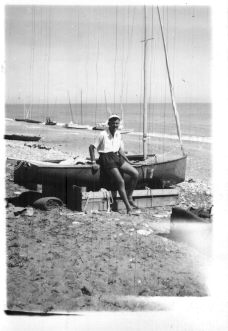
Initially the Club was set up on No 3 Beach to the East of our present location, as there was no tunnel at the time. The adjacent photo shows former member Hugh Jermyn who actually joined the Club in Egypt and helped transport the boats (Firefly 1102 in picture) to Cyprus. Note the cradles built to transport the boats from Egypt, in those days there were no launching trolleys of any sort.
The first committee meeting of ISYC in Cyprus was held on 30th November 1955, at what was then called No.4 Beach. Sharing the beach with them at the time were the RAFYC (Royal Air Force Yacht Club)and the USSC (United Services Sailing Club).
In September 1956 the first 2 Albacores were purchased and thus started a 35 year love affair with the class. The Albacores were an extremely popular class which was built up to a fleet of 12, all wooden hulled until late 1972 when 5 very tired wooden hulls were replaced with GRP hulls.
In march of 1958 the RAFYC and USSC decided to merge with the ISYC and the Club's stone buildings and beach pavillion (Shahab Dins) were built. Membership was now over 100 and regular matches were sailed against the Kyrenia and Limassol clubs. It was in this year that during a passage sail to the Limassol regatta that an Albacore was unfortunately lost.
The first reference to what we now know as "Tunnel Beach" was made in 1959. Later in that year it was decided to supplement the starting gun with a bell, which hangs on the bridge to this day. Also in this year the club bought it's first Terelene sails. In November of 1959 during a race to Evdhimou a Firefly was lost and as a result of this the club decided to purchase life jackets which were to be worn if the member was a "weak swimmer!"
In 1961 a competition was held for the heraldic design of a club flag. This was won by a Major Morgan and the design was subsequently registered with the RYA. It consists of Navy, Red and Sky Blue horizontal bands representing the three services, surmounted by a Bishops Mitre in recognition of the fact that the land the club sits on is owned by the Limassol Bishopric.
Regatta seasons in these days were really quite hectic with matches against :- Limassol Services Sailing Club (LSSC), Dhekelia Sailing Club (DSC), Limassol Nautical Club, Nicosia Nautical Club (sailed at Kyrenia), Famagusta Nautical Club, Kyrenia Nautical Club, RAF El Adam, Kuwait, Benghazi, Beirut Yacht Club and even the odd match against the United Services Sailing Club in Malta. These went on with one or two exceptions until a combination of the Defence Revue and problems in the north of the island curtailed them in the early seventies.
In the early sixties a number of clubhouse improvements were carried out including the addition of changing and workshop facilities. On the maintenance front bearing in mind all boats were at this time wooden hulls, Polyurethane Varnish was introduced.
In December of 1963 the first 4 Bosun dinghies arrived but proved to be so unpopular that by June the following year the club were trying to get rid of them. Then in July they swapped them for 7 Fireflies with DSC. In 1965 a new bar was opened and in December 1966 it was decided that ALL sailing members should wear personal buoyancy.

In 1975 the ASA took over sponsorship of the club from the RAFSA.; the glazed extention to the clubhouse was built and first references were made to the possibility of building a 'Mini Mole'. The first mole (1976)consisted mainly of beach sand and shingle being bulldozed into a mole shape. In the following winter (1977) it was almost entirely washed away.
In June 1978 the mole was rebuilt, this time including a concrete slipway, but yet again the winter storms badly damaged it. This process of mend in the summer for the winter storms to break down went on till 1982 when it was decided to rebuild it using aalmost exclusively large rocks. This was far more successful but the winter still caused some damage.
In 1980 the club bought it's first Laser dinghy, however, there were also 5 privately owned Laser's already at the club. Then in 1982 the club bought a second new Laser and followed that up in 1983 by buying 3 of the privately owned Lasers. In November 1985 3 more Lasers and a Topper were bought. This was followed by a further 5 Lasers (the blue ones)in 1986.
Mole rebuilding after winter storms.(late 70's early 80's)
It was also in 1986 that first mention was made of the suitability of Bosuns for training purposes and the first 3 (second hand) were eventually bought in 1987. These were supplemented by 2 new ones later on in the same year. These were further boosted by the arrival of 2 more new Bosuns in 1989. Also in 1989 Ladies Sailing Mornings were initiated and these have continued on and off untill present times
In November of 1989 the Army Sailing Association made 14 Kestrels available for use on the island and ISYC's share was 6, with 6 going to DSC and the remaing 2 to MTW (Military Training Wing)
1989 - Present day to follow when research completed.
Today the club exists to provide sailing experience and instruction to members of HM Forces whilst posted or detached to Cyprus. In addition a small percentage allowance is made to allow enthusiastic Ex Patriot members the privelige of sailing with fellow "Brits" at this wonderful location.
We have a fairly large fleet of boats comprising 10 Bosun's, 5 Kestrel's, 13 Laser's, 6 Topper's and our latest aquisitions 2 Dart 16's & 12 Laser Pico's.
 This page is still under construction, if you should happen to have useful information or can correct details or even have photo's of the early days please Email the address below.
