
| The
Islamic Republic of Iran covers 1,648,195 sq kms in
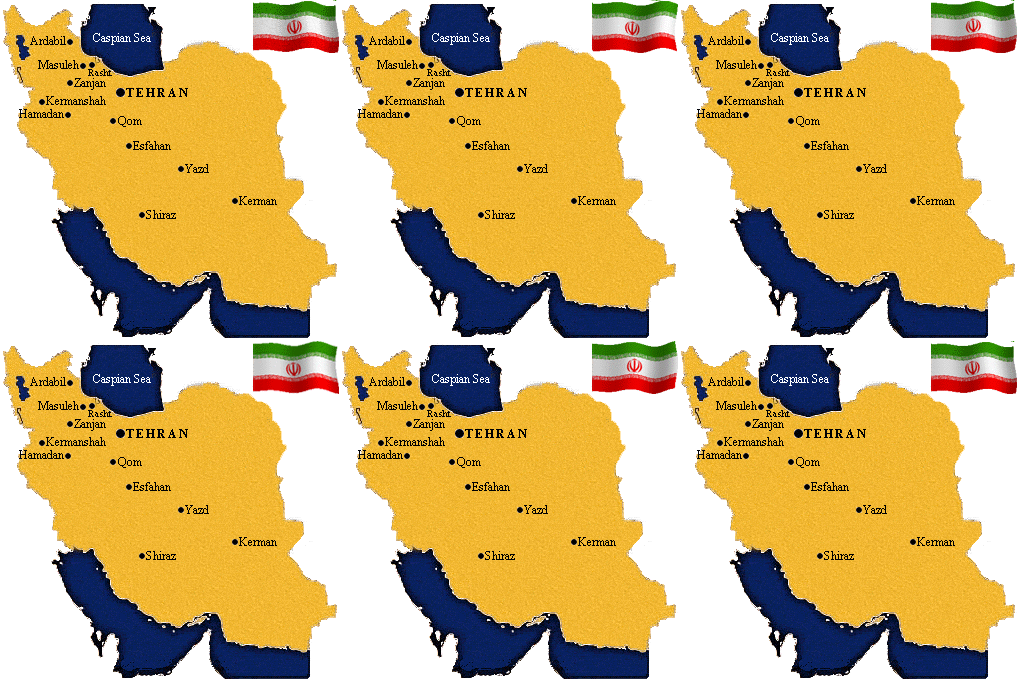
south western Asia.Its strategic position, its vast resources,including petroleum,natural gas and minerals,its population amounting to 60 millions,and its unique cultural life make it a country of high importance. Both history and geography of Iran make it a land of highly popular with visitors.The former gives it numerous spectacular monuments, and the latter make it enjoy a climate full of variety. The northern coastal region with luxuriant forests; southern coasts with forests of tidewater; deserts with their mysterious calmness; impressive lake such as Urmia, Hammun, Parishan, Ne'ur,Sama and Zarivar;and snow-clad mountains of Damavand, Dena,Karkas,Sabalan,and Tochal are among the beauties of nature, being of great appeal. |
| CLIMATE
Iran's complex climate ranges from subtropical to subpolar.It is mild and humid in the Caspian region,but warm and humid in thesouthern shores.The north-western and north-eastern areas are cold and dry, while the central part has a desertic climate.The heights of Zagros and Alborz enjoy mild weather in summer.Because of this complex climate Iran is famed for having four distinct seasons at the same time,so that one can go skiing in the northern mountains and swimming in the southern waters in the same seaeon. Plant and animal life is of great variety. Wildlife includes leopards,bears,mouflon,ibex,wild ass and wild boars.Studies have revealed the presence of a remarkably wide variety of reptiles like crocodiles and turtels. Some 200 varieties of fish live in the Persian Gulf.Sturgeon is one of 30 species found in the Caspian Sea. |
 |
 |
HISTORY
Iran is a cradle of human civilization. In the late 4th and early 3rd millennia BC Elamite civilization rose on the lowland Khuzistan, in the South-west of Iran. In the late 2nd millennia BC the Iranians migrating southward from the Central Asian Steppes,began to settle in the Iranian plateau. By the mid-9th century BC two major groups of Iraniansrose to be the dominant force on the plateau:the Medes and the Persians.In 550 BC the Persians defeated the Medes, and the Achaemenid kings appeared on the international scene. The Parthian and Sassanian dynasties ruled Iran successively. In 625 the Sassanians were defeated by the Muslim armies and the vast majority of Iranians converted to Islam,attracted by the divine teachings of this religion. After the Arab invasion of Iran, the Saffarids were the first independent Iranian Muslim dynasty established in Iran (866-903). The Samanids and the Buyids also made great attempts to bring to fruition the Iranian renaissance. In 1216 the Mongols, sweeping in with relentless fury, obliterated many Iranian cities. In the safavid period (1501-1736) when Iran gained a powerful dynasty, the country made great progress. The Afsharids and Zands were the next dynasties that ruled Iran successively in the 18th century. The 19th century, when the Qajars reigned over Iran, was a time of disintegration for the country. Many events, both internal and external, caused it to fall into decay. In 1925, after the deposition of the last Qajar shah, Reza Khan transfered sovereignty to himself. In the reign of Reza Shah and his son, Mohammad Reza Pahlavi, the increasing political and economical dependence on the western countries as well as disrespect to religious values raised hatred of people for the Pahlavi regime. This hatred was manifested in demonstrations against the government under the leadership of Imam Khomeyni in 1978., leading to establishement of the Islamic Republic of Iran in 1979. |
| CULTURAL
LIFE
Iran enjoys a cultural life of wide variety. There are several festive occasions, the most important being Naw Ruz, the Persian New Year, and the Birthday of the Twelfth Imam. The New Year celebration begins on 21st March and countinues until the 13th day of the new year, being a day for picnicking in the countryside. A tradition related to this celebration is setting seven objects being of symbolic value on a piece of cloth called "sofreh". The name of each symbol begins with a [s] sound. At the very beginning of the new year all members of the family sit at the sofreh. At the beginning of each lunar Islamic year the martyrdom of Husayn ibn Ali in 680 at Karbala, Iraq, at the hands of the Umayyads, is commemorated by passion plays, called ta'ziyeh. Being a country of great antiquity, Iran's architecture is wonderfully rich in variety. Some of its best examples are palaces of Takht-e Jamshid or Persepolis, historical buildings of Esfahan, Castle of Bam, ziggurat of Chogha Zanbil, villages of Abyaneh and Masuleh (in Kashan and Gilan respectively), and many majestic mosques throughout Iran. Carpet looms dot the country. Each locality uses a special design and quality of carpet that bears its name, such as Kashan, Kerman and Esfahan. The most widespead techniques for ornamentation are engraving, chiselling, gilding, damascening, encrustation and embossing. Potteries are also widely scattered throughout Iran. Literature is of high significance in Iran. Hafez, Sa'di, Khayyam and Ferdawsi are among great Iranian poets, being world-famous. Khayyam is known to English readers especially through the translation of his Roba'iyat (quatrians) by Edward Fitz Gerald. Hafez is considered the greatest of the Persian lyric poets. The all-weather roads, the railway system, the airports in major cities and provincial capitals, and the hotels and other accommodation facilities contiribute to the thriving of the Iranian tourist industry. The warm - hearted and hospitable people welcome the visitors. |
 |
