
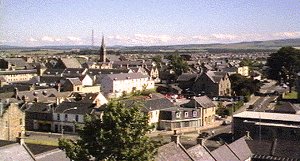
Typical Morayshire Scenery
The Life And Times.....
I was born (1946) in the Scottish town of Forres and raised in Elgin. Both
towns are in the county of Moray which is located in the north east of the
country.
Moray is now joined with the next county to the west, Nairn, for administrative
purposes and is often referred to as 'The County of Moray and Nairn'.
This page is not really about me so much as it is about the things that shaped
my life and I suppose my thinking.
Elgin is situated in 'The Laich Of Moray' which is largely an agricultural
area. The district enjoys excellent weather from that aspect and has
a rich dark soil which seems to support all types of crops that the annual
weather and temperature variations will allow. In addition to crops
the area also has some dairy farming and, to a lesser extent, various other
examples of animal husbandry.
Due to its proximity to the sea and the flat lands to the north of the city
Elgin's architecture tends to lean towards the 'sturdy'. Winters can
be quite severe for an area which is classed as 'temperate'. In the
main, the buildings in the district adhere to the same concepts. The
main building material is a light brown/red sandstone while the roofs are
generally of a natural,blue slate. These materials are attractive and
weather resistant which, together, saves the city from what could have easily
been a dour, depressing appearance.
In addition to the agricultural input to the wealth of the area there exists
various industries of which the processing of wool is a major example. The
Johnstons Mill web site gives an excellent insight
into this. Another major 'earner' for the city of Elgin is the
bottling/packaging of whisky and some aspects of this can be seen in the
Gordon & MacPhail
site.
 The area is steeped in the history of Scotland. Many of
Scotlands kings and princes were resident there at various times. The
Elgin Cathedral was founded in 1224 as the seat
of the Diocese of Moray, which had previously been at Kinneddar, Birnie and
Spynie. In 1390 the notorious "Wolf of Badenoch", son of King Robert
II, quarrelled with Bishop Alexander Bur, who excommunicated him. In
revenge he burned the Cathedral and the towns of Elgin and Forres. The
Cathedral was rebuilt and continued in use until the Reformation. In
1567 the lead was stripped from the roof by order of the Privy Council and
Regent Moray, and the process of decay began. On Easter Sunday 1711
the great central tower fell, and by the end of the 18th century the
once-magnificent Cathedral was being used as a quarry for building stone.
In 1825, however, the Exchequer assumed responsibility for the preservation
of the structure, and restoration work is still going on. When complete
this was justly regarded as the most beautiful of Scottish Cathedrals and
known as the "Lantern of the North''. Though it is now a ruin, the
visitor will not fail to be impressed by the soaring towers and intricate
traceries of
stone.
The area is steeped in the history of Scotland. Many of
Scotlands kings and princes were resident there at various times. The
Elgin Cathedral was founded in 1224 as the seat
of the Diocese of Moray, which had previously been at Kinneddar, Birnie and
Spynie. In 1390 the notorious "Wolf of Badenoch", son of King Robert
II, quarrelled with Bishop Alexander Bur, who excommunicated him. In
revenge he burned the Cathedral and the towns of Elgin and Forres. The
Cathedral was rebuilt and continued in use until the Reformation. In
1567 the lead was stripped from the roof by order of the Privy Council and
Regent Moray, and the process of decay began. On Easter Sunday 1711
the great central tower fell, and by the end of the 18th century the
once-magnificent Cathedral was being used as a quarry for building stone.
In 1825, however, the Exchequer assumed responsibility for the preservation
of the structure, and restoration work is still going on. When complete
this was justly regarded as the most beautiful of Scottish Cathedrals and
known as the "Lantern of the North''. Though it is now a ruin, the
visitor will not fail to be impressed by the soaring towers and intricate
traceries of
stone.
 To the west of the city stands the artificial hill
which was once the site of the Elgins Royal Castle which was occupied by
King Edward I of England in 1296 during the Wars of Independence. Only a
fragment of the castle now remains. The hill is surmounted by a column,
erected in 1839 in memory of the 5th and last Duke of Gordon; the statue
was added in 1855.
To the west of the city stands the artificial hill
which was once the site of the Elgins Royal Castle which was occupied by
King Edward I of England in 1296 during the Wars of Independence. Only a
fragment of the castle now remains. The hill is surmounted by a column,
erected in 1839 in memory of the 5th and last Duke of Gordon; the statue
was added in 1855.
Lady Hill derives its name from the castle's Chapel of St Mary, which continued
in use until the 16th century. The picture shows Elgin seen from Lady
Hill.
from Moray On
Line.....
http://www.moray.ac.uk/mol/moray.htm
Back to SITE MAP

