
. . . RS=2MG/c2Nowadays it is known as Schwarzchild formula, and RS as Schwarzchild radius. Starting from this RS radius photon will lost its energy just in the infinite and fall back. The formula contains M, mass of star. Its value is unknown, but fortunately cosmologists say there are only few mass-groups:
To become more familiar with black holes, let's determine radius R1, where orbiting a spacecraft one turn needs punctually 1 year. ( Formula can derived from Kepler-laws (**) )
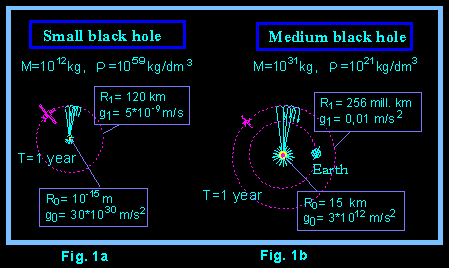 If we want photons to turn back to our orbiting rout and not to the
infinite, we have to compress black hole a little bit. The smaller
the hole, the smaller the rate we have to compress it. Giant black hole
needs 20 mill.km compression, but a medium one needs only 1 millimeter.
This emphasises the importance of gravity acceleration near surface!
It is not too high in case of giant hole
( "only" 30000 m/s2 ), but extremely high in case of small
one (30*1030 m/s2).
A compering number: g= 274 m/s2 on surface of Sun.
(On the pictures the compressed radii are marked with R0. )
If we want photons to turn back to our orbiting rout and not to the
infinite, we have to compress black hole a little bit. The smaller
the hole, the smaller the rate we have to compress it. Giant black hole
needs 20 mill.km compression, but a medium one needs only 1 millimeter.
This emphasises the importance of gravity acceleration near surface!
It is not too high in case of giant hole
( "only" 30000 m/s2 ), but extremely high in case of small
one (30*1030 m/s2).
A compering number: g= 274 m/s2 on surface of Sun.
(On the pictures the compressed radii are marked with R0. )
Some years ago BBC showed a video on life of Stephen Hawking, well known researcher of black holes. Though best physicians were listed as adviser, there were disturbing or even mistaken statements with connection of BHs. Let's analyse some of them:
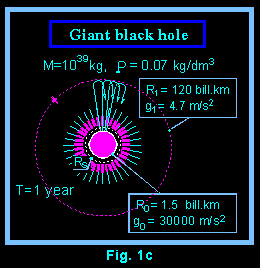
ad 1.) "Photons are drawn back ... " really means that
speed of light changes, decreases. This is the "ballistic emitter
theory of light" created by Ritz in 1904 - and denied by de-Sitter at
the same year. Speed of light is constant (c), says Theory of Relativity too.
But gravity influenceses its wave-length - and the simplest explanation that it
influenceses its speed.
 So BHs and other phenomenons show that speed of light
depends on gravity. The stronger the gravity the lower the speed of light.
(See fig. 2)
So BHs and other phenomenons show that speed of light
depends on gravity. The stronger the gravity the lower the speed of light.
(See fig. 2)
 ad 2.) I admit, a "violet mist" is just good to show somehow
"event horizon" , but there is no such a thing around BH ! Yes, maybe
there is a "barrier" for photons emitting just from surface, but this is
no barrier for a photons emitted one millimeter higher or one millimeter
lower. And it is no barrier for spacecraft or astronauts. There is no
physical law or reason to create a real barrier around BHs. Gravity
acceleration is quite small there:
ad 2.) I admit, a "violet mist" is just good to show somehow
"event horizon" , but there is no such a thing around BH ! Yes, maybe
there is a "barrier" for photons emitting just from surface, but this is
no barrier for a photons emitted one millimeter higher or one millimeter
lower. And it is no barrier for spacecraft or astronauts. There is no
physical law or reason to create a real barrier around BHs. Gravity
acceleration is quite small there:
g1(small) = 5*10-9 m/s2, . . g1(medium) = 0.01 m/s2, . . g1(giant) = 4.7 m/s2.There is another basic problem with "event horizon" :
no reason to suppose that medium and giant BH will stop contraction
for the sake of our "1 year rout". Surely they became smaller and
smaller. There is not known physical effect nowadays to stop this
process and, parallel with compression "event horizon" will very quickly
approach BH surface. I believe that it is a recklessness statement to
take the difference more than 1 meter. (All this destroys figures showed
above, I admit. But onward we will put aside this fault and go ahead on
the naive way suggested by statements of video-film and pictures above.)
ad 3.)
A spacecraft can easily move to and fro across event
horizon with aid of its relatively weak rocket-engine and, finally can
left this area using as few fuel as low the value of gravity is there.
And no change in its rout if a heavenly body crosses this theoretic
barrier: it will continue its elliptic or hyperbolic way without any
abashment.
.
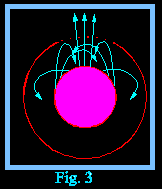 ad 4.)
The statement is simply untrue: astronaut inside will
see astronauts outside, as he will not be yet on the surface. He will
see stars too. Will be light-beams curved, if astronaut is on his
half-way? Hardly not, because gravity is relatively weak there.
ad 4.)
The statement is simply untrue: astronaut inside will
see astronauts outside, as he will not be yet on the surface. He will
see stars too. Will be light-beams curved, if astronaut is on his
half-way? Hardly not, because gravity is relatively weak there.
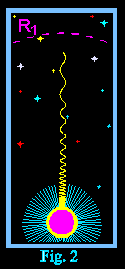
The "partly closed" event horison is an often cited imagination. (See Fig. 3) Photons, which started in perpendicular direction can escape, but others, which started slantwise, can't. This claim misses the target because of missing the scale. As height of event horizon is always very small, none of photons will escape. But this figure is just good to present that notion and even place of event horizon is not at all exact.
ad 5.) "Four weeks to fall"? - Maybe yes - maybe no . . (maybe rain - maybe snow . . ) If surface R0 and "event horizon" R1 of BH are just in proper distance (fare enough) - why not! But four minutes or even four mill-seconds would have been closer to reality. The "four weeks" data suggests quite false imagination.
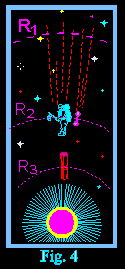 ad 6.) Statement "his body will be lengthen" seems to be
bizarre, but it is surly true! Near black hole change of gravity
is also very big. Let's suppose that gravity grows 100 m/s2
in every meter. Distance of upper and lower part of astronaut is cca. 0.5
meter and his body mass is cca. 100 kg. Then his waist will be pulled
(and lengthen) by as much as 2500 newtons gravity force. As figure 4
shows this occurs at R2= 1870 km above surface.
ad 6.) Statement "his body will be lengthen" seems to be
bizarre, but it is surly true! Near black hole change of gravity
is also very big. Let's suppose that gravity grows 100 m/s2
in every meter. Distance of upper and lower part of astronaut is cca. 0.5
meter and his body mass is cca. 100 kg. Then his waist will be pulled
(and lengthen) by as much as 2500 newtons gravity force. As figure 4
shows this occurs at R2= 1870 km above surface.
This
extreme force grows exponentially and at R3= 250 km it will
tear in half an iron beam, if it is as tall as an astronaut. At the
surface this force becomes million times bigger and tears this iron
beam to bits (maybe atoms).
ad 7.)
BH swallows just
as much matter nearby as common stars do - no more and no less. They
work under the very same physical law - i.e. gravity. They are unable
to capture a heavenly body alone, a third big mass is needed to do so,
just as case of common stars. Clouds of dust or gase are other case.
They have inner friction, lost speed and are captured later.
Effects depend on volume of central- and nearby masses only, nevertheless
a common star or BH is in the centrum. Luminous swirling clouds or short
period stars rotating around an invisible centre prove only the presence
of an unidentified big mass and not the presence of the theoretical
creature, BH.
ad 8.) Tunnel effect is best known in case of electrons. The so called "physical vacuum" borrows energy subatomic particles getting over obstacles. In case of photons this effect is unknown. But if so, no reason that pairs of positrons and electrons - to be birthed by escaped gamma-photons at theevent horizon - can overcome gravity field of a giant black hole and escape.
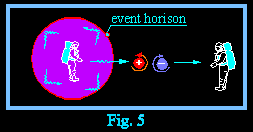 Another interesting but unproved theory that electrons escape, but
positrons fall down. ( An often quoted figure is something like Fig. 5)
As positrons are supposed to have negative mass ( ? ) and negative energy
( ?? ) so they are promising creatures for theoreticians to get rid of
rotation and heat of BHs. . . Well, let us make a small calculation!
One kilogram positron has 1.7*1021 coulomb positive charge.
Capacity of a medium BH - as spherical condenser - is 1.6 micro-farad.
(***) So one kilogram positron would cause 1027 volt voltage
at surface of BH. This huge voltage will push further positrons away
and pull electrons backward.
Another interesting but unproved theory that electrons escape, but
positrons fall down. ( An often quoted figure is something like Fig. 5)
As positrons are supposed to have negative mass ( ? ) and negative energy
( ?? ) so they are promising creatures for theoreticians to get rid of
rotation and heat of BHs. . . Well, let us make a small calculation!
One kilogram positron has 1.7*1021 coulomb positive charge.
Capacity of a medium BH - as spherical condenser - is 1.6 micro-farad.
(***) So one kilogram positron would cause 1027 volt voltage
at surface of BH. This huge voltage will push further positrons away
and pull electrons backward.
There is one more hidden statement at
Fig. 5. It shows a positron with an anti-clockwise spin and an electron
with clockwise spin. Wrong imagination! Both particle have both spin
direction, in 50-50% distribution.
So spin of positrons are not suitable
to stop revolving BHs.
ad 9.) To become as cool as
absolute zero?

.
In my opinion
there are too much suppositions in theory of BHs, house of cards is too
high. Science often quotes 'Ocham's razor principle', well known and
really useful: "Don't increase number of new parameters superfluously.
Use maximum one!" In theory of BHs there are dozens of new parameters
. . . Yes, they are maybe necessary. But to tell everybody that
theory of BHs is full of unproved suppositions - it is also necessary.
| Safe of Protected Minds Bureau - SPMB - certificates all details below : | |||||
|
PROTECTED MINDS:
BHs and other phenomenon show that speed of light depends on gravity.
A spacecraft can easily move to and fro across event horizon.
BH swallows just as much matter nearby as common stars do - no more and no less.
Spin of positrons are not suitable to stop revolving BHs.
BHs can't get rid of heat!
Theory of BHs is full of unproved suppositions.
|

| |||
(*) Epot = Ekin ;
. . . - G*M*m*( 1/R0 -
1/RS) = m*c2/2 ;
. . .
R0 = inf., . . .
G=6.67*10-11, . .
RS = 2*G*M/c2
(**) Fgrav = Fcentr ;
. . .
G*m*M/r2 = m*r*omega2 ;
. . .
omega = 2pi/31558000;
. .
 . .
. . Physics, Relativity, Cosmology |
remark, opinion
. . .
|
. . forward, I hope! . . Thomas-t |

