
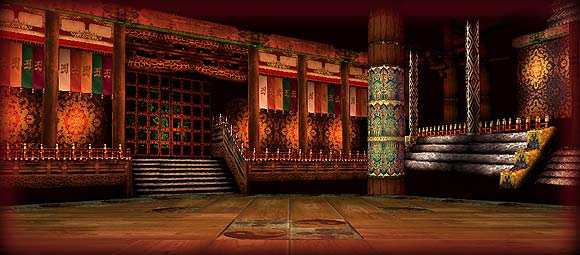
The Hoko Temple was constructed in Kyoto under the auspices of Toyotomi Hideyoshi, a ruler of Japan during the 16th century. Although the temple was officially intended to be a place where Buddhist monks could pray to bring peace and stability to the nation, the temple has a secondary, ulterior role as a focal point of a "katana-gari" campaign to quell the peasant-led uprisings that occurred frequently druing that era.
(Japanese Historical Note: "Katana-gari" was part of a political policy to remove weapons like katanas away from all people with the exception of the samurai nobility and to establish a rigid feudal class system. Until that time, there were no strict social boundaries between soldiers (samurai), merchants (sho-nin) and farmers (no-min). This is why Mitsurugi, who once was a peasant, could rise to the ranks of the samurai-class. After this rigid feudal policy was instituted, farmers were prohibited from bearing katana, and therefore effectively eliminated the ability of the lower classes to improve their place in society.)
Toyotomi felled thousands-year-old cedars to make the central support pillars of the temple and used iron from weapons confiscated through the katana-gari to create the giant Buddha statue. Unfortunately for Toyotomi, these materials used in the construction of the temple proved to have evil karmic consequences. The destruction of the old-growth cedars was equivalent to the killink of an ancient life force. In addition, the blood of the victims killed by the weapons cursed the iron.
It was only natural that this place bore the seeds of disaster and became the source of misfortune for the Toyotomi clan.
