
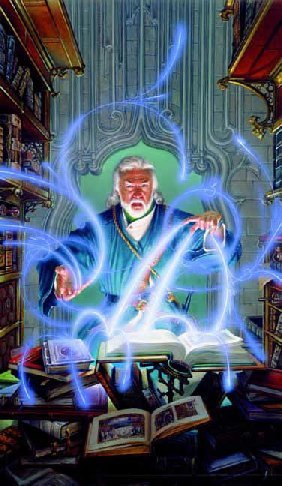
Spending their lives in pursuit of arcane wisdom, wizards have little time for physical endeavors. They tend to be poor fighters with little knowledge of weaponry. However, they command powerful and dangerous energies with a few simple gestures, rare components, and mystical words. Spells are the tools, weapons, and armor of the wizard. They are weak in a toe-to-toe fight, but when prepared they can strike down their foes at a distance, vanish in an instant, become a wholly different creature, or even invade the mind of an enemy and take control of their thoughts and actions. No secrets are safe from a wizard and no fortress is secure. Their quest for knowledge and power often leads them into realms where mortals were never meant to go.
Wizards cannot wear any armor, for several reasons. Firstly, most spells require complicated gestures and odd posturings by the caster and armor restricts the wearer's ability to do these properly. Secondly, the wizard spends their youth (and will spend most of their life) learning arcane languages, poring through old books, and practicing their spells. This leaves no time for learning other things, such as learning how to wear armor properly and using it effectively. If the wizard had spend their time learning about armor, they would not have even the meager skills and powers that they begin with. For similar reasons, wizards are severely restricted in the weapons they can use. They are limited to those that are easy to learn or are useful in their research. Hence, a wizard can use a dagger or a staff, items that are traditionally useful in magical studies. Other weapons allowed are darts, knives, and slings.
Learning and casting spells require long study, patience, and research. Once a wizard's adventuring life begins, they are largely responsible for their own education, they no longer have teachers looking over their shoulders telling them what spell to learn next. This freedom is not without its price, however. It means that the wizard must find their own source for magical knowledge: libraries, guilds, or captured spellbooks and scrolls. All a wizard's spells are kept in their Spellbook. The spellbook is the wizard's diary, laboratory journal, and encyclopedia, containing a record of everything the wizard knows. Naturally, the spellbook is a wizard's most treasured possession; without it they are almost helpless.
A spellbook contains the complicated instructions for casting the spells the wizard knows. Merely reading these instructions aloud or trying to mimic the instructions does not enable one to cast the spell. Spells gather and shape mystical energies; the procedures involved are very demanding, bizarre, and intricate. Before a wizard can actually cast a spell, they must memorize its arcane formula. This locks an energy pattern for that particular spell into the wizard's mind. Once this spell is memorized, it remains in the wizard's memory until the wizard uses the exact combination of gestures, words, and materials that trigger the release of this energy pattern. Upon casting, the energy of the spell is spent, wiped clean from the mind of the wizard. The wizard cannot cast that spell again until it has been rememorized from the spellbook once again.
Initially the wizard is able to retain only a few of these magical energies in their mind at one time. Furthermore, some spells are more demanding and complex than others; these are impossible for the inexperienced wizard to memorize. With experience, the wizard's talent expands, enabling them to memorize more spells and more complex spells. Still, the wizard never escapes the need to study the spellbook to refresh their powers.
Wizards begin with the ability to memorize and cast three (3) 0 Level spells per day. As they advance in experience, they are able to memorize and cast more spells. A listing of spells can be found on the Magecraft page.
