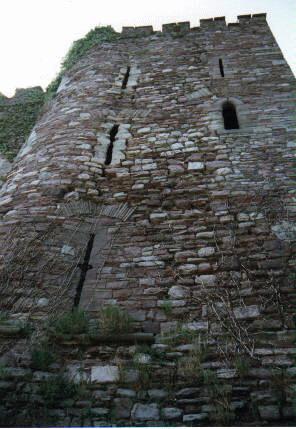
What Is A Castle???
In the early Medieval period in
Wales and the border up to 1282,
castles in the true sense of the
word, were for defence. Other
buildings more like country houses
were built where the primary
function was living accommodation.
Not surprisingly these lightly
fortified houses were built away
from the dangerous frontiers.
Obviously such distinction between
fortresses and fortified houses still
existed though now it is often
difficult to tell what was the
difference then. Today it is
possible, indeed easy to distinguish between
a country mansion and a country
cottage. However the differences between a converted
farm house and a small
mansion might not be so easy to define. The
same is true with castles. They were
all individual expressions of ideas. The word
castle covers a broad spectrum of
structures. This is as true now as it was then.
One man's castle was another man's
home! It is noticeable too that in the Domesday
Book there are references to
enigmatic fortified houses as well as to castles.
Such a distinction was obviously as
valid and as dubious then as it is now.
Castles were not built to any pre-conceived
rigid plan as Roman forts once were,
rather they took advantage of any existing defensive
features. They are often
found at the end of ridges, on hill tops, at
the junction of rivers or in marshy
ground, all of which offered immediate advantages
to the defender. Once the
position had been chosen, elements were added
to make the defensive attributes
of the site greater. A large ditch might be
dug and powerful ramparts built with
the resultant spoil. Often a huge mound of earth
called a motte would be made to
dominate the area. Timber works might be built
on or in these earthen defences,
sometimes a palisade round the edge of the ditch
and on top of the rampart. Then
a wooden tower might be built on or, in several
cases, within the motte.
A castle was primarily a military
structure, occupied by its masters on
their continual perambulation of their
territories. When the lord was not in
residence the castle was looked after by
a constable and one or two paid soldiers.
In time of war the garrison would rapidly
be augmented by the local populace and
landholders who owed military service to
their lord for the privilege of holding
their lands. This may seem haphazard
today, but at that time it was impossible
to move a large attacking force quickly,
therefore a castle garrison had time to
form the defence. Generally the feudal
military land obligation was a period of
service at the tenant's own cost,
sometimes in person, sometimes by a
certain number of knights, mounted
infantry, bowmen or footmen for a set
number of days. Initially the service was
for 40 days and the knights were accommodated
in their own houses in the castle,
but as these fees, as they were called, were
split amongst co-heirs the amount of
service would diminish and by the thirteenth
century many obligations were down
to just a few days. For a lord wishing to undertake
military operations such a
piecemeal and part-time army was obviously less
than satisfactory, and so as time
went by military obligations tended to be relinquished
and replaced by a cash
payment, generally known as scutage or shield
money. This enabled a lord to hire
professional armed forces who would fight whilst
pay was forthcoming and not go
home at times of vital need simply because the
length of service they owed to
their lord was expended.
When it came to castles proper, the defensive
quality of the building was
paramount to a lord, his splendour in residence
came second. In the early days
lords were itinerant, moving from place to place
with their increasingly large
retinues and consuming the foodstuffs of the
district at, for the local populace, an
alarming rate. A lord could not stay in one
place simply because of the cost to the
local community. He would literally eat them
out of house and home. Loyalty to
the lord, especially in the early days, was
strictly personal and if the lord did not
show his face to his vassals often enough they
could turn to another lord for
protection and advancement. This problem was
especially rife in the Marches of
Wales when often several barons, Norman and
Welsh, claimed the same piece of
land.
The castles of Breconshire were primarily fighting
castles. Few were built with
comfort or accommodation in mind. Their purpose
was to keep the flag flying
whilst massive military forces were built up
to destroy the attackers. In the
Middle Ages most battles were not just random
clashes between armed bands,
almost inevitably they were clashes between
besiegers and those attempting to
relieve the besieged. The bloody campaigns that
will be related below clearly
show the changing military designs over two
hundred years of nearly continuous
warfare, when Breconshire was part of the Middle
March of Wales.
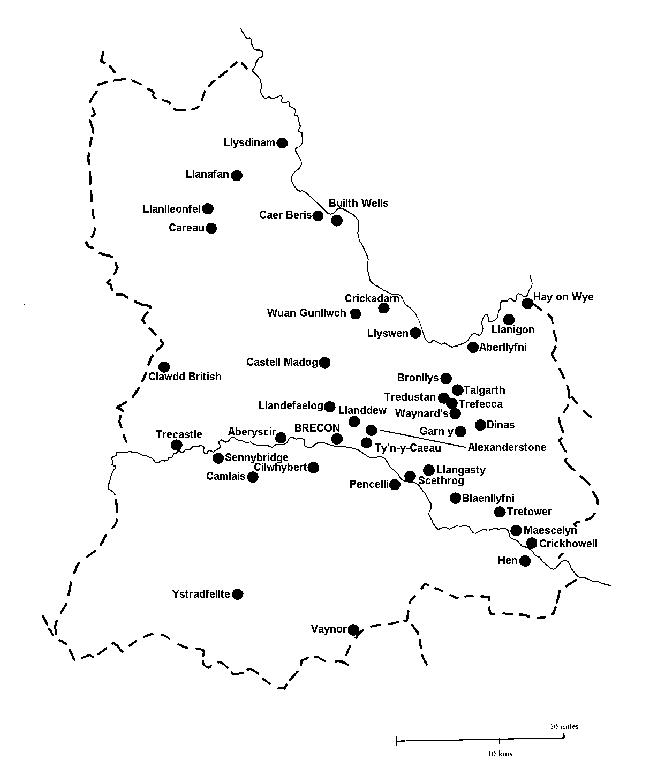
Below: map of the 12th-century castles of Breconshire
 Many castles in Breconshire are of the type
called motte and bailey, that is the
large steep-sided conical mound with a defensive
enclosure at its base. Later, or
sometimes simultaneously with these constructions,
stone elements were added to
the castle. Sometimes a stone gateway, the most
vulnerable part of the castle,
sometimes a stone tower on or in the motte and
nearly always at some time in a
castle's life, wooden or stone accommodation
was added in the bailey. The lack of
such accommodation could well prove disastrous
for the garrison, especially in a
bleak winter such as that at Cefnllys Castle
in Radnorshire during the campaign
of 1262.
The main purpose of the castle can therefore
be seen to have been military.
Accommodation on the frontier was of secondary
interest to self-preservation, as
it has always been. It was only later, with
the pacification of a district, that the
castle was abandoned, for new, cheaper and more
homelike surroundings, for it
was often far too costly and difficult to convert
the cold, dark and forbidding
fortresses into comfortable country residences.
This is why we often find a manor
house or farm adjacent to a castle ruin. But
the old castle was still there just in
case - a kind of insurance policy. This is superbly
illustrated in Breconshire by the
fine examples of Tretower Castle and Court,
standing within easy distance of one
another. The castle itself is interesting, having
in its life changed from castle to
home to castle again. In 1403 the Berkeley owners
of the court refurbished the
old castle walls in hope of self-preservation
as well as obedience to the royal writ.
The castle, itself already well over three hundred
years of age was still fulfilling
its original military purpose. The desperate
actions of the castle's defenders
would have been echoed on numerous other occasions
in other unrecorded
sometimes hopeless actions down through the
centuries.
Below: Brecon Castle
Many castles in Breconshire are of the type
called motte and bailey, that is the
large steep-sided conical mound with a defensive
enclosure at its base. Later, or
sometimes simultaneously with these constructions,
stone elements were added to
the castle. Sometimes a stone gateway, the most
vulnerable part of the castle,
sometimes a stone tower on or in the motte and
nearly always at some time in a
castle's life, wooden or stone accommodation
was added in the bailey. The lack of
such accommodation could well prove disastrous
for the garrison, especially in a
bleak winter such as that at Cefnllys Castle
in Radnorshire during the campaign
of 1262.
The main purpose of the castle can therefore
be seen to have been military.
Accommodation on the frontier was of secondary
interest to self-preservation, as
it has always been. It was only later, with
the pacification of a district, that the
castle was abandoned, for new, cheaper and more
homelike surroundings, for it
was often far too costly and difficult to convert
the cold, dark and forbidding
fortresses into comfortable country residences.
This is why we often find a manor
house or farm adjacent to a castle ruin. But
the old castle was still there just in
case - a kind of insurance policy. This is superbly
illustrated in Breconshire by the
fine examples of Tretower Castle and Court,
standing within easy distance of one
another. The castle itself is interesting, having
in its life changed from castle to
home to castle again. In 1403 the Berkeley owners
of the court refurbished the
old castle walls in hope of self-preservation
as well as obedience to the royal writ.
The castle, itself already well over three hundred
years of age was still fulfilling
its original military purpose. The desperate
actions of the castle's defenders
would have been echoed on numerous other occasions
in other unrecorded
sometimes hopeless actions down through the
centuries.
Below: Brecon Castle
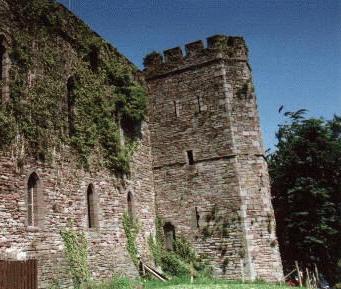 Below: the tower at Brecon Castle