
Lab #4 - Transmission Lines
Part 1 - Coaxial Cable Speed
A function generator producing a 50 Ohm output square wave, an oscilloscope, and a long cable were connected in a circuit. Without the cable being connected, the frequency was set to 200 kHz and the amplitude to 1 V. The duty cycle was then turned on and adjusted so that the square wave was high for 1 microsecond and low for the remainder of the time. The cable was then attached and the signal shape looked similar to the following.
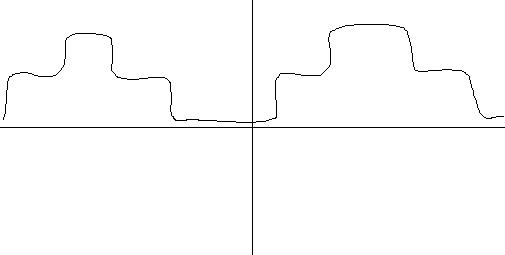
Using the cancelation with the reflection to estimate the time for the signal to travel the length of the cable and back again found that the it took the signal 0.26 microseconds to make the trip. Since a 100 foot cable was used, we can say the signal was traveling at 3.85 x 10^8 ft/s. This is about 40% the speed of light.
Part 2 - Coaxial Cable Impedance
The same circuit from part 1 was used, but with various resistors in place of the load resistors. The amplitude of the reflection was then measured.
| Resistor (Ohms) | Amplitude (Volts) |
| 10000 | 2 |
| 330 | 1.2 |
| 100 | 0.6 |
| 47 | -0.2 |
| 22 | -0.8 |
| 10 | -1.28 |
| 0 | -2.1 |
From looking at this data table, thedata shows that the impedance of this cable is between 47 and 100 Ohms, closer to 47 Ohms. This matches up with the expected value of 50 Ohms for the cable.
Part 3 - Stereo Speaker Cable
Parts 1 and 2 were then repeated with a stereo speaker cable instead of a coaxial cable.
Time Needed by Signal to Travel the Wire = 2.4 x 10 ^ -7 Seconds
Speed of Signal = 2.2 x 10 ^ 8 ft/second
| Resistor (Ohms) | Amplitude (Volts) |
| 10000 | 2 |
| 330 | 1.9 |
| 100 | 1.4 |
| 47 | 1.0 |
| 22 | 0.8 |
| 10 | 0.6 |
| 0 | 0.3 |
