
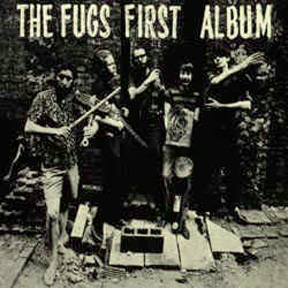
The Electric Circus began as a popular New York nightclub, complete with pulsating lights, fragmented pieces of movies, colored patterns and slides sweeping the mirrored walls, strip lighting writhing on the floor, flashing on and off like a demented snake who's swallowed phosphorus. It was the hippest place in New York for the affluent celebrities, artists and social climbers to be seen. The downstairs section was turned into a bar called the Dom. According to Ronald Sukenik in Down and In: A History of the Underground, the entire Lower East Side, "all the painters, all the poets, everybody in the world showed up." There was no attraction except nickel beer. The glorified basement began hosting live jazz and bands that played back in the larger room for dancing. Upstairs the Electric Circus was still going, but had changed from being a Jackie Onassis celebrity place to being a kids' place. Black kids replaced many of the white East Villagers to listen to the jukebox stocked with soul music. In late 1964, when the Beatles had just hit America, the Fugs (pictured above) were conceived in the dark recess of the Dom. Originally attracted by the poetry readings, Ed Sanders (proud publisher of a literary magazine called Fuck You, A Magazine of the Arts) and Tuli Kupferberg were two like-minded vermin who together spawned the unofficial origins of "underground" music. The group worked out their material in other venues like Slug's and the MacDougall Street Theatre in Greenwich Village. They invented outrageous dances like "The Turkey Gobble" to go along with their songs, released on the debut album in 1965 on the small jazz-oriented ESP label. The label rejected the second set of songs as too offensive. Later released under the title Virgin Fugs, the album epitomized the Fugs' sense of humor and satire. By making fun of commercial culture ("Caca Rock" and "I Saw the Best Minds of My Generation Rot" written by Allen Ginsberg) and government institutions ("CIA Man" and "Kill For Peace"), the Fugs displayed a healthy disrespect for nearly everything, or an unhealthy anti-social attitude, depending on your perspective. The few things that deserved their respect consisted of the drug and sex culture of the Lower East Side. Songs like "New Amphetamine Shriek" and "Saran Wrap" bluntly and humorously (again, depending on your perspective) brought them to new heights of obscenity. Sanders later became better known as the author of The Family, a book on Charles Manson. The band inspired many lesser-known contemporaries such as Dave Peel & the Lower East Side, who produced such infamous songs on the album, The Pope Smokes Dope, like "The Chicago Conspiracy," "I'm A Runaway," "The Birth Control Blues," and "I'm Gonna Start Another Riot." Another band to play at the Dom, was The Velvet Underground (pictured below). Lou Reed previously worked as an assembly-line songwriter for Pickwick records, and published Delmore Schwartz-influenced poetry in Fusion magazine. By 1965 he had already written future VU classics "Heroin" and "Waiting for the Man." He met John Cale at a party and played his songs with an acoustic guitar. Cale was not interested in "folk music." But he soon realized that Reed's urban-realist lyrics had less in common with Bob Dylan and Joan Baez, and more with La Monte Young's avant-garde experiment in dissonance, The Dream Syndicate, which Cale discarded his classical studies in viola to be a part of. The concept of the group was to sustain notes for two hours at a time, an endeavor that was undoubtedly fueled by the acid, opium and grass that La Monte was dealing. They rehearsed seven days a week, six hours a day, until the end of 1965, when Cale started rehearsing with Lou Reed and named their band after a paperback book about sadomasochism written by Michael Leigh in 1963. 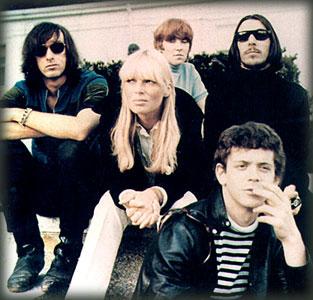
By 1966, Reed, Cale, Maureen Tucker and Sterling Morrison had secured a residency at the Café Bizarre, a strange, touristy club with large drinks that contained ice cream and coconut fizz. Paul Morrissey, an associate of Andy Warhol, caught the Velvet Underground and decided it would be good publicity for Andy to manage a rock 'n' roll band. After much persuading, Warhol swanned into the Café Bizarre, and was immediately hypnotized by the eccentric group of people singing about heroin and S&M to unsuspecting tourists. According to Morrissey, he secured the deal with Reed and told Warhol, who responded with "Oh uu-uu-uuuu . . . okay." Once the management of Bizarre figured out what the Velvets were actually singing, they fired them. Paul Morrissey felt that Lou Reed was an uncomfortable performer, and they needed another singer. He thought of Nico, whom he had met in Paris, and had cut a record with the Rolling Stones' manager, Andrew Loog Oldham. She added a lot of celebrity cache, as she had had a substantial part in Fellini's La Dolce Vita, and had supposedly dated Brian Jones and Bob Dylan, who's "I'll Keep It With Mine" was supposedly written for her. Reed was reluctant, but Cale talked him into accepting her. He ended up letting her sing only three songs, however. The Velvets were now part of Warhol's multi-media freakshow unit, The Factory. Warhol put them on his touring "total environment" show, The Exploding Plastic Inevitable. He made many films, featuring random people who Warhol called "Superstars." Instead of sharing The Fugs' sense of humor, the Velvet Underground relied on their detailed studies of urban realism, with the powerful interpretation of addiction in "Heroin" (notably lacking any comfortably instructive moral) and "I'm Waiting For The Man." Friends and scenesters like Danny Fields convinced Reed and Cale that the slide projections and polka dot light shows were corny compared to their powerful music. After firing Warhol, who understandably preferred more artificial dwellings, they recorded the relentlessly abrasive White Light/White Heat in 1968, featuring the epic "Sister Ray," an unprecedented orgy of squalling noise. After pushing their sound to particularly unbearable limits at a club housing a psychiatrist convention, the band members were offered free counseling. While they eventually became much more influential than The Fugs, their jubilant yet brutal sound and imagery prevented them from selling any more albums on Verve than The Fugs sold on ESP. (Click on More Punk To Continue) |
