
|
|
|
|
|
|
|
WWW.JOHNBALDWINMUSIC.COM |
|
|
CD |
WRITINGS
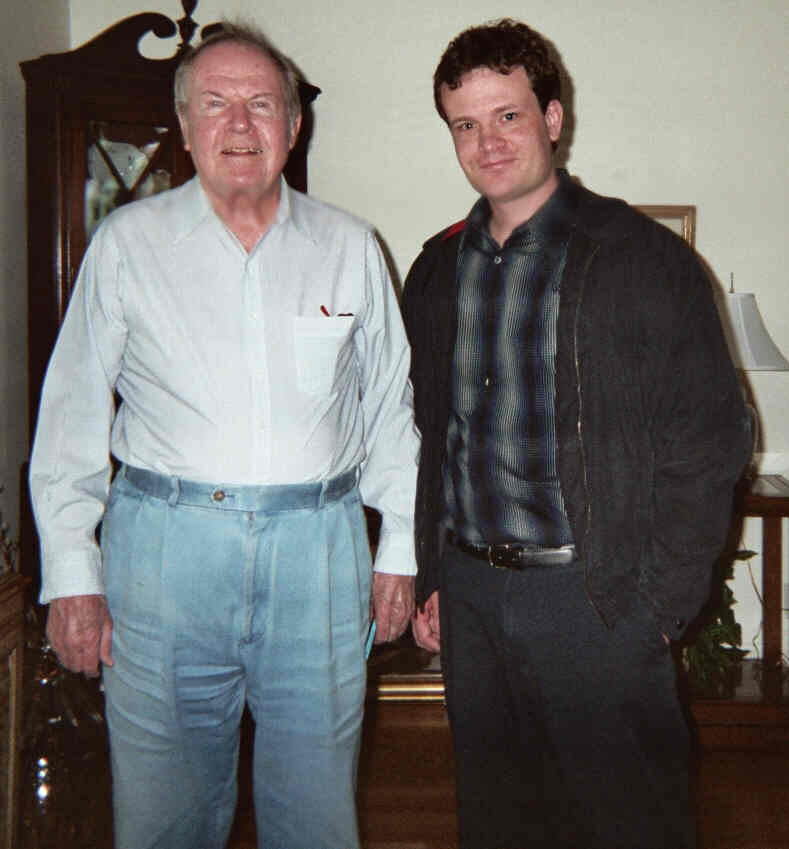
"Tommy Newsom interview full transcript by John BaldwinJune 2006 Mace and Crown Newspaper: Old Dominion University, Norfolk, VA
For permission publishing parts of this article
contact
baldwinmusic@yahoo.com
John Baldwin: On the last Tonight Show, Johnny Carson said that with you guys leaving 'television is gonna lose the last big swing band in the world.' Would you comment on the state of the big band in today's culture and where it is headed? Tommy Newsom: I wish I had a crystal ball. I don't think it will ever go away completely. But the fans of the big bands are going away. JB: They're growing older
then? TN: Yes. They're going wherever they go. We went to hear the Glen Miller Band the other night. Actually, I heard the original Glen Miller Band when I was 12, and that was a gas. They were so proficient and really polished. Excellent. They were the hot band of the time. I think it was 1942. Of course, by the end of the war the bands had started to disappear. And by the end of the 40's the bands had really diminished. And it was a continuing process. Some guys held on for years: Count Basie, Duke Ellington, Woody Herman. There are some current bands. Like in New York the all-girl band Diva. They're hot! They're a dynamic band. And I think Maria Schneider has a big band. She's kind of avante garde. The Diva band is more modern but they still have an element of the hot swing band. If people hear that stuff they really like it. When I was growing up it was on everything, on the radio all the time. In
every beanery or drugstore they had jukeboxes you could play for a nickel. The world was full of that music. Now you have to search for it. There's a big, big difference. I hope they can hang on because it means that we might still have some good melodies. In today's culture the melody is hard to come by. JB: Big bands are still alive in the military. TN: Oh yes! That's really one of the best sources of employment for those who want to play music. I did that. I was in the Airmen of Note for three years. That changed my life. I was going to be a school teacher but the band was so good that I said 'I've got to try this, see if I can make a living doing it,' and I got lucky. It worked out. We had an excellent band. I was there from 53 to 56. We were just good. For instance, the first month I was in that band we went to New York and played a TV show. I said 'Geez, this is great!' They put us up in a hotel. It wasn't
like being in the military. It's great but the trouble is they've got you. If they want to send you to Iraq, you go. The lead trumpet player with Diva is a member of the army blues band. They let her go and play gigs with Diva. But she's been over to Iraq a number of times. So you take your chances. But try walking across the street. You're taking a chance there. JB: To get in the military bands you really have to be a top notch player, don't you? TN: Yes. I think they're better than ever nowadays. Of course they always were high quality. The dance bands are better. The Airmen of Note today is better than the one I was in. I don't particularly care for their choice of music. But I'm from another era. Music is like that. It's generational. Each generation has its own music. It goes on forever. JB: You went to ODU, which was a division of William and Mary at the time.
Was ODU generally a liberal arts college when you went there? TN: It was a junior college. It was called the Norfolk division of William and Mary and UPI at the time which is now Virginia Tech. JB: Did you study music there? TN: They did have some music classes. But I started as an art student. When I saw a couple of the students really had it, I knew I didn't have it. It's clear as a bell with pictures. So, the second year I was at William and Mary (ODU) World War Two had just ended and all the GI's were coming in on the GI bill. All the guys were getting out of the service. They had this rush of people with temporary barracks all around. Like public school is nowadays. They started a music program. They had harmony, ear training, music history, the beginings of a music program. With all those guys coming back we ended up with a great band. We had the best band that I was ever in
from this area. We played for nothing half the time just to be playing. It was great! In fact, that was the best band I was in until I got in the Airmen of Note. After William and Mary I went to Peabody Conservatory in Baltimore. But that was all classical. They didn't recognize saxophone or guitar. It was not an instrument. JB: It seems that Berklee is the only one emphasizing jazz harmony. TN: Yes. Berklee is well regarded. I know quite a number of people that go on there. They get a good grounding there. There's a prejudice against jazz harmony. It wasn't respectable years ago. We had a student dance band when I was at Peabody. But one of the students put that together. We just played little gigs. They taught standard European conservatory style, which is great. You need that stuff. I'm glad I went through that. I studied counterpoint and orchestration. All of it you
learn by doing anyhow. But it's good to go through that standard training. It opens your mind up. Like writing bass lines. In the dance band era the bass or the bass trombone always played the root of the chord. But classical expanded my musical palette. It frees up the movement of the bass so you'll make more interesting choices. JB: Did this work itself into your arranging? TN: I think some of that got in there. The secret is to write every day just like you practice your horn. If you write every day you get some chops. You get some flow. It's like a muscle that needs to be worked. The big time guys they wrote hundreds, thousands of tunes. All of them didn't make it. But all you need is a few and you're straight! It's nice if you have that ability. It's a wonderful thing. JB: Was arranging and rehearsing the Tonight Show band a lot of work? TN: It
was easy. And at times it was hard. Having run for so many years it was like an assembly line. They had the talent coordinators, these people who would handle the guests and find out what everybody's gonna talk about. the band would go in during the afternoon and we'd rehearse with whatever people we had to accompany, or we'd play some new music. When you do these things enough it kind of goes on its own momentum. The beauty of it was that it was different every day. It wasn't always the same like with people that play music in Broadway shoes. That's one of the last bastions of steady employment for musicians. But it's murder! Playing the same note in the same place every night, some of those people get a little weird. A friend of mine plays the trumpet solo in "Chicago" every night. It's not easy. Things start working on your mind after awhile. But the Tonight Show was a beauty because of the variety. And somedays we wouldn't even rehearse at all. Sometimes we'd go in,
have a long break, go play the warm-up for the audience and we were off. We always had to have soemthing ready in case somebody dropped out. That's when we'd get a band number; when somebody didn't show up or somebody ran long and they had an awkward time sgement. But it was wonderful! It was a very compatible group. I was with them for ten years in New York. At that time they had staff orchestras, NBC, ABC and CBS. NBC had 45 musicians. In fact, before I was there they had a whole symphony orchestra and Arturo Toscanini was the conductor. It was dynamite. CBS had a symphony orchestra. But by the time I got there in '62 they had 45 men on staff. We had two complete bands that played the Tonight Show. We'd alternate. It was great if you got an outside engagement. You could switch with somebody. It was very flexible. They were very good about it. And the caliber of the players was very high. When I got in the band one of the guys has been with Glen Miller, Al Klink, tenor
sax player. And the first sax player had been Benny Goodman's sax player. These were my heroes when I was a kid. It was sensational for me. That was 10 years there and 20 years in California. It's hard to imagine a better situation, being employed as a musician steadily. Who'd ever heard of a job lasting 30 years in music? JB: Were there any memorable mistakes on the Tonight Show? TN: Sure. They almost never stopped the tape. So it was like a live show. One time I think Della Reese had a stroke or something. It was sad. She came out of it okay. But that was during the show. There are cuckoos that can get through security. No matter what you do the nuts get through, for some reason. In night I was in front of the band. I had the earphones on. There are signals going on and they count you down. Just as we were about to start I saw a guy walk by me. I thought he was a stagehand. It was some guy from
the audience. He was going up to that curtain where Carson came out. This guy went through the curtain. And then I see curtain all going around. A couple of stagehands grabbed this guy. They were wrestling with this guy and the producer is over there screaming at me 'music!' I wasn't going to play something to cover up that things might be going wrong here. Anyhow, it was some guy that probably just wanted to shake his hand. But they do that. We just put the show back a couple minutes until everybody got calmed down. Some lady came down one day and wanted a hug, right in the middle of the show. Bananas! Another night this guy, he had to be a little loose upstairs, he was a frustated comedian and he wanted to do his act on the show. He walked out of that curtain and did his act. And they didn't even make a scene over it. They just let him go. Nobody laughed because they knew that it wasn't scheduled. So this guy did his act. They just let the show
run five minutes longer and then they cut out his act. There was a singer I had written arrangements for who forgot her words. She assumed the band was going to stop so she stopped singing. She goes over and she's talking to the stagehands. Meanwhile, we're vamping on one chord! I think she tought we'd stop and start again. But the director makes that decision and didn't want to do that. So all of that was on there. Carson was a sport. You know how he was with animals. Animals relieved themselves on him sometimes. I think inwardly he was afraid but he was a brave character. He would do things even if he was afraid. One time they had rigged up some explosions, like miniature landmines. Why they did this I don't know. But he let them blow him up in the air. They put a little bigger charge than they had planned on. He did several things like that, jumping out of a plane. I think he did it once. I wouldn't have. The
unscheduled things. I should have kept a journal but I didn't. The sad thing is they used to give us a sheet for the week of who was on. That would have been perfect. JB: How often do you perform and arrange now? TN: I don't play as much as I want to. I play some gigs locally. I'll play some jazz festivals. I like improvising. That's what I really like to do. Occasionally I get out to play in a big band. I like small groups too. There's a lot of good players here because of the armed forces school of music. I'm actually arranging more now than when I was gainfully employed. I write for Doc still. That's fun. It's time consuming, the symphony. It takes some time to get all the parts. I still do it the old-fashioned way. I used to write for Louie Bellson a lot. I wrote for Diva. That all keeps me busy. I thrive on it. JB: Is music suffering in today's school
agenda? TN: Boy is it ever! When we lived in California I don't think they had any music budget at all. And I had heard how good the school system was. I knew a guy that taught at Beverly Hills High School. That was pretty high-powered finaces there. They didn't have a music budget. I gave him some free arrangements. Yet they have an oil well in their athletic field. Can you believe that? It's the damndest thing. The high school's got this this big rig there, but somehow the powers that be don't think that culture is necessary. I think they're on the wrong track. When I was a kid we would sing songs and then a music teacher would come by once a week. There was no money when I was in grammar school. It was during the depression, the 30's. Even in those days they thought it was an important part of education. I think it is for a well-rounded person. Most people like good music if they get a chance to hear it. Good music is not really available
unless you seek it nowadays: good music, good jazz, good anything! JB: What are the best ways to pass on the importance of music to the younger generation? TN: I think it's a human need. People don't like silence. Anything on TV has some kind of noise going on. Human beings need music. It does something to them you almost can't describe, in your soul. It's necessary. Look at the great composers. Mozart is 250 years old today. It's still valid. There's never been anything better! It might not be everybody's favorite in these days, but if you listen to it there's a great deal of beauty in there. And Bach's music is even older. There's something for everyone up to the present day. We were talking about the blues. That will never go away. JB: So will jazz and the big band live on as well? TN: I think jazz and big bands will continue to have
a place. As long as people like to play music. There's got to be something to it. It's a need. It's a human need. JB: So it's a social meeting ground then? TN: Actually the swing band era was all based on dancing, which is couples being couples. It'll never go away. The good thing is if you have a good group people respond to it. The kids will respond to it. Kids like the big bands if they hear them. The Diva band goes and plays colleges. They tear it up! They're strong. JB: Tommy thank you for your time. TN: I enjoyed talking to you. I hope you have good luck in your career. |



