|
Switzerland |
|
|
Brief History of Basel
You might expect BASEL (Bâle in French, and
often anglicized to Bâle), situated on the Rhine exactly where Switzerland,
Germany and
France
touch noses, to be the focal point of the continent, humming with pan-European
energy. It’s true that Basel’s voters are the most fervently pro-European of all
Switzerland’s German speakers but, somehow, the close proximity of foreign
languages and cultures has introverted the city rather than energized it:
Basel’s a curiously measured place, where equilibrium is everything. You won’t
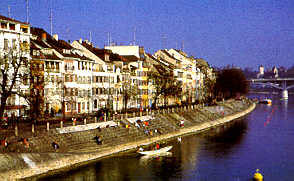
find anyone shouting a With both a gigantic river port – Switzerland’s only outlet to the sea – and the research headquarters of several pharmaceutical multinationals (including Novartis, one of the principal players in global development of GM crops and foods), Basel nurtures its reputation as Switzerland’s wealthiest and most discreet city. Its historic centre – dominated by the awe-inspiring Münster – is definitely worth seeing, and the city’s long-standing patronage of the arts has resulted in a panoply of first-rate museums and galleries – 35 in all, including the stunning Beyeler collection, Basel’s sole unmissable attraction. And yet, bequeathed a glittering medieval past endowed with some of the greatest minds of European history (Erasmus, Holbein and Nietzsche, to name just three) and centuries-long access to the best of three neighboring worlds, it’s almost as if Baslers lost the plot when it came to defining their city for today. Most people seem to back the standard Swiss default option of gathering wealth in a discreet and orderly fashion, saving money shopping in France and having a better time partying in Germany. Which is all very well, but it tends to leave their own city rather bereft in the process. Another fly in the ointment has been the recent Nazi gold controversy, in which it was indicated that venerable Basel – and, more specifically, the little-known but extremely powerful Bank for International Settlements headquartered in the city – spent the 1930s and ’40s quietly laundering the Nazis’ ill-gotten gains under a cloak of neutrality. Evidence of such murky banking practice was received with shock, anger and disbelief in Basel and around the country, and has yet to be fully accepted. Unaccustomed to being faced with pointing fingers, Baslers may take some decades to assess and absorb the accusations. Sites to See in Basel You wouldn’t really come to Basel for the nightlife, and even the locals tend quite often to prefer skipping across the border to nearby towns in Germany or France to let their hair down. Even the presence of university students doesn’t lighten the tone tremendously, and it’s a common moan of students stuck in Basel for the duration that there’s not much to do. Get full information on gigs and dance-nights from Downtown, a free leaflet put out monthly by the Basler Kantonalbank, available from the tourist office. As far as more refined entertainments go, the Basel Symphony and Basel Chamber orchestras both perform at the central Stadtcasino (061/272 66 57), along with a host of guest performers. The city’s Musik-Akademie (Leonhardsgraben 4) has a rock-solid reputation, and also often presents concerts and recitals from students and visiting soloists. Basel’s main draw is its burgeoning theatre scene (universally in German), with the Stadttheater (Theaterstrasse 7) and the Komödie (Steinenvorstadt 63) leading the field; book for both on 061/295 11 33. Of the dozens of smaller theatres, Theater Fauteuil (Spalenberg 12; 061/261 26 10) stands out for the quality of its productions, while the Baseldytschi Bihni (Im Lohnhof; 061/261 33 12) offers a truly incomprehensible evening of drama in the local Baseldytsch dialect. Steinenvorstadt is lined with first-run cinemas. Basel is famous around Switzerland and Europe for its ancient masked carnival, or Fasnacht, a three-day affair starting on the Monday after Mardi Gras. The earliest documented record of carnival is from 1376, although celebrations undoubtedly date back to well before that (earlier city records were destroyed in a fire in 1356): it’s said that Fasnacht, originally spelled Fastnacht, is related to an old word faseln, meaning fruitfulness. In the fourteenth century, carnival took the form of knightly tournaments held on Münsterplatz, events which may have had an origin in pagan ancestor worship since noble families had been buried in and around the Cathedral for generations. Through the Middle Ages, theologians railed against both excessive drinking at carnival time and the use of devilish masks and disguises – it’s no coincidence that the iconoclasm which marked the beginning of Basel’s Reformation broke out on Mardi Gras, 1529. For some unexplained reason, over time celebrations were shifted one week later to after the beginning of Lent (Basel still celebrated carnival despite its embrace of Protestantism after the Reformation), and were transformed into a series of processions organized by the city’s guilds and associations. Drum-and-pipe bands accompanied the display of weaponry, dancing and fancy-dress revelry. Greater organization throughout the nineteenth and early twentieth century resulted in the carnival of today, where some 12,000 people take part under the auspices of several hundred Cliques, groups or musical bands, all of which must apply in advance to the Fasnachts-Comité for permission to march. It’s a feature of Basel’s carnival that, unless you’re part of a performing Clique, you have to stay as an observer – unlike, for instance, in Luzern, where carnival is an all-in street-party welcoming participation from anyone and everyone. On the Sunday night after Mardi Gras, Basel’s carnival-goers kick off their celebrations at the nearby town of Liestal’s spectacular bonfire parade, which lasts until after midnight (see here). Everyone decamps back to Basel in preparation for the Morgestraich, a magical and unmissable parade of huge illuminated lanterns through the city centre which begins in invariably freezing darkness at 4am on the Monday morning; the ornately decorated lanterns are left on display in Münsterplatz from Monday evening through to Wednesday morning. From lunch time, the various masked Cliques parade through the city in a Cortège, with much music, dancing and jollity, followed in the evening by masked bands and small groups with fifes and drums roving through the Old Town. Baslers take their costumes seriously (half-masks and face paint are taboo), and many people spend weeks in advance making huge, cartoonish papier-mâché heads and sewing lavish jester-like costumes. It’s a tradition for locals to recite Schnitzelbängg, satirical verses directed at local bigwigs, in the city’s taverns and restaurants during the Monday and Wednesday evenings. Tuesday night sees Guggemusige concerts of comical oompah, played on old and dented brass instruments by bands gathered in Barfüsser-, Clara- and Marktplatz, and musical groups and masked Cliques continue to prowl through the Old Town during Wednesday afternoon until nightfall – whereupon everybody turns in for some restorative sleep. Throughout the celebrations, you’ll come across places selling Fasnachtsküchli, a light, thin round cake covered in icing sugar, and Fastenwähe, a kind of caraway-seed pretzel. Carnival Basel’s most famous festival, attracting attention from all over Switzerland and Europe, is carnival, held over three days from the Monday following Mardi Gras. Just as venerable, though, is January’s Vogel Gryff festival, centered specifically on Kleinbasel. In March, the Swiss Trade Fair, or MUBA, is held in Basel’s Messe conference centre – a giant event serving as a showcase for Swiss accomplishments in trade and industry which is of little general interest in itself but which books the city out. The annual World Watch, Clock and Jewellery Fair does the same thing in April, while in June Basel’s ART International Contemporary Art Fair is the largest event of its kind in the world, generally very interesting to attend and inspiring many associated arty happenings throughout the city. The night before the Swiss National Day – July 31 – sees a festival of folk music on the Rhine, with stalls, traditional foods and a huge fireworks display. TEFAF, or the International Art and Antiques Show, is a movable Messe feast in the early autumn. The last Saturday in October marks the start of Basel’s two-week Autumn Fair, Europe’s longest-running traditional fair, held without a break since 1471 and now metamorphosed into sub-carnival festivities centred on funfairs and street jollity. Vogel Gryff Dating back to the thirteenth century or so, Kleinbasel’s Vogel Gryff festival incorporates pagan rituals and customs in the guise of fêting the head of one of the three guild associations of Kleinbasel. It takes place on January 13, 20 or 27, depending on which association holds the baton that year. At 11am, a raft carries the Wild Maa (a hairy figure symbolizing fertility) down the Rhine to the Mittlere Brücke; he holds an uprooted pine sapling and dances – with his back always turned to Grossbasel – to an ancient drum march. The Leu (lion) and Vogel Gryff (griffon) meet him on the bank to the accompaniment of booming cannon, and at noon the three of them stand at the midpoint of the Mittlere Brücke and dance a traditional, highly ritualized dance to the sound of a drum, every precise step documented from the origins of the festival in the Middle Ages. This is as close as the party gets to Grossbasel, since everyone then proceeds back to Kleinbasel for the Gryffemähli, a luncheon for the members of the three guilds (where the symbolic dance is repeated), and a procession through the streets accompanied by four jingling jesters who collect money for Kleinbasel’s poor. During the evening, the party enters full swing, with much drinking and merrymaking, while the three figures continue to dance their odd and mysterious dance in the older Kleinbasel restaurants. The Rhine describes an elegant right-angled curve through the centre of Basel, flowing from east to north and dividing the city in two. On the south/west bank is Grossbasel (Greater Basel), focused on the historic Old Town. Glitzy shopping streets connect Barfüsserplatz and Marktplatz, the two main Old Town squares, while medieval charm is retained in the steep lanes leading off to either side, where you’ll find peaceful leafy courtyards surrounded by sixteenth-century townhouses, a host of medieval churches, and the majestic steepled Münster dominating the skyline from its lofty Rhineside terrace. The Old Town and surrounding districts comprise the main business, shopping and nightlife areas of the city. The university, off Petersgraben, overlooks the Old Town from the west, while the main Swiss and French train stations are about a kilometre south. On the north/east bank of the Rhine is down-to-earth Kleinbasel (Lesser Basel), more residential and less weightily historical than its neighbor, with some laidback nightlife and the German train station near the giant Messe conference centre some 500m east of Kleinbasel’s central Claraplatz. Ways to Travel Stay overnight in Basel and you are automatically entitled to a Mobility Card, giving free tram and bus travel throughout the city; the card is available from your hotel at check-in. Basel runs on trams, with buses serving outlying neighborhoods only. The whole of the city centre, as far north as the German border, is in Zone 10. Tickets for a four-stop journey cost Fr.1.80, for a longer journey within one zone Fr.2.80, across two zones (valid for the Vitra museum in Germany) Fr.3.60. There’s little point shelling out Fr.7.80 for a day pass. Eurailers and InterRailers get no reductions on Basel city transport, but Swiss Pass holders travel free. Virtually all trams pass through Barfüsserplatz. There are three bridges linking the city centre with Kleinbasel, but a more fun way to cross – and a method used by many locals too – is on one of the cable-ferries that have plied to and fro for centuries (although the boats themselves are newer than that). The most useful, from north to south, are the Vogel Gryff, or Klingentalfähre (March–Oct Mon–Fri 7am–7pm, Sat & Sun 9am–7pm; Feb & Nov daily 9am–7pm); the Leu, or Münsterfähre (March–Oct daily 9am–noon & 1–7pm, except Fri morning); and the Wild Maa, or St Alban-Fähre (April–Sept Mon–Fri 7am–7pm, Sat & Sun 10am–7pm; March, Oct & Nov Mon–Fri 7–8am & 11.30am–6pm, Sat & Sun 10am–6pm). Fares are in the order of Fr.1. As well as a host of eat-aboard cruises, Basler Personenschiffahrt (061/639 95 00) runs a couple of scheduled passenger boats to nearby points up and down the Rhine (May–Oct only), including a round trip to the German border at Dreiländereck (Fr.13), and a longer journey east to Kaiseraugst (Fr.35 round trip) and Rheinfelden (Fr.44 round trip). Boats depart from Schifflände beside the tourist office in the city centre, next to their information and ticket booth (Mon–Fri 9am–noon & 1–5pm; April–Oct also Sat 11am–6pm & Sun 8am–3pm). Bike rental is available at the station (daily 7am–9pm). Taxis, such as those from 33er (061/633 33 33), are a great way to get around if you think a Fr.5.30 flag fall plus Fr.2.65/km is a fair and reasonable price. Hotels Swissotel Basel-The hotel shares its bright white façade with Basel's convention center in the Messe (trade fair) district. The broad reception area is punctuated by thick pillars and flanked by the reception and business center on the left and a litter of leather seating spilling out from the Plaza Bar on the right. A mainly business clientele occasionally mixes it with international sports and entertainment stars. The biggest addition to come from renovation in 2002/2003 is the new Amrita fitness center in the basement. Along with exercise machines, guests enjoy the aqua tinted water of the oval pool, bordered by its own coffee bar, a solarium, and massage room. For a different style of relaxation, guests get complimentary entry to the Plaza Dancing nightclub in the same building. The hotel guest entrance is also in the basement.
Radisson SAS Hotel Basel- Ideal for business and leisure travelers, the Radisson SAS Hotel Basel is located close to the vibrant commercial center of Basel, Switzerland's second largest city. The hotel is situated between Basel's world-famous zoo and the city's main theater. The main train station is only a 5-minute walk from the hotel. Guestrooms are stylishly decorated in Scandinavian or Art Deco designs. The hotel features a pool, gym, steam bath, and solarium. Guests can dine in style at the Steinenpick restaurant or enjoy a light snack in the Kaffi Mühli restaurant. For those looking to explore the area, stroll through the well-preserved old town or take a boat trip on the Rhine. Venturing further a field to Germany's Black Forest or France's Alsace region could not be easier.
Central Hotel- A new established low rise hotel situated close to the shopping area & next to the main railway station Basel SBB. Hotel offers 23 tastefully furnished rooms all equipped with Cable/Color TV Direct Dial Phone and Smoke Alarm. Hotel facilities include Bar, Car Hire & Parking, Concierge, Laundry Services and Safe Deposit Boxes. Small dogs are also allowed. High Speed Internet Access upon request (ADSL) Hotel does not have an elevator. To check-in you must go to Hotel Euler which is next door, Centralbahnplatz 14.
Ramada Plaza Basel- Business and leisure travelers can rely on every amenity and guest service they need at Ramada Plaza. With convenient locations in gateway cities and major business centers, Ramada Plaza hotels offer health club facilities, meeting space and restaurants featuring regional specialties plus extras such as early check-in, concierge services and a twenty-four hour business center at many locations. / At one hundred five meters tall, the thirty-one floor Ramada Plaza Basel is the tallest residential building in Switzerland. Located adjacent to the Messe Basel fairgrounds and exhibition center, the Ramada's stylish guest rooms occupy floors five through fourteen of this "glass giant". The brightly lit conference center is in a glass extension on the third floor and appears to be suspended in mid-air. The executive lounge on the thirtieth floor offers a breathtaking and fascinating view of Basel. All guest accommodations and meeting rooms feature high speed Internet access. Parking is available offsite at an additional charge and pets are allowed in guest rooms with a per pet per day fee of CHF 15. When only the best will do, Ramada Plaza is the choice of discerning world travelers!
Welcome to the Hotel du Commerce in Basel. Excellently located in the centre of Basel - right opposite the fair and congress area and near the musical-theatre - the Hotel du Commerce is offering it's services as an ideal place to stay not only to fair and business guests, but also to the culturally interested individual traveler. Built in 1954 and continuously kept up-to-date (latest renovations in 1999/2002/2003), the hotel is owned by the same family for over 48 years. Therefore, as a guest in our hotel, you will find yourself in a charming and friendly atmosphere, surrounded by a pleasant and modern interior. With pleasure we would like to present you one of our newer "acts" - the 1999 finished new hotel building and car park in our quiet and completely new arranged yard - which allows us now to offer you still more comfortable rooms and more place to relax from a busy day. Our new designed lobby and floors as well as an extended and invitingly arranged breakfast room are some more renewals, with which we would like to surprise you at the Hotel du Commerce during your visit in Basel. Our team is looking forward to your attendance. Additional Information: 2 children age 5 and under stay free in the room with parents and in existing bedding. Children age 6-12 receive a reduction of 50%.
Information on this page taken from www.isyours.com and www.expedia.com
|
|
This web site was constructed for a school project. Information was taken from the credited sites along with information from search engines. We can be reached at lpierson1@ucok.edu. |