
LINKS :
A) Four-Stroke Cycle
The overwhelming
majority of car engines still employ the four-stroke cycle (four piston strokes
per cycle), invented by Nicholas Otto in 1876.
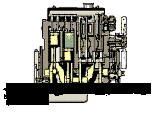
The first downstroke of the piston
that is attached to a connecting rod at its top end and to the crankshaft at the
bottom, draws a petrol-air mixture into the cylinder. This is then compressed,
which is the second stage of the process. The volatile cocktail is then ignited
by a sparking plug and the resulting explosion forces down the piston, so
turning the crankshaft. The final phase of the operation is the stroke that
expels the exhaust gases from the cylinder.
B)
Cylinder Head
The engine’s cylinder block is
invariably made of cast iron on to which is bolted an aluminium cylinder head.
This contains the valves that permit the petrol-air mixture to enter the
combustion chamber and the exhaust gases to leave it. These can be actuated by
pushrods from a block-located crankshaft-driven camshaft, although the head more
usually incorporates single or twin "overhead" camshafts driven by a ribbed
rubber belt.
C)
Fuel Injection
A carburettor had been used from
the earliest days of motoring as a component in which the petrol-air mixture was
created. The limitation of such an arrangement was that the mixture was unevenly
distributed which resulted in incomplete combustion and an undesirable amount of
unburnt fuel reaching the atmosphere.

As a result, the carburettor has
now been replaced by fuel injection. This first appeared on high-performance
cars in the 1950s. Not only is a precise amount of metered petrol delivered by
pump to each cylinder, but the air supply can also be carefully controlled by
the use of an individual inlet manifold.
D)
Lubrication
An engine cannot function unless
it is well lubricated with oil. This is circulated under pressure from a pump
that draws lubricant from a reservoir contained within the sump at the base of
the engine. It is delivered under pressure to the main crankshaft bearings from
a gallery located in the side of the block, and to the appropriately named
big-ends of the connecting rods via holes drilled in the shaft. Oil reaches the
bores by splash although it is pumped to the camshaft and valve gear.
E)
Cooling
As the combustion temperature of
petrol is 2500° C, the engine must be cooled. The cylinders and head therefore
incorporate water jacketing for a coolant that contains an antifreeze mixture
circulated by pump. It is cooled in a radiator located at the front of the car
by a passage of air that is drawn through it by a thermostatically operated
electric fan.

F)
Ignition
Whether a carburettor or fuel
injection is employed, the petrol-air mixture has to be ignited by a sparking
plug. Current is fed to each via a distributor supplied from a high-tension
coil. The current requires interruptions in its cycle, and these are produced by
a contact breaker contained within the distributor. Nowadays, more efficient
contactless distributors are employed that work in conjunction with a
computerized engine management system.

G)
Electrical Equipment
The car’s management system is yet
another component to make demands on the car’s battery. The system is charged by
an engine-driven alternator that, unlike the dynamo it replaced in the 1970s, is
efficient at low speeds or when a car is "ticking over" in a traffic queue.
A key function of the electrical system is to start the car’s engine. This is usually undertaken by a pre-engaged motor, in which a solenoid moves a bevel gear into mesh with the teeth on the engine’s flywheel. In addition to providing current for the car’s lights and windscreen wipers, modern electrical systems have to service a radio/tape recorder, cigarette lighter, heated rear window, central door locking, windows, air conditioning, and, more recently, seat adjustment.
H) Manual Transmission On most front- and rear-drive cars the gearbox is attached directly to the engine. To facilitate gear changing, the drive passes through a clutch that must be briefly disengaged by the driver. This detaches the component’s pressure plate from the driven one.
The gearbox usually incorporates four or five forward speeds and reverse. It consists, in essence, of three lines of gear clusters, all of which are in constant engagement. There is a short first-motion shaft, connected to an output shaft, that meshes with an offset layshaft. The changes are effected by sliding dog clutches positioned on the combined first-motion/output shaft. This also incorporates synchromesh cones, which facilitate silent gear changes.
I)
Automatic Transmission
This works in conjunction with a
torque converter or fluid flywheel, which transmits the engine’s power through
the medium of hydraulic fluid to the automatic gearbox. It accordingly does not
require a clutch pedal.
An automatic unit is far more complex than a manual one and has at its heart a series of epicyclic gears, which are selected mechanically. Changes are effected automatically by a complex sequence of hydraulically controlled commands.

A simpler system that makes fewer demands on the engine, and is therefore more economical, is continual variable transmission. This initially used rubber belts in conjunction with pulleys that expanded and contracted to alter the engine’s power ratios. On the current version, however, this function is undertaken by a steel belt.
J)
Drive Lines
In a front-wheel drive car, power
is conveyed by gearing to a differential that is incorporated in the
engine/gearbox unit. Its function is to permit cornering so that the
outer-driven wheel turns faster and further than the inner one. Drive is
transferred to each wheel by a constant velocity joint that can also absorb
steering forces.
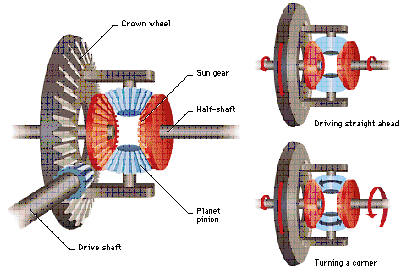
On a rear-drive vehicle, power is transmitted from the gearbox to the rear-located differential via a propeller shaft. It is then conveyed to the wheels by half-shafts (in the case of a live rear axle) or universally jointed drive shafts (if independent rear suspension is employed).
K)
Independent Suspension
The arrival of front-wheel drive
saw an increase in the use of independent front suspension, in which each wheel
is able to act in isolation to the other. One of its most important advantages
is that it keeps the wheels vertical and the tyres on the highway, regardless of
body roll, and therefore enhances the car’s road-holding ability. The most
common version employs two unequal length "wishbones", with coil springs
providing the suspension medium. In the alternative MacPherson strut system
there are no wishbones and the spring is combined with a shock absorber.

L)
Brakes
Most cars use disc brakes on their
front wheels; these are fitted on front and back wheels on more expensive
models. When the brake pedal is applied, hydraulic power is applied to calipers
that grip the disc and so contribute to arresting the car’s progress. Drum
brakes, that use internally actuated shoes, are often fitted at the rear. All
cars feature a hand or parking brake that operates on the vehicle’s rear brake
shoes or discs.

M) Steering The most popular steering system is rack and pinion. Power-assisted steering, which is hydraulically activated by an engine-driven pump and previously the preserve of expensive cars, is becoming increasingly popular.
N)
Bodywork
A body’s aerodynamic efficiency is
measured by drag coefficient (Cd) and the lower the figure the greater the car’s
wind cheating properties. Nowadays, most cars register a reading of 0.3 to 0.4
and such features as integrated bumpers, a tapered nose, and windows that are
flush with the body sides are incorporated to keep a vehicle’s Cd as low as
possible.
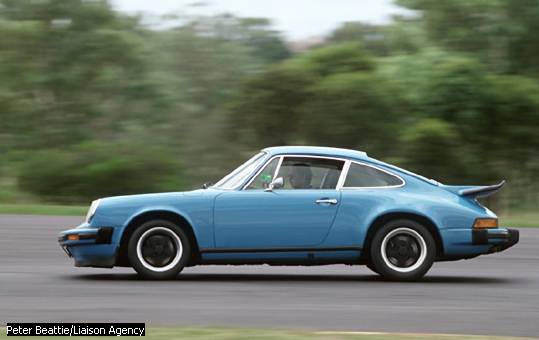
As a result the Cd of a typical family car can be superior to that of some performance models. The Ford Mondeo and Vauxhall Vectra have Cd readings of 0.31 and 0.28 respectively, while the current version of Porsche’s long-running 911 sports cars registers 0.33.
O)
Saloon Bodies Most cars were fitted with open, wooden-framed, hand-crafted steel or aluminium bodywork that was mounted on a separate chassis frame. Saloons were more expensive because they used more materials. It was not until 1925 that the American Essex company risked all by offering a closed car that sold for less than a touring vehicle. The gamble paid off and the rest of the motoring world soon followed suit.Machine-made pressed steel body panels had been used by Dodge in America from 1916; this led to the all-steel saloon and, finally, the unitary body, which dispensed with the chassis and transferred stresses to the hull. Citroën’s advanced front-wheel drive Traction Avant model of 1934 was the first mass-produced car to feature the concept and was followed by General Motors’ German Opel subsidiary in 1935. General Motors was also responsible for introducing silent gear changes to motoring in 1928, and in 1940 an American car, the Oldsmobile, was the first vehicle to have automatic transmission.
Cars used leaf springs inherited from horse-drawn carriages until the 1930s, when independent front suspension was developed. However, its rear equivalent was rarer and usually confined to more expensive vehicles. An exception was provided by Volkswagen AG in Germany. The Beetle was the Volkswagen which was designed by Ferdinand Porsche in 1934 and entered series production in 1945. Featuring all-independent suspension, it was powered by a rear-mounted, horizontally opposed, four-cylinder engine that was cheap to run, and which also defied convention by being air- rather than water-cooled. The Beetle became the most popular car in the history of motoring; it is still in production and a record 21 million have been built.
A German company also produced the economical and efficient diesel engine, invented in 1893 by Rudolf Diesel. Adopted in the 1920s for use in commercial vehicles, in 1935 Mercedes-Benz introduced the 260D as the world’s first diesel-engined car.
P) Front-Wheel Drive In 1937 the French Citroën company briefly offered a diesel option in its front-wheel drive Traction Avant. This model represented the first serious challenge to the orthodox front-engine/rear-drive configuration. Although the mechanics were more sophisticated, the Traction Avant cornered better and could be built with lower body lines because there was no obtrusive transmission tunnel.
While the Citroën’s engine was conventionally positioned, the British Motor Corporation’s front-wheel drive Mini of 1959, designed by its chief engineer Alec Issigonis, had its power unit turned 90° to a transverse-mounted location. This allowed for more passenger accommodation: four adults could be seated in a car only 3 m (10 ft) long.
