by
Rasul Hadizade
Placed on the web by Iraj Bashiri,
copyright, Bashiri 2001
The moon hid behind the swift-flying clouds of spring, peeking out to illuminate the vast green steppe from time to time. Then the flames of the campfires to the south would dim, and the silhouettes of tents with banners flying overhead would appear in the silvery moonlight only to fade from sight once more as the moon ducked behind a cloud. Then, as if by magic, the fires would blaze up again.
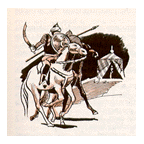
Two horsemen waited motionless above the deep irrigation canal. They faced north, but turned now and again to gaze at the sleeping camp behind them. From the far-off villages to the west, cocks' crows and the barking of dogs could be heard occasionally.
Their bay horses grew tired of standing still and stamped the ground, impatiently tugging at their bridles, lavishly decorated with chased silver, urging their riders to move on.
The reflection of the moon played on the dark, glassy surface of the irrigation ditch which stretched out into the distance and disappeared behind a stand of poplars. A stone flew up from one of the horses' hooves and plopped into the ditch, cutting the moon in half. The shattered pieces of the mirror-like surface carried the halves away on rippled waves, but soon they were back together again. And once more the silver ship of the moon with swift clouds for sails was reflected in the dark water. Caught up in the play of light on the water, the horsemen failed to notice the ominous storm clouds blowing in from the west to hide the luminary of the night which showed its face less frequently now.
The darkness grew thicker, and thunderclouds covered the sky. Cold gusts of wind with tiny drops of rain struck their faces.
One of the riders dismounted, laid his spear in the grass, and without letting go of the reins, tightened the girths of the saddle.
"Look, Safar! " his companion exclaimed, not taking his eyes from the flames of the campfires. "At night our camp is like a vast cemetery with a candle burning on every grave."
But apparently, Safar didn't catch what the other said, for he silently took up his spear and remounted.
"It's time we were getting back. Everything is quiet. Let's go!"
And without waiting for a response, he turned his horse around and headed back for camp. His companion soon caught up with him, and they trotted side by side. Glancing at Safar's gloomy face, his partner said:
"You haven't smiled for days. Has anything happened? Are you trying to keep something from me?"
"No, nothing's wrong," snapped Safar, and continued gloomily on his way.
Suddenly his horse shied near a pile of stones and pricked up its ears. A gopher raced across the road a few paces ahead, and two fire flies circled under the horses' heads. Safar's mount grew calm, neighed loudly, then continued on its way. As if waking from a deep sleep, Safar said:
"For the last month, I've thought of nothing but my poor old mother day and night. You know yourself, Abbas, that when I left, she couldn't get up from her bed. I haven't heard a word from her in all these seven months, and I have no idea how she's doing. The last few days I've had the feeling I'll never see her again. When we left, I promised her we'd only be gone about two months."
"Yes, we're all sick to death of this campaign. Even the ones who convinced the emir to come here regret their actions. Now they don't know how to get him to go back to Bukhara."
Safar stared silently at the fires by the tents. An owl flew overhead and let out a piercing shriek.
"See, there's even a hoot owl. A bad omen to be sure! I've been overwhelmed by ill omens lately--I'm quaking in my boots from the lot of it! "
"So are we all supposed to go around being superstitious as a gaggle of old women now, or what?"
"No, Abbas, it's not just that. Misfortune awaits us. I can feel it in my bones! Three nights ago, I had a nightmare, and I'm still not completely myself. I dreamt that I was riding watch alone far from the camp. I came to a very wide river and stopped to look at the churning waters. I noticed something moving on the other shore, looked more closely, and saw that it was my mother. She was lying prone on the sand and raised her head to stare intently at me. Her gray hair fell in a tangle over her dark, pained face, and she stretched out her feeble arms and called out to me, but I could barely hear her voice. I was powerless to move. An enormous snake slithered to the right of her--if I were a moment too long in coming, the viper would bite her. So I spurred my horse on and plunged into the river. But the water was at flood tide, and my mount was caught in a whirlpool which sapped the last of his strength. But I could see only my mother through it all. When I reached the middle of the river, I heard a terrifying roar, and the current almost swept me away. My eyes were blinded by a flash of light, and a mighty hand plucked me from the horse's back and tossed me onto the bank from which I set out. I began to scream, opened my eyes, and saw the roof of the tent above me and Abulfazl by my side. The poor man had gotten up to see what was wrong and was staring at me in concern and amazement. And outside, there was a thunderstorm.
" 'Why are you shouting? 'he asked.
" 'I was having a nightmare! 'I told him and turned over on my other side.
"After that, I couldn't fall asleep for a long time. Every time I closed my eyes, either the snake appeared, or my mother started to call me. Just now when the stone fell into the ditch, I could see the roaring river of my dream and the blinding light, and it seemed to me that my poor mother was on the other shore..."
Safar lapsed into silence. The howling of a jackal could be heard in the distance. Lightning flashed in the west, illuminating the low-hanging storm clouds.
From the left where the village was came the cries of a hoot owl, muffled by the distance. This one reminded Safar of the other hoot owl which had flown overhead. This second screech seemed a sure omen that misfortune would not be long in coming. He could imagine the piercing eyes of an owl before him, so he winced, scowled, and lowered his head.
Abbas was also alarmed by his friend's tale. The mysterious sounds of the night pressed on his heart, and he tried to find some more comforting interpretation of Safar's nightmare so he could ease his friend's troubled mind, but his thoughts grew confused, and not a word of encouragement would come to him. He coughed uneasily.
"It's Satan trying to turn your head. Take heart, 'my friend, and you'll see that everything will be alright! "
But Safar did not answer. They were already near the camp, and here and there, peoples' shadows were visible near the fires. Three soldiers sat by the fire before a tent that had seen better days. Two others, covered with a rough wool blanket, were sleeping with their backs to the fire.
When they heard the clatter of the horses' hooves, they woke with a start and turned to face the approaching riders, not taking their eyes off them until they galloped up to the fire.
"Why aren't you asleep yet?" inquired Abbas, who tethered his horse and walked over to sit down beside them. "Give our old nags some hay, Safar, then come rest your weary bones a while."
He threw an armful of kindling wood on the fire and blew on the flames, wiping the tears from his smoke-filled eyes with the cuff of his sleeve. The tongues of flame rose ever higher from the blue puffs of smoke and reflected crimson on the pale, tired faces of the sleepless warriors. Safar's cheeks flushed, but he was still worried and uneasy. He sat sideways and stared dully at the fire, stirring the glowing coals with a long stick.
"If you get rested up before your watch, you'll never tire before morning," said Abbas, pointing at the sleeping figures with a smile. "Yakub, have you seen Mansur today? How was he feeling?" he asked the man next to him.
"Sure," replied the other with a sigh. "He seemed better, but he's nothing but skin and bones and won't even look at anyone, poor fellow."
"Losing his brother Ilyas was a great blow to him. You don't find many soldiers as fine as that one," Safar responded quietly so the others wouldn't hear.
"It was as if Ilyas was looking to die. Do you remember the day we saddled up our horses to play chavgan? Mansur and I begged him not to play, because he wasn't well yet. But he wouldn't listen. The emir's word was law, after all."
Safar considered Ilyas' untimely and unexpected death during the mounted games an ominous sign: he had fallen dead from his mount. He was terrified that he might meet his end just as uselessly: on the campaign or out hunting without ever seeing his mother again. It was not the unexpectedness and unpredictability of death that frightened him but the thought of how it would grieve his ailing mother, she would not be able to bear his death. So Safar added nothing more to the conversation but rather tried to chase all gloomy thoughts away. He looked over at his mount, still chewing its hay, and pushed a smouldering ember back into the fire.
"Rudaki the poet is coming," said Yakub.
They all felt their spirits surge, and Safar's depressing ruminations were dispelled at once.
The figure of a short man appeared from the darkness some twenty paces away. Abbas jumped up and crossed his hands on his chest in a gesture of greeting. The rest rose as Rudaki approached with his head lowered. He stopped a few paces from the fire and glanced in the direction of the soldiers. A faint smile could be seen on his lips through the uncertain light of the campfire.
"Assyalamu aleikum, o poet," the warriors greeted him in unison.
"Va aleikum oos selyam! " replied Rudaki. "Keeping the peace for us, I see..."
"Yes, sir, your Excellency," came the barely audible reply from a soldier by the name of Abulais. The others lowered their heads in respectful assent.
"A thousand thanks and great praise. To keep the peace is truly a noble endeavor. May Allah the Most High be with you! "
Rudaki righted his cloak and, without waiting for a response, went to his tent. The standing soldiers looked after him. They could see his stooped back as he slowly increased the distance between them until he disappeared into the darkness.
"It seems our poet is out of spirits--he left so quickly," decided Yakub, the first to resume his place by the fire. "Do you remember how he used to sit with us until far into the night joking, reciting his poetry and singing... This isn't the first time I've seen him wandering alone among the tents at night. Whenever he sees me, he asks briefly how I'm feeling then heads quietly for his tent as if his mind were somewhere else."
"He may just be working on a new poem," proffered Abulais. "The light stays on in his-tent till morning every night."
"Yesterday, his assistant Yakhya recited one of his poems for me," announced Safar, and a smile flitted across his lips. "He said it was a verse Rudaki composed during the emir's trip to Sarakhs dedicated to the beauty of Bukhara. When I heard the poem with its stringed tar accompaniment, I immediately forgot all the adversities and misfortunes of the last few days. I asked him to let me make a copy of it so I could enjoy the beauty of the words." Safar took a scrap of paper from his robe and read by the light of the fire, glancing down at the words:
A breeze from Bukhara has blown here
Filled with the fragrance of jasmine, sweet basil, and mint.
Some say: "This breeze is from Khotan, for there,
Meadows have more flowers than a speckled robe.
But no, this intoxicating breeze is surely from Bukhara,
The city where my beloved treads upon the grass.
Silently, I breathe your name once more.
I dare not say it aloud for fear the rumors will fly.
Yet, despite all my fears, it escapes my lips unbidden,
Though I know the price of such indiscretion to be quite high.
While Safar was reading, Abbas did not take his eyes off him, enjoying the excitement of the other's sensitive soul, reflected so openly on his face. And for his part, Safar, not suspecting that in addition to Abbas, all the rest were listening attentively, stared out into the foggy night. As he finished the last couplet, he turned to his friend.
"It's a nice poem," said Abbas. "I heard it a long time ago and even knew some of it by heart."
"Our poet loves Bukhara a great deal," piped up Yakub. "He feels like a bird without a nest when he stays away for too long. Many of his verses are dedicated to our city..."
"Yakub, it's time the fellows set out on their rounds," Abulais interrupted him. "Let's send them off and we'll sleep for a while. Abulkhafs! Murad! Time to get up! "
The two men sleeping by the fire arose, mounted silently, and headed south. Abbas stretched, covered himself with a blanket of rough cotton and shut his eyes. The rest followed his example and lay down on the tender young grass.
They all fell asleep, but Safar stared at the dark sky that hung low over them like a cellar ceiling. He was exhausted from depression and insomnia. An incoherent picture of the past, alarming thoughts of the future, and his friends' words flashed through his mind so rapidly that he could not focus on any one thing. If he closed his eyes for a second, he was beset by the roaring river, the distant figure of his mother, and the repulsive gleam of the snake's scales. He opened his eyes and turned to his other side with a sigh.
Finally, he was overcome by exhaustion and fell asleep. Now neither the mysterious rustle of the steppe that night, nor the cries of the birds or even the rumble of thunder in the distance could wake him. He slept like a babe in its mother's arms, calmed by her life-giving warmth.
2
Every morning after breakfast, Rudaki sat down to read. For the second day, he was poring over a tract by an obscure Greek scholar. In places, the translator had misinterpreted the text, and it seemed that the Greek had foreseen the rise of Islam, which seemed highly unlikely. Although the author believed in the power of the Almighty, he considered matter the fundamental substance of the universe. He thought fire had brought all that was living and non-living into motion. He used logic and examples to support his position. Rudaki left the real world behind to wander about the realm of thought, penetrating its most secret places as he carefully turned the fragile pages of the old manuscript.
Occasionally, he would take up his reed-pen to note down the conclusions and postulates that pleased him most.
The hours flew by, and Rudaki continued reading, totally engrossed. Surprising as it may seem, he did not even notice when three high-ranking and respected dignitaries from the emir's court entered his tent.
Their greeting jolted the poet back to reality. He stood up to return their greetings and invited his unexpected guests to make themselves at home.
"I'm honored by your presence. My humble shelter is filled with rays of joy," he said politely, crossing his hands on his chest. Then he quickly gathered up the papers and manuscripts and put them into a beautifully carved wooden chest.
The unexpected appearance of these three noblemen who were so close to the emir himself surprised him. What did they want? True, Abujafar, who managed the emir's estate, and Muhammad Salekh, his trusted confidant, occasionally dropped by, but this was the first time Takhir Balkhi, commander of the army, had ever come. Rudaki had only seen him at the emir's feasts. What could possibly have brought such a man to the tent of a poet?
"You leave your quarters so rarely these days," began Muhammad Salekh as soon as Rudaki had sat down. "Allah preserved us, you have not fallen ill, perchance?"
"No, I am quite well, thank you. But the gloomy skies and the endless rains depress me. I feel more like staying here and reading than going out on such days."
Muhammad Salekh glanced at Takhir Balkhi as if appealing for support. But the officer had bowed his head and was staring through big brown eyes at the harp hanging on the peg. So to keep the conversation going, Abujafar said:
"You're quite right, dear poet; on such days, none of us feels like leaving his tent."
"And we've been away from our wives and children so long, we're all bored to tears and more than a little homesick," added Muhammad Salekh.
"Could it be that our sovereign has no intention of returning to Bukhara in the near future?" inquired Rudaki.
"We have tried time and again to bring the subject up, but the emir takes no notice of our words. He simply praises the gardens and delectable fruits of Bogdis and extols the meadows of Herat."
Rudaki turned to the military commander and asked:
"Surely there is something our honored hadji can do to convince the emir to return to Bukhara..."
"I asked the emir about this in private, but all he did was knit his brows and raise his goblet in place of an answer, indicating that I should drain my glass along with him."
"It seems our ruler likes the climate here," inserted Abujafar.
"But the weather in Bukhara is not inferior to this, especially in spring. Surely the beauty of the River Mulien is as great and the air near the river bank just as pure! " remarked Rudaki in surprise.
"Right you are," said Muhammad Salekh wistfully. "How nice it would be to spend the spring in Bukhara with our wives and children and then escape the heat of the summer in Samarkand. It would save us all a lot of trouble if only the emir would give his consent..."
Rudaki silently cast a glance at Takhir Balkhi, wondering what he would say. But he just sat with his head down.
"Honored poet," began Muhammad Salekh afresh, "we, your humble servants, have come to you with a request and believe that you will justify the hopes we place in you." And catching an encouraging glance from Rudaki, he continued more boldly: "We have decided to bring up the subject of Bukhara at the next feast the emir holds to try to convince His Highness it is high time he returned home. But our plain speech might not have the desired effect, while we are sure that your eloquence and verses are certain to move him. Perhaps you can help us find a way out of our dilemma."
"I doubt very seriously that verses have more of an effect on the emir than the words and convictions of worthy and respected gentlemen of the court," Rudaki remarked sternly.
"Most worthy poet, we know your verses well and value them, and we are equally aware of the esteem in which the emir holds you. Every word that falls from your lips has a definite effect on our sovereign," confirmed the commander.
"If you decide to take this step, master," broke in Muhammad Salekh, "you will release many others besides us from their sufferings--even our pitiful slaves will be better off if we go home."
Then he noticed that the poet was staring at his low sandalwood desk, and the pensive expression on the bard's face confused him. Suddenly, he felt helpless as a child. And in fact, there they were three highly placed officials of the Samanid emir's court--sitting in the humble tent of a poet begging for help like a bunch of strays without kith or kin. And really, their arguments were so naive that to object would be to show one's own stupidity--something Rudaki surely knew better than they did. These thoughts made Muhammad Salekh nervous, and then Abujafar had to go breaking in with his totally inappropriate insinuations. The emir's confidant burned with shame when he heard how Abujafar prattled on:
"And as far as remuneration, you need not concern yourself. We are prepared to pay gold and silver twice over the amount the emir himself would grant for the service we require."
And with this, Abujafar glanced in the direction of Takhir Balkhi.
Rudaki glared at Abujafar and spoke with an ironic smile:
"My dear sir, no words measured in precious stones or verses composed for silver and gold can possibly have the effect you desire. It is not heaps of gold but reminiscences of Bukhara, the native city so dear to my heart, that can give me the strength to pull verses from the depths of my soul which will touch the hearts of others."
No one replied, for the poet's irony confused the noblemen. But they took his words for a hopeful sign and beamed at him.
"We are grateful to you, o poet most worthy," Muhammad Salekh murmured at last. "Those of us from Bukhara, and particularly our vizier, the most honored Balami, will be grateful for any assistance you might find it in your heart to render us."
Rudaki made no reply, but attempted to change the theme to improve his mood so he would not offend one of his guests with some rash remark after their inappropriate suggestions. But the conversation flagged, for his guests did not want to cause him any unnecessary concern: they had achieved their goal and needed no more from him. And so Rudaki, who realized that his sharp tongue and bitter irony might have offended these mighty men, showed them respectfully out of the tent.
When they had gone, he sat before his desk and resumed his study of the philosophical tract which had been so much to his liking in a vain attempt to forget what had happened.
* * *
The rays of the sun poured through the cracks in the ceiling of the cupola, falling on the felt mat and blankets, lighting up the tent like candles in a candelabrum suspended from above. Outside, slaves could be heard as they ran about, pleased with the good weather which had appeared after days on end of nothing but rain. Rudaki watched the reflection of a sunbeam slowly make its way to the edge of his desk.
The unexpected visit of the three noblemen and their short conversation had upset his equilibrium. He glanced at the book lying on the cover of the carved chest which he had been reading before their visit. But now the Greek philosopher's complex interpretation of the creation and evolution of the world seemed empty and pointless. His thoughts were occupied by the request of men involuntarily torn away from their homes and families, men burdened by this separation and deprived of the joys of life.
He stretched out on his couch above a low desk and, recalling the face of the commander who had sat before him the previous day with a downcast face like a naughty boy being scolded, he smiled. Was that not the haughty noble who had urged the emir to travel to Herat seven months before and to take not two hundred slaves but four hundred... And now his longing for his wives and children had driven him to the tent of the court poet.
Homesickness overcame him and made him sad. He remembered his native village and the road to Samarkand. His mind was filled with the sweet thought of the days he had spent in Bukhara. These reminiscences gave him such pleasure that he involuntarily closed his eyes so nothing would interrupt this vision of the past. What mysterious force was calling him home? He had no wife or children, so that wasn't the problem. It was just that he suddenly became intensely aware of his solitude, not only in this small tent and in the camp, but he realized he was alone in all the world...
He could see the tiny village of his birth embraced by the tall white-capped mountains and the green grass over which he had run barefooted as a boy and then a teenager. There were the crystal clear springs that had quenched his thirst, but not the flame that burned bright in his youthful heart. He heard again the shepherds pipes -and the three-stringed tars, the laughter and prancing about of the barefooted boys along the village streets. Then the quiet of moonlight evenings and the tales of his friends and brothers. He laughed at their jokes and enjoyed their merry songs. All this swept past him as quickly as a swift mountain stream.
He recalled the road that ran from Panjrud to Samarkand, and then farther, all the way to Bukhara. Had he not doomed himself to solitude, then? No, for he loved Bukhara as much as his native village; it was there that his dreams had been realized: he had gotten an education and begun to write poetry. it was in Bukhara that he had spent the sweet years of his youth. in Bukhara, he had found friends after his own heart and interlocutors who, like himself, had overcome many difficulties along the road to the capital on their way from distant parts. They proudly wrote poems and books in their once-humble native tongue, Dari. He found new sources of strength among his friends there and felt that he would be forever young.
But on his extended journeys about the fine regions of the Samanids state and at the emir's feasts, he felt lonely.
When he recalled how the noblemen had talked about their wives and children he gave a crooked smile. "If, like me, they had no families, they would probably dispense with their governmental duties altogether! I doubt they would ever return to Bukhara! " Memories and inexpressible pain drove him from his desk. He jumped up and began to pace about the tent. His throat grew tight and his breathing labored as if all the air in the tent were poisoned.
So the poet rushed to the doorway and stood there drained of all strength. Breathing deeply and screwing up his darkened eyes in the bright sunlight, he looked about. In the distance towered the great tent of the Emir Nasr. There was no one about except the two guards by the entrance. The blue and white banners hung lifeless in the still air. Without taking his eyes off them, Rudaki thought it entirely possible that Nasr's father had been killed in just such a tent a little more than two decades earlier. It was said he had come home drunk one night and ordered the guards and two trained lions away from the doorway. He didn't see why he needed to take such precautions, for his power was unlimited and firm enough to surmount all obstacles. The next morning he was found murdered. To that day, the old men talked of the presumptuous carelessness of the great emir. Rudaki always listened to the legends of the emir's death in silence, but thought to himself that the great emir's power certainly wouldn't last long if it rested solely upon the strength of guards and trained lions. Surely there was some less tenuous means of preserving one's power and one's very life!
The poet thought with horror that if not that day then the next, the son might meet the same fate as his father. Then what would happen? Could it be that the bloody battles and selflessness of the people which had allowed the Samanids to come to power and given rise to the splendid buildings and magnificent palaces, to the gathering of the finest scholars and thinkers of the day in Bukhara, carrying the fame of the Samanid state and its capital to the very center of the caliphate had all come into being just so that on that day, far from the seat of power and from the affairs and business of governing, the emir might wake from an untroubled sleep in his great tent and continue to amuse himself?
Rudaki went back inside. He had neither the energy to read nor the inspiration to write poetry. He sent his assistant, who had appeared at the appointed hour away until the following day.
Towards evening, as twilight was falling over the steppe, Rudaki donned a clean robe, put on his turban, took up his staff, and went out. Life in the camp was in full swing. The slaves were bustling about preparing the evening meal, scraping the sweat from the horses' coats and grooming them, cleaning their masters' garments, and conversing by the fire. Rudaki stood for a while and observed their incessant motion as they went about their daily tasks. Then he set off for a quieter place. Leaning forward slightly as he walked with the aid of the staff he maneuvered his powerful frame past the torn, raggy tents that were the slaves' quarters and past their campfires, responding to their greetings with a nod of his head. He could think of nothing but how to get to the steppe as fast as possible so he could be utterly alone, far from the sound of human voices and the constant buzz of the great camp.
As he made his way past the commander's tent, he recalled the confusion on the man's pleading face and quickened his step to avoid meeting him by chance.
He had barely reached the steppe when he heard the plaintive sound of a flute coming from one of the tents. He stopped to listen, entranced by the captivating melody. He peered in the direction from which the lovely sound was coming, for he wanted to see the flute player. But then he turned back around, deciding to listen till the very end of the tune without missing a note. Gradually, the song grew softer until it finally ceased altogether. But still, the poet did not move, for it seemed to him the music had not ended. At last, he realized the flute had finished some time ago, so he continued walking, humming the haunting melody he had just heard.
The moon lavished its silver light on the broad steppe. The groves of trees scattered here and there reminded him of the dark tents of the nomads. Either the haunting melody of the flute or the mysterious beauty of the steppe had cheered Rudaki infinitely. Like a thunderhead blown away by the wind, the ominous anguish that had beset him during the day dissipated.
The outline of the fortress at Herat appeared in the distance with the guards' lanterns twinkling like pale stars just before morning. A huge torch blazed above the Khush gates. Herat and its environs were well known to the poet. Legions of traders who spoke in many tongues gathered before the great gates on bazaar days. He would go up and down the rows in search of rare examples of Hindu and Kashmir handicrafts, and sometimes he would even manage to find fine writing paper or a valuable manuscript. When there was no bazaar, the area was quiet. North of the fortress, the glassy Indjil River sparkled in the moonlight. One of its branches flowed right through the city itself. Beyond the river stood the splendid houses of the rich landowners, surrounded by verdant orchards. Several days before, Rudaki had been a guest at one of them as part of the emir's retinue.
The poet sat down on a boulder beside a large lake that had formed during the recent floods and stared at the fortress. He thought of Bukhara's Arg and the lush orchards all around it. The water of the Mulien sparkled exactly the same way in the moonlight, flowing unhurriedly past banks wrought skillfully by human hands, its majestic, glassy surface reflecting the orchards and palaces. Occasionally, Rudaki would recite poetry to his friends on the river bank or hold verse competitions there. And sometimes, he would compose ballads under the willows in the quiet of the evening. He could see it all in his mind with crystal clarity.
Again he recalled his first days in Bukhara. After the mountain orchards of his native village, the man-made parks and gardens of the capital seemed strange to him. The unkempt splendor of nature seemed oddly absent from them. It was a long time before he grew accustomed to the uniform canals, straight as an arrow, and the dull sameness of the streets. The wild rivers and high peaks of his native land drew him irresistibly homeward. But little by little, the quiet and calm of the gardens laid out along the Mulien and its pure water that gave cool and repose in the heat of the day won Rudaki over. Strolling along the peaceful river banks, he could not get enough of the beauty created by human hands and the strength of reason in this oasis in the midst of the dry desert sands.
Now he was alone, far from Bukhara and the gentle breezes of the Mulien, far from his dear friends. Again homesickness took hold of him. He wished only to be in his beloved city with his true friends. He could see each of them in his mind and held a silent conversation with them all.
Rudaki peered up at the dark cloudless sky, sighed, and whispered:
"Splashing and sparkling, the Mulien calls me home. She whom I love calls me home."
The words flowed from him so unexpectedly that he did not even notice their melodiousness or meter. But still, he repeated them softly once more. The homesickness for Bukhara and the longing for his friends that had been with him all day seized his whole being, and the lines to a new poem flowed from the depths of his soul one after the other. They were majestic as the Arg--the fortress of Bukhara--and melodious as the song of the flute he had heard on his way out of the camp. Pure, calm, and fresh as the crystal clear water of the Mulien. Fervent and moving as a meeting with old friends. Fragrant as the breath of a lover. The verses came of their own accord, taking possession of his every waking thought, but still, somewhere deep within him was the idea: "Maybe these are the rhymes that will move the emir to return home." He sat motionless for a long time, filled with the quiet and spaciousness of the steppe, at one with nature, pouring the riotous joy that seized his soul into the flaming verses that poured unbidden from his subconscious and would not be subdued by his reason.
3
The damp weather had a bad effect on the weak, sickly Emir Nasr. He had a bad cough and was troubled by chills and fever, so he sat despondent in his tent for days on end. Solitude and illness made him petulant and irritable. His servants ran their legs off and the members of the court were in despair. But two days earlier, the clouds had dissipated, and the people close to the ruler had noticed signs of merriment upon his face. He even began to treat his servants more kindly.
That morning, he summoned his advisor Muhammad Salekh and quietly shared a meal with him. All evidence of the recent ill-tempers had vanished without a trace. When his confidant rose and asked permission to leave, backing respectfully toward the door of the tent, the emir stopped him. His majesty desired that his friends and companions gather at the royal tent that very evening to entertain him. The ruler was particularly insistent that Rudaki be present.
Muhammad Salekh quickly informed Abujafar of the emir's orders. Consulting one another continuously, they began to prepare for the feast. Muhammad Salekh set off to invite Rudaki personally. When he saw the pensive, serious expression on the poet's face, he decided not to repeat the request with which he had come to the man a few days before.
"If he refuses again, it will only ruin my festive mood. It would be better just to wait until this evening and see what happens."
There were not many people at the emir's feast: in addition to his close advisers, there were only Rudaki and his assistant and two musicians--a flute player and a fellow with a stringed tanbur. Rudaki sat in the place of honor next to Muhammad Salekh. Accompanying himself on the harp, he sang the lovely rhymed couplets known as ghazals and listened to the musicians. Nasr drank wine continuously, and despite the kind insistence of Abujafar, he merely picked at the exceedingly palatable delicacies placed before him. Nor did the commander of the garrison lag behind his royal highness in consumption of strong drink. When the music ended, Muhammad Salekh and Abujafar tried their best to amuse the emir with jokes and anecdotes. Occasionally, even Rudaki joined in the conversation with an amusing parable or a recitation of some profound couplet. In response, Nasr would smile kindly at him, roll his drunken eyes, and exclaim:
"Bravo, Rudaki! Bravo!
The disjointed conversation dragged on and on. Rudaki was bored to distraction. When the tanbur player struck up a tune, he noticed that the emir's eyes had filled with tears.
He glanced quickly at the harp standing next to his assistant and recalled the verses that had come to him in the steppe the evening before. He looked over at Muhammad Salekh and saw that the latter was following the mournful melody of the tanbur, head lowered, brows knit into a frown. The final notes of the melody had not yet died out when Rudaki rose, crossed his hands on his chest, and announced in a resonant voice:
"Your Majesty, no matter where we, the humble servants of your vast and mighty state, may be, our hearts are always in Bukhara, the seat of your government and site of your ancestors' magnificent mausoleums. These facts make Bukhara sacred to every one of us. Several days ago, I composed an ode dedicated to this marvelous city which is so dear to all our hearts. It is a reminiscence of the dear friends of our hearts who impatiently await the return of their beloved ruler. With your permission, Your Highness, I will sing several verses."
Muhammad Salekh jerked and started from his somnolence. Abujafar and Takhir Balkhi trained eyes bright with unshed tears upon the poet. Nasr slowly raised his head, his reddened eyes also brimming, his sorrowful glance a plea for sympathy.
"Go ahead," he said barely audibly.
Rudaki took up his harp and tuned it without taking his eyes off the slight, stooped figure of the emir. Then he pressed the harp to his breast and began to play, his gaze turned on the harp pins. Everyone fell quiet: only the breeze against the cupola of the tent continued to rustle. Rudaki lowered his eyelids. The melody he had heard the day before rang out, and in the rich vibrato of his voice there sounded not emotion but a sense of resolution: he had to influence the emir. Rising and falling like the gentle waves of a calm sea, his voice slowly made its way into the hearts of those around him, calling forth a reciprocal tremor.
Splashing and sparkling, the Mulien calls me home.
She whom I love calls me home.
The song, trapped for long days and nights in Rudaki's soul, had torn its way to freedom and was soaring beneath the broad expanses of the great tent's cupola. But to Rudaki it seemed that there was not enough room in the whole of the enclosure for his words: the air felt stuffy from the breath of the wine-soaked guests.
He had not sung with such abandon and sweet oblivion for years! The minor chords and melody of his favorite song filled his heart with a strange sense of triumph. Rudaki even forgot about the presence of the emir. His tender words praising the greatness of Bukhara and those who had increased that glory lent his singing solemnity and profound feeling. His glorification of the past rulers of the city served as a covert hint at the nonentity of their descendant, a weak-willed captive of the vine. The tiredness could be heard in Rudaki's voice whenever he hit a high note, for he was far from young. But his supple fingers made the harp sing as irrepressibly as ever.
When Rudaki finally opened his eyes, he looked at the emir who had covered his wine goblet with his palm and, supporting his lowered head with the other hand, was rocking slightly from side to side. Rudaki realized that he was crying. Takhir Balkhi was stupefied, drunk on the wine and the music. Abujafar was staring at the poet with a steady gaze from which it was obvious that he was prepared to fall on his knees before Rudaki, but could not express such profound gratitude in the presence of the emir. Muhammad Salekh sat still as a statue, his eyes on Rudaki, waiting with bated breath for the emir's response.
The poet's assistant understood from his expression that the old man was tired and did not want to continue, for he might ruin the mood he had just created if he did. So the younger man took up the harp and his lovely voice filled the tent before the sounds of his master's song had even died away. The walls reverberated with the captivating melody:
Make haste to Bukhara, city of happiness, 0 Great Emir.
She sends you her fond regards and calls us home.
You are the moon, and Bukhara the firmament on high,
And what is lit by the moon's light calls out to us.
You are a mighty plane tree, and Bukhara a garden in full bloom.
The rustle of leaves and birdsong call us home.
The music had barely ended and cries of approval began to ring out when loud sobbing was heard. Face on his cushion, crying pitifully as a baby, sat the great Emir Nasr. His overturned goblet rolled before him.
Turmoil broke out. Muhammad Salekh motioned for the musicians to leave the tent at once. He stood and tried to right the cushion under his majesty's head.
Nasr pushed his hand away, then raised his head, and motioned for Abujafar to refill his overturned goblet. The latter jumped up and refilled the goblet from a painted pitcher. Then he filled the rest of the goblets. Nasr still sat clutching the goblet in his unsteady hands.
"Bravo, worthy poet! Bravo! " he shouted in a voice hoarse from crying. "You have cheered our wounded heart and given our stiff body strength. You have gladdened the spirits of our ancestors who have been laid to rest in the sacred soil of Bukhara. No doubt, they have grown angry with us for having deserted them. Worthy of great praise, you are, o exalted poet! I"
Nasr's voice had begun to tremble. To hide the tears streaming from his eyes, he drained his goblet, then turned to Muhammad Salekh and ordered:
"Tomorrow break camp, and we shall set off for Bukhara! Do you hear? We must return to Bukhara as quickly as possible! " Then he turned to Rudaki and added: "Yes, we must go to Bukhara... We are most grateful to you, o honored poet! We praise your great gift and inspiration. Our guests are free to take their leave, now."
Rudaki stood, bowed low, and left the tent. His chest drew in the fresh air of the steppe, and the captivating melody reverberated in his ears.
Nasr was left alone in the great tent. He stood up and leaned his back against the desk, but his legs would not support him, so he collapsed onto the rug. He tried several times to get to his feet, but he could manage only to turn over on his back. The only spots of color on his pale face were his eyelashes and thin mustache. His faded lips continued to tremble as if even in his dreams he were remembering the angry spirits of his noble ancestors and were thanking the poet Rudaki for his timely warning.
... The sun was not yet up, but the edge of the horizon had turned a faint pink. The purple mantle of dawn played over the grass and the leaves of the trees, covering them with a haze of gold and green. Only the song of the birds in the nearby groves broke the early-morning quiet, and then the muted bells of a long caravan which had set off half an hour before. A brightly painted throne had been affixed to the back of one of the camels in the middle of the caravan. And upon this throne solemnly sat the Emir Nasr in a robe lavishly embroidered in gold thread. Closing his eyes, puffy from drunkenness and long, sleepless nights, the emir dozed, starting awake with a shiver of alarm from time to time. His head was filled with disturbing thoughts which kept chasing sleep away. Would he reach Bukhara healthy and in one piece? Would he make it back to his friends and elegant palaces? Would his thin, sickly body survive the long, arduous journey? Would Bukhara greet him with open arms, as the poet had implied the night before, or would some
deadly disaster befall him along the way?
He wanted to chase away these unpleasant thoughts for long enough to enjoy the calming aroma of the steppe, but he could not banish the tormenting fears even for an instant.
Rudaki and his assistant followed somewhere near the end of the long caravan train. He looked straight ahead as if he could see the fulfillment of all his hopes and desires somewhere in the distance. The poet was filled with inexpressible joy. With great pleasure, he felt the warmth of the rising sun on aging body and listened to the chirp and twittering of the birds all around, heralding the great awakening of nature that took place each spring.
1974