
|
M. R. Shafi'i-Kadkani
(Iran) |
Borbad's Khusravanis-First Iranian Songs
Finding the beginning of Persian poetry, as is the case for finding the first poem in any language, is an ongoing concern. Can we really conceptualize mankind apart from his poetry? After all, poetry is the essence of his thoughts. It is his way of relating to nature. Poetry is akin to his being. How can we separate him from his spirituality?
In fact, the story of poetry falls outside the purview of history per se, making any attempt at determining the first poem for any language futile. Poetry begins with the movement of the first caravan-it is, as it were, the sound of the bell on the leading camel. That is why the title of the first poem and the identity of the first poet will have to remain unknown. The story of Adam's composition of an elegy after the death of his son (killed by his other son) is a legend. The fact that it is reported by Islamic historians does not make it any more credible. There are, however, certain things that can be asserted with certainty. For instance, based on ancient sources, we can assert that Persian poetry is rooted in the hymns of Zoroaster, the Gathas, the religious songs of the Iranians, as well as in the rest of the Avesta This discussion, too, although widely examined, remains inconclusive. It is claimed that Dari poetry appeared after the Arab invasion and that as long as there is no supporting evidence to the contrary, that remains the case. In support of this claim, the poems of Abu Hafs-i Sughdi, Abu al-Abbas-i Marvazi, and those of the Arab poet, Yazid Ibn-i Mifraq are presented as evidence. Obviously, were we to limit Dari poetry to post-Sassanian times, we would have no option but to choose the first poem from among the works of these poets.
Allamah Qazvini has presented a lengthy discussion of this subject in twenty essays. But his views, too, are focused on these same few specimens.
|
|
According to our best information, this is an example of the oldest Dari poem, older even than that of Ibn-i Mifraq, because the story it tells precedes Ibn-i Mifraq in time.
We cannot, therefore, distinguish Dari as a post-Sassanian phenomenon; the ancient quality of its poetry does not allow that. The theories thus far have tried to establish Dari as a continuation of Pahlavi Middle .
But we understand now that the Dari language had been a language spoken alongside Pahlavi Middle Persian at the courts of the eastern Iranian kings. Ibn-i Muqaffa', quoting Ibn-i Nadim and Hamza-i Isfahani in Al-Tanbih Ala Huduth al-Tashif, and Yaqut Humavi in Mu'jam al-Buldan have made references to this fact.They speak of Dari as a language, with its own literature, spoken during late Sassanian and early Islamic times.In addition to historical facts, the same information can be deduced from a linguistic analysis of the poems and from investigating the history of Persian literature after the Arab invasion. The very eloquence of poets like Rudaki and authors like bespeaks the status of Dari as a language that had been in use for quite some time. How else could it soar to the heights it did within only a couple of centuries?
Further support can be found in Dari quotations attributed to Sassanian monarchs in such Arabic works as Al-Mahasin wa al-Azdad of Jahiz.Can we ignore all this evidence and limit the poetry in the Dari language to the era after the Arab invasion? If the language was in use, it must have had its own poetry. We may not have access to a sample of that poetry, but should this lack of access compel us to deny the existence of the poetry as well?
Islamic historians like Mas'udi in Al-Tanbih wa al-Ashraf and Abu Hilal Askari in Al-Tafsil bain al-'Arab wa al-Ajam point to a wealth of poetry during the Sassanian era. We do not know, however, how much of this poetry had been in Dari and how much in Pahlavi Middle . The sources are silent on the distinction. We have only Malak al-Shu'ara Bahar's statement made on the basis of the Turfan finds. In his articles entitled "Shi'r dar Iran," in Mihr, he states that the poetry referred to was in Dari because he detected certain differences between the language of that poetry and Pahlavi Middle . Furthermore, that language contained some vocabulary that is absent in Pahlavi Middle . Safa, on the other hand, assigns these works to Parthian (northern) and Sassanian (southern) Pahlavi. The language of these fragments is still being debated but, most likely, it is Pahlavi. To my knowledge Bahar's is the only reference to Dari poetry during Sassanian times. This, of course, throws doubt on the poetry ascribed to Bahram-i Gur and Huma-i Chihrzad.
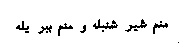
The poem ascribed to Bahram had been doctored. If it was not for Ibn-i Khurdadbih's statement in Al-Masalik wa al-Mamalik, we could consider it a figment of the imagination of the historians and story tellers. But we have to give some weight to Ibn-i Khurdadbih's statement that the following had existed:
|
However, most scholars do not accept the Dari ascription and consider this poem to be in heptameter, i.e., containing seven syllabic feet.
The Surud-i Karkui, too, in spite of Bahar's ascription of Dari to it,and in spite of the poem's originality, cannot be considered Dari as long as the time of its composition is debatable. Conjecture places it after the Arab conquest but, even then and even if we accept it as Dari, it is not the oldest. We must search for even more ancient specimens. As mentioned, Tarikh-i Qum and Mujmal al-Tawarikh record some poems ascribed to Huma-i Chihrzad and Ardashir-i Babakan but, if these were Dari verses, why are there no mentions of them in our literary histories?We know that before the Arab invasion, Persian verse, being syllabic, did not conform to the Arabic metric system. Those familiar with the Arabic meters, considered the syllabic verse to be a kind of prose. That is why Awfi, who was familiar with the Arabic metric system, assessed Bahram's syllabic verse as follows: "He [Bahram] was the first to compose poetry in Persian. During the time of Parviz many such compositions existed and were put to music by Borbad.
But, since these poems are devoid of meter, rhyme, and the other trappings of poetry, we have not dealt with them in any substantial manner."This statement indicates that even at the time of Awfi some form of the syllabic verse was still in existence. The frequent references to the songs of Borbad and Nakisa in Persian, during early Islamic times, is indicative of the prevalence of this kind of verse at that time. Furthermore, there are documents indicating that Borbad's verses had been published at that time. The following poem of Mujladi (or Makhlidi) Gurgani, who lived at the end of the 4th or beginning of the 5th century AH, is indicative of that: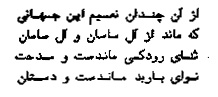
|
Regarding this Edward states: "There can be no doubt that Sassanian courts were filled with music and with songs and that the trend was, at the least, reflected in post-Sassanian times. No matter how drastically the change to a metric system may have affected the syllabic poetry of ancient Iran, at least superficially, the quatrain and the ode are Iranian in origin."
Elsewhere says, "Although Persian poetry reached its apogee in the 10th century in Khurasan, ... there is a story that indicates its existence at the Sassanian courts. This story is repeatedly recorded in trusted ancient sources, only the name of the musician takes various forms. The difference is, perhaps, in the rendition of the Pahlavi form. I cannot but say that the subject calls for deeper investigation."The above statements indicate that the Farsi language had been spoken at the Sassanian court alongside Pahlavi, that it had been a literary language with its own verse form, and that in later (i.e., post-Sassanian times it had appeared as Dari. One of the examples of poetry of this period frequently discussed by the literary sources, is the songs of Borbad, musician, performer, and theoretician. He lived at the time of Khusrau Parviz and there are many references to his legend in the literature of subsequent centuries.
Christensen says, "Burhan-i Qati' mentions thirty songs that had been composed by Borbad for Khusrau Parviz. The same statement is repeated in Nizami's Khusrau and Shirin with a slight discrepancy. Ascribing the Khusravanis to Borbad, Tha'alibi says that even during his time, musicians performed the khusravanis in the festivities sponsored by the kings and others. In fact, khusravani has not been just one song or melody. Awfi refers to khusravani in the sense of the Seven Royal Dastgahs which Mas'udi calls al-Turuq al-Mulukiyyah..."
These seven rah's are mentioned by both Mas'udi and Ibn-i Khurdadbih. Mas'udi, however, gives the number to be seven, while Ibn-i Khurdadbih gives eight.Before producing samples of the khusravaniyyat, i.e., poetry that is syllabic and possibly written in Dari, we shall first proceed to examine the khusravaniyyat genre. Bahar recognizes them as poems written in praise of kings, mu'bads, God, and the temple of fire. They are referred to as surud (songs) or khusravani songs.
Huma'i recognizes the khusravanis as a type of rhymed verse composed by Borbad in praise of Khusrau Parviz. They were sung with a special melody. Nasir al-Din Tusi, in Asas al-Iqtibas, refers to them as a kind of pseudo-metric verse. He distinguishes them as forms composed of equal syllables resembling metric verse compositions. The Tarikh-i Sistan relates the Persian language to music and the writer of al-Mu'jam speaks about Borbad (from Jahrum) as a master musician composing poetry for Khusrau Parviz's festivities. Even though the entire composition is in praise of Khusrau Parviz, he says, it is recited in prose. And Abu Hilal Askari says the following in his al-Sana'atain about khusravani. It is a melody in present-day Farsi wherein the words are used in a non-verse composition. They are poems which can be classified as such only due to the lengthening applied to otherwise simple prose forms."Lughatnama-i Dehkhuda, Burhan-i Qati', Anandraj, Qiyas al-Lughat, Anjuman Ara, and Mahshi al-Lughat all support the statements presented above.
Furthermore, Mehdi Akhavan-Sales (M. Omid) presents a comprehensive and well-documented survey in Yaghma of the khusravanis. Unfortunately, he does not produce any samples and rests his case mostly on Bahar's assertions regarding the poetry of the Samanid poet Abu Talib Tayyib Ibn-i Muhammad in Lughat-i Furs-i Asadi. In other words, he guesses. In any event, as long as the form belongs to post-Sassanian times, we should be on the lookout for a more ancient specimen.There is a stanza in Ibn-i Khurdadbih's Mukhtarat min Kitab al-Lahv wa al-Malahi that, I believe, deserves particular attention. Ibn-i Khurdadbih, of course, is known for his contribution to history, geography, and music during the third century AH. The piece is ancient and is presented by a student of Ishaq Musili, a student well-versed in the history of Persian music.
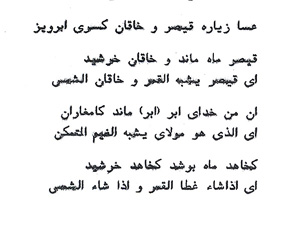
Further support for the credentials of Musili is found in Mas'udi's Muravvij al-Zahab. Mas'udi explains how Musili appeared at the court of the Abbasid Caliph al-Mu'tamid and was commissioned to lecture on international music.In this book, the original of which is no longer extant, but excerpts of which have survived and have recently been published, we read: "...the greatest Iranian musician at the court of Khusrau Parviz has been Bahlbad (Borbad) from Ray, a skilled lute player who composed songs, played music, and sang songs for Khusrau Parviz. Often he communicated the more distressing items of news, news that others did not dare mention to Khusrau, by incorporating such news in his songs. Altogether, fifty such songs are recognized. The following is an example:
|
Even without the Arabic translation, a present-day Iranian understands this poem.
 is, of course, "cloud" as attested by
  and
and  is
is  . The problematic part is, perhaps, the introductory phrase that could mean "At the time of visiting the Caesar, Khaqan, King of Kings Parviz. It is not a part of the poem because, unlike the hemstitches of the poem, it does not have an original form.
Returning to the piece itself, each hemstitch consists of 10-11 syllables. We cannot give an exact number, of course, because we don't know how the poem-with long and short syllables-was read at that time.
The discovery of this poem not only provides us with an ancient poetic form that harks to the time of Khusrau Parviz, but it also throws light on some other issues as well. The first is a recognition of the syllabic nature of the poetry of that time. Literary historians unfamiliar with the metric system mistook it for prose used by Borbad as the base for his compositions. Only Nasir al-Din , who was familiar with the syllabic system, refers to khusravaniyyat as a type of pseudo-metric form.
Of course, on the basis of this single verse, we cannot posit that poetry in ancient times was exclusively syllabic. This poem only confirms that the metric verse was introduced into Iran by the Arabs.
It also rejects Huma'i's view that posits the existence of a metric system for Sassanian times. Although in defense of Huma'i, we should add that he does not state this position firmly, rather, he makes inferences on the basis of music. Finally, this poem supports the statement of Ibn-i Muqaffa' and Hamza-i Isfahani, and others that the Dari language was spoken atthe court of the Sassanians and that it had its own literature and songs.
| Ma'ruf
(Tajikistan) |
The Musical Culture of Iran at the Beginning of the Middle Ages
Manuscripts play a crucial role in research by revealing important data regarding the various aspects of Iranian and, indeed, Tajik civilizations. Based on sources written in different languages and in varied contexts-literary, geographical, or religious-researchers can formulate specific views regarding the political, economic, social, cultural, and civilizational aspects of historical eras. Translations of Arabic sources into Perso-Tajik which were commissioned by scholars, nobles, and wazirs of the Samanid era (AD 874-999) deal with the history of Iran at the time of the Sassanids (AD 224-651). The relations between the Iranians and the Hephthalites of Varazrud and Khurasan, including military, political, economic, and cultural ties during the fourth to sixth centuries fall within this time period. During the Samanid era, authors, copyists, and translators paid special attention to the ethnic ties, geographic boundaries, languages and, in particular, the musical tradition of the Hephthalites. In order to understand the social, political, and economic dynamics of the musical culture of the Iranian peoples of the Sassanid and Hephthalite eras, therefore, we must research the books that were authored, copied, or translated during the Samanid period. The result must then be compared with our finds in archaeology, numismatics, and other such fields. One such source that demands our special attention is the
Tarikh-i Tabari of Abu Ali .In AD 963, commissioned by Abu Salih Mansur Ibn-i Nuh (AD 961-976), the Samanid wazir, Abu Ali Muhammad Ibn-i Muhammad Ibn-i Ubaidullah-i (d. 974), began the translation into Tajiki of the Arabic text of the Perso-Islamic scientist Imam Abu Ja'far Muhammad Ibn-i Ja'far Ibn-i Yazid-i al-Tabari (AD 829-923). Called the Tarikh al-Rusul wa al-Muluk (History of the Prophets and Kings), the work deals with world events from the beginnings to the year AD 915, i.e., to the middle of the reign of the Abbasid Caliph al-Muqtadir (AD 908-932). 's work which covers the events until AD 824, i.e., until the death of Caliph al-Mu'tasim, is known as the Tarikh-i Tabari of Abu Ali Bal'ami.
Nevertheless, it is obvious that the materials presented by are not sufficient for a comprehensive study of the musical traditions of the Iranian peoples at the beginning of the Middle Ages. Tabari's data is not original to him. Furthermore, many of the sources on Iranian musicians and dancers, used by in his work, have not survived. 's own insight, however, is of great significance for the study of the musical culture of the Iranians. 's work, like Tabari's, can serve us as an informed guide. Without such a guide it would be impossible to trace the contributions of the Iranian musical tradition in the Arabic sources. And we are speaking about works that, according to al-Dinavary (AD 828-889), formed the bulk of the knowledge of the savants of the reign of Caliph Umar al-Khattab (AD 634-644).
Compared to the scholars who followed, too, we find 's knowledge of the pre-Islamic musical culture to have been noteworthy.
All this has brought us to an examination of the contents of al-Tabari's work on the subject of the musical culture of the Iranians before the advent of Islam. After all, at a time when the culture of the Tajiks is being "revived," we should know what status it held during the early Islamic times and what light additional sources can shed on the subject. Some of what is outlined below will be a reiteration of facts, of course, but there is still some merit in the exercise. Although worth close scrutiny, 's views on the musical culture have not been studied before.Although Tarikh-i Tabari is redolent with information about the lifestyle and culture of pre-Islamic Iran, it is 's contribution to it, especially on the musical culture, that makes the work attractive. 's coverage of the musical culture at various courts is brief, of course, but when it comes to the court of Khusrau Parviz (AD 590-628), his views become focused and poignant. In fact, it is this kind of informative contribution by Bal'ami that has gained fame for al-Tabari's Tarikh.
According to Tabari, Khusrau Parviz was the most astute, brave, and insightful of the Sassanian monarchs. He was called Parviz (victorious) because he had gathered the most wealth and because he had excelled in Luck among his peers.
Recalling Khusrau Parviz's reign, writes, "Parviz had a treasure which he called 'Badavarda' (blown in by the wind). Originally, this was a treasure that was being sent by the Emperor of Rome to Ethiopia. It was carried on a thousand ships all filled with gold, precious stones, pearls, rubies, and silks. The ship [sic] was sunk in a storm but the cargo, brought to the shore by the wind, fell into the hands of Parviz and was called Ganj-i Badavarda... Furthermore, 12,000 maidens served at the court of Parviz as singers, dancers...and he had a unique musician called Borbad..."
Similarly, Parviz's wife, beautiful Shirin, had gathered dancers and singers like Borbad, Sarkash, and Khushazarvak around her to enhance her knowledge of the national music of Iran. The directorship of the activities of these performers, singers, composers, and clowns at Shirin's "White Pavilion" was entrusted to Borbad. It was also at this very juncture when Parviz was being entertained by the Great Borbad, that historical Tajikistan began its life under the Turkish Khaqan of the Hephthalites. The Hephthalite government, a superpower of that time, had created strong political and cultural ties with the countries of the world, especially with China. Records indicate that between AD 507 and 531, the Hephthalites sent 13 embassies to the court of the Toba-Vays. Among the members of the embassies there were musicians and performers as well.Under the rule of the Khaqan of the Turks, the historical regions of Varazrud-Takharistan and Sughd were consolidated into independent states. The views of Abu Ali and the other authors regarding the musical tradition of the peoples of Varazrud, Takharistan, and Sughd during the Middle Ages is as follows. Both regions of Takharistan and Sughd are the homeland of Borbad-i Marvazi. Unlike Iranshahr and Khurasan that formed a single government, Takharistan and Sughd were separate political entities. Takharistan consisted of the southern and central regions of present-day Tajikistan, the Surkhan-Darya region of Uzbekistan, and northern Afghanistan. And this vast region, according to the Chinese traveler, Siyun Tszan, was divided by national boundaries into twenty-seven nearly independent kingdoms. Like Takharistan, Sughd, too, had its own constituents, including two regions, five urban districts, and fourteen rural districts in the Zarafshan and Qashqa Darya Valleys.
In tandem with the development of the musical cultures of Iranshahr and Khurasan at the court of the Sassanians under the Great Borbad, in Takharistan and Sughd, too, similar efforts were underway for performance, voice, and research in aspects of musical culture. The situation of solo instrumentation and voice in the context of literature, philosophy, and ethics was improving and expanding. Indeed, according to various written sources and archaeological finds, among the Takhari and Sughdian musicians of the time, Borbad-i Marvazi's "seasonal" and "ritual" songs occupied a special position. Chinese and Perso-Islamic sources indicate that the Takharistanis and the Sughdians used small and large drums, various types of flutes (nai and qaranai), lute, and large and small tambourines, and dutar. N. B. Bentovich states that in their performances the Sughdians employed more than eighteen different instruments.
During the fifth to the eighth centuries, historical Takharistan and Sughd had a considerable musical culture. In spite of the silence of the Perso-Islamic sources about what had existed, Chinese sources and recent archaeological finds point to a high level of musical culture in Takharistan and Sughd. They also indicate that Sassanian Iran's musical culture was positively impacted by this eastern development. Of course a great deal of this activity between Takharistan/Sughd and eastern (China) and western (Roman) lands depended on increased trade among the peoples involved. The best musicians, performers, singers, and clowns accompanied the trades people, ambassadors, and visitors to those lands. Discoveries at ancient Panjkent, Afrasiyab, Varakhshah, Tal-i Barzu, Ajinnateppe, and Balalikteppe indicate the type of professionals that lived and performed in Sughd and Takharistan during the time of Borbad-i Marvazi. In fact, images of musicians playing different musical instruments have been discovered in Panjkent, Ajinnateppe, Balalikteppe, and in the ruins of Khatlan. In the ruins of Panjkent we encounter the image of a beautiful woman in a white dress. She wears a crown made of gold and golden rings.
Elsewhere we encounter four women, musicians and singers, playing various instruments and singing.Furthermore, in the palaces of the rulers of Khatlan, I. Ghulamova has discovered the pictures of two women one of whom is playing the ''ud and the other the ghizhzhak. In addition, in his search in Balalikteppe, L. I. Albaum has found the broken pieces of the body of a tar and the handle of a ghizhzhak. The evidence outlined above proves that the musical cultures of Takharistan and Sughd had been on a par with the musical cultures of Iran and Khurasan.Chinese sources-The History of the Sung Dynasty
(AD 581-618), The History of the Tang Dynasty (AD 618-907), and The New History of the Tang Dynasty-contain a wealth of information about the Sughdian and Takhari singers, dancers, clowns, and the instruments they employed. The authors of the History of the Sung Dynasty, after much deliberation on the musical culture of the Sughdians write, "Our knowledge of Samarqand goes back to the time when Emperor Ja'in II(AD 561-577) married a girl from the northern villages and brought her here. Actors from those areas accompanied the new queen to our land. This occurrence brought the musical culture of the newcomers to the notice of the emperor. The "Tszidiyan-Nunkhechzhin"songs were favorites.Apparently, over the centuries, the music of
the west (Chinese view), from Sughd to Khurasan, had many supporters amongtheChinese, Tibetans,andIndians;.Thisattraction to western music was intensified even more during the Sung and Tang dynasties.I. Shafer, an Americanmusicologist, writes that whenever western regions were conquered by the Chinese, their music, too, was treated like a "slave." Music was expected to be delivered to the conqueror. At the court, the emperor's chosen individuals were assigned to special "bureaus." According to the annals of the Sung Dynasty as many as seven bureaus, including bureausforSamarqand;andBukhara,wereestablished.When discussing the music of Samarqand and Bukhara, mention is made of the flute, naqarah, lute, tambourine, wind instruments, as well as ten other instruments. In the Bukhara bureau twelve artists, and dancers, singers, and were at work. A realist observer of the scene states that the Chinese were jealous of the progress that the Takharistanis and the Sughdians had made. The attendants of the Emperor of China as well as the Emperor himself were entertained by Bukharan artists-flute players from Samarqand, surna players from Khutan, and Dancers from Chach.According to the information in Chinese chronicles presented by Shafer in his Shaftaluha-i Zarrin-i Samarqand, in AD 713, the ruler of Samarqand sent a number of dancers as gifts to the court of Siyan Tszun (AD 710-755). Similar gifts were sent by the governors of Kumid (AD 719), Kish, Samarqand (AD 727), and Maimurgh (AD 733). In addition to dancers, singers and musicians, too, were sent to China from Takharistan and Sughd.
Chinese sources include pictures of some of the Takhari dances like Gului, Khytenu, Chzhenzhi, and, especially, Khusyunu. According to these sources, there were two types of Takhari dances: quiet and agile. The quiet dance had smooth moves with which the dancer soothed the audiences. But the dance that the Chinese youth preferred was called "jumping." It was performed by Sughdian and Chachi performers. The young dancers wore vaskats, long hats and shoes and danced to the music of the surnai. The Chinese audiences also liked the "Chachi" dance performed by Sughdian girls wearing tasseled hats, embroidered dresses, gold or silver belts, and gold embroidered shoes. The music was played by the famous Sughdian artist, Kan-Kunlin.The most famous of the dances of the Sughdians was the "Whirlwind" or khusyunu. The dancer included several whirling moves in her initial act referred to as "the girl's whirlwind moves." According to Shafer, when performing this dance, "Sughdian girls, wearing red dresses, green capes, and red shoes danced their way from one side of the stage to the other, including flighty moves and jumps in the act. At the climax of the dance, the Sughdian dancers winked at the audience, increasing the impact of the dance. Often the dancer's moves were so fast that a poet had remarked, "Any increase in the jump would, like a piece of a cloud, hurl her into space." At the time the emperor, his wife Lady Yan, and Rakshan favored this dance. The emperor's wife had gone as far as learning this dance while Chinese poets composed many poems about it and about the beauty of the eyes of the Sughdian dancers.
Within
Takharistan;andSughd,too,likeinIranshahrand Khurasan, music continued its development. According to the annals of the Tang Dynasty, "On the eleventh month, the Sughdians, tambourine in hand, danced, asking for rain or warmth. In their happy mood, they sprinkled water on each other," or "The Sughdians in large numbers danced in the streets and sang."The foregoing was a brief look at the history of the development of the musical culture of pre-Islamic Sughdia and Takharistan as outlined in Tabari's History and in the annals of China. the analysis was not meant to be comprehensive. It is hoped that researchers will continue the effort thus started.
|
Iraj Gulsurkhi
(Iran) |
Music in the Shahname
Firdowsi enumerates many musical compositions in his Shahname among which surud, bazh, and taranah can be mentioned. This kind of music predates the Shahname by some seven centuries.
Surud is a type of music that does not have any religious connotations. It included, with certain variations, the music of the court, military music, music played at lower courts, and at the houses of nobility. The music played at court was referred to as khusravani. This khusravani, of course, was different from the type of music recognized by the same name, i.e., the music that still exists in the Humayun maqam and other maqams and the native form of which is found among the present-day Lurs, Kurds, and Azerbaijanis. Fortunately, the original form of this music is rendered in notes and can be reproduced. In recent times, however, surud has assumed an exclusively military use in marches. A number of khusravanis have survived from the time of Borbad and there may have been khusravanis by others, given the fact that Borbad composed his works exclusively for Khusrau Parviz. There are still singers in Luristan and Kurdistan who perform khusravanis. The themes of these compositions are centered exclusively on the lives of the kings. Recently, I recorded a khusravani called Khusrau and Shirin in Luristan. It is in the Luri dialect. And I should add that folk Shahname, i.e., the Shahname that has passed from generation to generation orally, is several times longer than Firdowsi's original. Thus, the composition of khusravani continues. There is even a khusravani about Karim Khan of the Zand Dynasty. The recitations are accompanied by kamancheh, often with nai-i duziyaneh or dunai, or
withthetambourine. Khusravanis abound in Azerbaijan, Aran, Armenia, and Georgia. Shah Isma'il, Kurughli, and others have khusravanis of their own.Bazh is used in the context of worship and as such is a kind of religious zamzamkhani. It encompasses the recitation of all the hymns of Zoroaster. Indeed the hymns began with zamzamkhani and, with audience participation, reached their climax. Examples of Yasna 47, prepared for chorus and a wonderful bazh copied from the Alvand stele of the time of Xerxes, are available.
Taranah belongs to the public at large. In Persian "tar" means "wet," but in this case it means "fresh." Taranah, therefore, is a musical piece that is constantly renewed. The word "reng" in Persian is a corruption of tarangeh or taranah. A different type of taranah is employed at the end of each maqam performance.
Lands in Which Persian Music Thrives
The Persian language, especially in its Dari form, brings a large body of people together. But this gathering is in no way comparable to the one that is brought together by Persian music. By Persian music, of course, we mean the shur, mahur, nahavand, dugah, chahargah, and the recitation of the Shahname with its special heroic rhythm. Persian music is recognized in Armenia, Turkey, Uzbekistan, Iraq, Syria, Lebanon, Saudi Arabia, Egypt, Libya, Tunisia, Algeria, Morocco, Spain, Southern Europe, Bulgaria, Rumania, even in Austria. It has influenced the works of Ludwig van Beethoven, Wolfgang Mozart, Johannes Brahms, Dukhnani, Franz Liszt, Gadail, Bela Bartok, and Arkal. George Ansko uses Iranian melodies of the Humayun and Chakavak type in his First Rhapsody. The history of the influence of Persian music in Africa is outside the purview of this study. In this regard, suffice it to say that the Iranian musician, Zaryab, who was at the Abbasid court at Baghdad, traveled to Spain and, while there, set up a school of music and taught the fundamentals of Persian music. Zaryab's compositions are well-known in Spain. They were prepared for the guitar in 1993.
The Predecessors
In spite of the manipulation of the information on the role of Persian music on the music of the Abbasid court, it is evident that Persian music and the Pahlavi language have had their impact. Abu al-Faraj , quoting Ali Ibn-i Yahya on the fifth tar of barbat states the following, "A long discussion occurred between Ishaq, the son of Musa Musili and Ishaq, the son of Ibrahim Mus'ab. Musili asked, 'Did you hear what he asked me? He could not figure out a simple thing like that by himself. He must have learned this from the books of the predecessors. I am sure that they have translators and that such things are being translated for them. If you happen to come across such books, keep me in mind'."
The foregoing shows that during the reign of the early Abbasid Caliphs, thanks to Iranian wazirs and amirs, books on music were translated into Arabic. Even al-, documenting his sources, refers to them as the "predecessors." Neither Ibrahim, nor his son Ishaq Musili, has divulged the secret of their trade. Their secrecy and the secrecy of the other professionals at the courts of the Abbasids create a mushroom of the Arabic culture of that time-it has an attractive facade but lacks substance of its own. And even that would not have been possible without marginalizing the efforts of the custodians of the previous culture and without generalizing their contributions under the term "predecessors."
The Caliph al-Mansur's astronomer who preserved the Zoroastrian tenets and whose family is well-known and trustworthy had a grandson called Yahya (d. 932). In his work called al-Nagham, in several places, Yahya refers to "the assertions of the ancients on music," but he never explains who those ancients are. Historical Traditions of the Time of Rudaki
The time of the pioneer poet of the Iranian peoples, Rudaki (d. 941), coincides with Iranian civilization's epoch of scientific, literary, and cultural achievements. The greatest minds of the time converged in Bukhara, the focal point of the sciences, literary developments, and artistic innovations, where theoretical and practical aspects of the fine arts, including music, were studied and enhanced.
Arab and Perso-Tajik authors have written extensively on the art of music of the Rudaki era and have explained the major trends in composition, innovation, and instrumentation. Their contributions distinguish this era as the period of the revival of Iranian culture in the East.
Regarded as one of the mainstays of the culture, music is deeply rooted in the cultural traditions of ancient Iran, especially during the Sassanian era. The music of the Sassanians was not only original but was rich enough to nourish music geniuses like Borbad, Nakisa, Sarkab, Sarkash, Gisu Navagar, Azadvar-i Jangi, and others who specialized in music for the masses. The Arab invasion and the subsequent politics of marginalization of Iran put an end to this musical culture and postponed the recognition, development and appreciation of the instruments, voice, style, and performance for centuries; it halted research in the field. Many shining stars were sacrificed to the bigotry of the invading forces. Much of this literature perished. The rest was subsumed under Arab identity. It was not until the rule of the Samanids that Iranian culture reasserted itself.
Strictly speaking, the scientific and practical music of the Sassanian era is original in nature. There were, of course, influences from Greece, Babylon, Egypt, and India. It is, however, the essence of that music that was original to the Iranian lands. Furthermore, the Sassanians were eager to discover new grounds but, within that effort, too, they emphasized the Iranian roots of their music. In spite of their wild nature, the Arabs did not destroy that aspect of Iranian culture. On the contrary, the palaces of the caliphs of Islam were filled with the melodies produced by Iranian instruments played by Iranian peoples. In the long run, the free spirit of the adherents of this trend brought about the emergence of what came to be known as the "Shu'ubiyyah."
The rich traditions of voice and instrumentation of the Sassanian era eventually surfaced during the reign of the Samanids with a new style and a revived vigor. The directors and the teachers at the Samanid court drew on the Sassanian experience for inspiration. Following the Sassanian model, Samanid officials reestablished a new musical culture, a synthesis of poetry and music that affected performance, instruction, publication, and development of the arts in general. At this time, therefore, we observe an elevation in the status of professional musicians Instruction of music as a basic science, using encyclopedias as textbooks, became an established method. This new attraction to music also affected the status of the singers, composers, and rawis who frequently found themselves in key positions in the government and politics of the realm. Important decisions could no longer be made without the input of artists. Eventually, an office called "Khurram Bash" or "Director of Fine Arts" was established. In addition to the artists, this office also drew on the talents of a bevy of experienced consultants from other fields.
It should be added that until the time of the Samanids, the Iranians had to exercise a degree of secrecy in the performance of their cultural rites. The Samanid rulers were partial to music and, for the administration of their realm, imitated the Sassanians. In Baghdad, the Caliph al-Muqtadir attracted poets, musicians, and representatives of other aspects of the musical culture. All these artists At the Samanid court, the synthesis of poetry and music that had begun under the Sassanians continued and led to a series of innovations in the ancient art and in its enrichment. Alongside the musicians, at this time, we also find poets like Abu Hafs-i Sughdi (d. 902), Rudaki, and others whose works complemented the efforts of the musicians. Some even incorporated music in their poetic recitations.
The artists of this time included Abu al-Abbas Bakhtiyar (9th-10th century), Isa Barbati (d. 941), Abu Hafs-i Sughdi, Mahmud Rubabi (d. 932), Abulhassan Jamasara (d. 952), Ahmad Khunyagar (d. 972), and other scholars and experts. They conveyed the musical tradition of Borbad (586-636/38), Nakisa (549-623), Ramtin (547-620), and Gisu Navagar (589-640) in a new format. The Khusravani, Lakui, Uramani are various types of Pahlavi songs, known in post-Sassanian times as fahlaviyyat. In fact, composition of the fahlaviyyat initiated a new trend in the artistic life of the times, many composers presented their own fahlaviyyat.
Lakui or Laskavi is the name of a musical form. The name is derived from the name of a beautiful singing bird. The lyric for this music was of the panegyric type and its formation is attributed to Borbad. During the time of Rudaki, this form was used very frequently. Indeed, Rudaki's bu-i ju-i muliyan is composed with this form in mind. It should be emphasized that, during the Sassanian era, the poet and the musician were often the same person. For this reason, Borbad, Ramtin, Azadkar-i Jangi (586-622), Sarkash (568-625), Gisu Navagar, and others were respected; they were treated as talented poets of their time. This trend was continued by the Samanid artists and was developed to its full potential by Rudaki and his contemporaries.
The combination of voice and instrumental music emerged as taranak (tranik), Chama (Chikamak), sarvod (surud), pazhvazhak, etc. Taranah(tranik) or chama (chikamak) also is among the most developed and recognized forms of the time of Rudaki. Many researchers, including Tajiks, recognize Rudaki as the founder of the genre.
We must add that this type of music (i.e., taranah), form and content, took shape under the Sassanians and that it appeared in two types. The first type is related to Borbad and his time. He was the first, to create the calendar or seasonal taranahs. The other type of taranah was called "rustic" taranah (rustak tranik). The style and the manner of its performance belong to the villages. It is the texts of these songs that are identified as fahlaviyyat.
These two types, i.e., taranah and chama, are mentioned in Abu Nasr al-'s Kitab al-Kafi al-Musiqi as taraiq and ravashin. Furthermore, this kind of music was related to the professional classes of Bukhara, Sughd, and Khurasan who listened to that music to relax after a hard day's work. The music itself is produced on ancient instruments and is accompanied by chorus. In cities, this music assumed local color and special distinctive features. This type of music was distinguished as professional and dated back to Borbad and the other masters of the Sassanian era. Many ancient sources reveal that the Arabic metric system is rooted in this era of Persian music. The important point then is that the well-spring of Arabic music is the musical culture of the Sassanians.
The form and the structure of the lyrics of the Sassanian period are based on three distichs, the very form that is retained and appears in Rudaki's compositions. That is why we cannot claim Rudaki as the founder of the taranah. Nevertheless, the same musical, literary, and historical sources relate that the lyrical aspect of the taranah flourished at that time. Furthermore, this music exerted a great deal of influence on the musical culture that developed at the same time at the court of the Umayyid Caliphs. In fact, the great musicians at the Arabian courts, musicians like the Musilis, Nashit-i Fars, Shahda-i Fars, and others, were all Iranian. Indeed, musicians like Alavaih-i Sughdi, Khurram-i Samarqandi, Bashar-i Burd-i Takharistani, and others held high positions at the Abbasid court. They have not only attributed their knowledge of music to ancient Iran, but have cultivated that musical culture as well. There are many statements like the following: "The Arabs have not made any contributions to music; the music at the court of the caliphs is nothing but Iranian music."
Similarly, there is another form called khurasani which also flourished during the Samanid times. This form, which was performed for relaxation, was based on the speech of the common people, had a very complex performance feature, and used the saz for instrumentation. The structure of this music is explained by Abu Nasr al- who traces its history to the Sassanian times. During the Samanids, this genre is developed further and is called khurasanikhani. Many master musicians like Muhammad Khusravai or Khurasani (d. 951), Jangi-i Mudaknir (d. 961), Isa Barbati, and others are known to have worked with this genre. Explaining the art of khurasanikhani, Rudaki says:
Askarali Rajabov
(Tajikistan)

|
Another of the genres prevalent during the time of Rudaki was the sarvad, surud, chakamak which also had taken shape as a vocal form during the Sassanian era. This genre, too, rooted in the efforts of Borbad, Nakisa, Bamshad, Azadvar, Gisu Navagar, and others was formalized during the Samanid era.
Mavara'unnahri and Surud-i Parsi, too, belong to the time of Borbad and are fully developed at this time. Rudaki proves his mastery in this genre in his "Lament in Old Age":

|
Without a doubt, the musical culture of the time of Rudaki had been very varied, revealing the aesthetic diversity and the richness of the Sassanian court. The development of the musical culture of the Samanids was not limited to that dynasty. Classical music received special attention and schools of music were taught by experts like Abu al-Abbas Bakhtiyar. The scholars at the school researched the theoretical aspects of music discussed in the works of the ancient Greeks and devised new methodologies. Besides, not all the scholars followed this trend. Katibi-i Khwarazmi (910-980), Abu al-Abbas Sarakhsi (d. 930), Ahmad Sarakhsi (d. 899), Abu al-Vafa-i Buzjani (940-998), Abu Nasr al-, Ibn-i Sina (980-1037), and others chose to continue the traditions of their ancient ancestors. The scientific and practical musical school of the Samanids alongside research in the works of their Iranian predecessors made noteworthy contributions in the instruction and translation of the works of such Greek scholars as Plato, Aristoksin, Nikomakhus, Aristotle, Ptolomy, and others. The methods of analysis, especially the manner in which the Greeks related music to the movement of the spheres, was criticized and music study was found on a scientific basis.
Because of this bold step taken at that time the musical culture of the Samanids is devoid of cosmological and legendary connotations and explanations. The musical culture of this era is based on works like Traniknamak or the book of taranahs and on chapters from Andarz-i Khusrau Qubadan, and Khusrau Qubadan va Qulam-i Dana-i U, works that had survived the Arab invasion. By using these sources, the national spirit of the ancient music is recaptured. In addition, the music researchers of the time did not limit their understanding of music to the local sources. Rather they expanded their reach and incorporated much of the musical knowledge of the time into their original creations. This method of research was the hallmark of the contributors of the Rudaki era. The results of these innovations in scholarship appear in the works of Abu al-Abbas Sarakhsi, Ahmad Sarakhsi, Abu Nasr al-, Ibn-i Sina, Zaila-i Isfahani, and others.
The belief that the Samanid music scholars imitated the Greeks is patently false. The music of this era has an exclusively local color and feel. Al-'s introductory note to Kitab al-Musiqi al-Kabir addresses this issue. "The Pythagorean thought that relates the creation of music to the movement of heavenly bodies must be rejected. The roots of music are in our knowledge and what is outlined here is the result of the efforts of our ancestors in this field-it represents their perception, talent, and understanding of this art."
Another important aspect of the Rudaki era is the devotion of the researchers to the revival of the traditions of the ancients. They concentrated their efforts on the pre-Islamic music of Ma Wara' al-Nahr and Khurasan, abandoning the musical developments that had been heavily influenced by Arab thought. Instead, they grafted the traditions of the Sassanians and the Sughdians to the body of their own innovations and compositions. It is at this time that, in spite of the barbarism of the Arabs, Abu al-Abbas Sarakhsi, Ahmad Sarakhsi, Abu al-Abbas Bakhtiyar, and others gathered the remnants of the musical culture of the past and recorded it for posterity.
Another contribution of the scholars of this time was a scientific compilation of the vocal and instrumental terminology. Forms like Tarak (zakhmazani), santur, chaqanah, shahrud, zangalak (zang), vanchak (vin), nai, dora (daira), taburak, shaipur, zandvar, zir, bam, barbat, dastan, mushta, rubab, ghizhzhak, zamzama, chama (chikama), taranah (tranak), surud (sarvad), and others were injected into the body of the scientific and practical literature at this time.
Still other aspects investigated at this time are the aesthetic, spiritual, and finesse of music as well as its public appeal to both scientists and artists. And none of this investigation is based on Greek contributions. Rather, it is an investigation that concerns the very life of the contemporary peoples and of their ancestral legacy. Recognition and instruction of the contributions of Rudaki will, without a doubt, enhance our appreciation of our fine arts.
|
Mehdi Akhavan-Sales
(Iran) |
Our Music
(In Memory of Sadeq Hedayat)
Our music is deep and sublime, humane and innocent. Its world encompasses our joys and pleasures as much as our laments and sorrows. But more than everything our music is delicate. It imparts serenity to the soul and affects us in ways that cannot be described in words.
I really cannot hide my feelings for our music (fortunately, my westernization has not reached that point yet). The melody of the tar devastates me to no end, especially in bayat-i turk, or Humayun, or Abu Ata, or Shur, or sigah, or chargah, or bayat-i Isfahan, or afshari, or mahur, or any of the others. I derive a similar enjoyment from listening to the sitar, santur, and kamanche. Recently, I have begun to enjoy violin and piano performances as well. We also should not forget suzani. Its music is in our blood... is of us... is us.
There is a condition, however, for the appreciation of this music. The individual should live in Iran until the age of twenty or thirty. After that nothing can replace the impact of Persian music on him or her. And you will not be able to deny its impact. The question, however, is this. Do we have to deny this feeling? Modernization and progress demand that we deny that our traditional music thrills us. And, unfortunately, many conform. Snobbism affected us from when, in ancient times, we set eyes on Westerners. Until today, like leprosy, their acquaintance has been eating away at our lives.
* * *
Dr. Tafazzuli, a good sitar player, spoke to me about his meetings of a number of years prior to our conversation with Sadiq Hedayat, in Paris, "Hedayat Sadiq and I met occasionally," he said. "One day he happened to be near my house. We watched the people, walked, and talked until we reached my house. I invited him in and he accepted. Inside, we rested and talked about diverse subjects as distant as Ray and Rome and Baghdad. We also imbibed an "elixir" that I had brought some time ago from Europe. We then talked about music. I suggested playing a record or two on the record player. He did not react. I named several records asking for his input, he did not respond. I enumerated the best of the Western singers, he remained silent. He eventually rose and, holding his drink, walked to the cupboard. When he returned, he was carrying my sitar. I was astounded as he handed the sitar to me and sat down. I had heard that he was not fond of Persian music.
The sitar was tuned for [bayat] turk. I began playing, beginning with an overture leading to gushas and farazes. It was a special time in our lives. Our youth mingled with the drink and the song. He sat there, nodded quietly and murmured something. Moments later he brought me some sweetmeat, asked me to play afshari and returned to his place and sat down, waiting in silence.
I tuned the sitar and began, passing boldly each stage, getting further and further into the spirit of the music. Suddenly I heard cry. 'Stop, stop!' he said, and began to weep.
I put the instrument down and ran to him. He held me back with his hand and indicated that I should leave him alone. I did.
We returned to the food and the drink and the talk. I hoped that we would reach a stage where I could ask him about his reaction to the music. He read my thoughts. 'A lot is said about me and my negative attitude toward our music,' he said, 'but they are all lies. I can never deny the depth and the purity of this music. Never. It entrances me and plays havoc with my soul. It drives me to insanity. It drains my energy.'"
* * *
"'What were we talking about?' he asked rhetorically. 'We were talking about the spiritual depth of this music in our being. Yet often I feel this music to be bound, as if confined to four walls where its notes and melodies fail to mingle. I feel our music has the serenity of the mountain brooks and, thereby, lacks the tumultuous waves of the ocean. Furthermore, it is filled with agony and submission to the will of God rather than with determination, anger, and decisive action. It lacks warmth. It is the music of the enslaved; the music of those who have suffered and who have been humiliated. There is nothing in it about victory, bravery, and standing proud before history. Yet it is a simple music, especially for those who understand it. Whereas the works of Beethoven and Tschaikovsky require an urban taste, a complex mental readiness, and knowledge of the subject before they can be appreciated, our simple music can be enjoyed by the peasants and the shepherds without need for any special knowledge.
That is why when I listen to our music, I find it fit for the festivities of Khusrau Parviz. I see Khusrau seated comfortably and, as he is being fanned occasionally, reaches for a grape. Shirin, his beloved, sits across from him. The music fills the hall as Borbad enters and enchants them all. Here Shirin's complaint reaches Khusrau's ear and Khusrau's love for Shirin is reaffirmed. Our music fits this scene but, unfortunately, you and I do not entertain with festivities of that nature.
We do not derive the total joy that the gushas and navas afford for a reason. That reason is compelling enough to persuade us to cast a closer look at Western music and, where possible, adopt some of its features."
* * *
To date, I have not encountered any substantial improvisation and renewal of our musical heritage. There is, of course, "orchestration." But even that is done in a most unorthodox manner. Simultaneous playing of several instruments and mixing of several notes or bringing together of Iranian and European performers cannot mask our lack of originality. All this activity has ruined tasnif (i.e., music, lyric, and voice) at the public level. If any good compositions have resulted from these bold steps, I am not familiar with them. Nothing is published along these lines.
While our modernization in music leaves much to be desired, in the genres of poetry and prose we have made real inroads. Looking at the future indicators, it seems that there still might be some hope for our "fine arts." After all, no civilization has suffered as a result of correct adaptation of principles from another civilization. Furthermore, is not civilization a kind of transaction of cultural treasures?
| Khosrow Ja'farzada
(Iran) |
Contradictory Definitions Stunt the Growth of
Persian Music at the International Level
Unlike European music which enjoys the support of the church, Persian music, like an orphan child, has to fend for itself.
Persian music is the outgrowth of an oral tradition. We can thus echo some of our officials who believe Persian music to be "backward," i.e., it reveals little or no development or perfection. As a result these officials deny Persian music a place in the culture and art of contemporary Iran and deny that it meets the needs of present-day Iranian society.Of course, it should be noted that the attribution of backwardness is a temporal rather than a qualificative assessment of Persian music. European classical music, too, compared to contemporary European music, the staple of concerts and chamber music, is backward. Backwardness in the East, however, is a more all-encompassing phenomenon. It includes not only the art of music, but the whole culture, including the sciences and the social and political relations.
Ibn-i Khaldun's Cyclical View of Culture
A discussion of "backwardness" is outside the purview of this article. We can, however, distinguish a salient feature of it, discontinuity. This feature applies as much to the musical heritage as to the culture as a whole. In this circumstance our experiences have been cyclical as opposed to linear. Therefore, each experience is independent. This lack of continuity prevents the society from building on the knowledge of its past experiences. Each generation completes its cycle and leaves. The next generation begins a new cycle. This is not to mention the new generations' attempts at rooting out the vestiges of the decadent past.
In his thirteenth century work, in relation to Arabic and Islamic societies, Ibn-i Khaldun speaks about this very cultural cycle. He believes that cyclical movements strengthen religious beliefs and affect social stratification. These movements begin in the desert where God is the individual's major companion. Soul-searching brings the individual to a strong sense of tawhid and to the dictates of the Qur'an. Moving into the cities then, the sons of the desert take control only to fall victim to the onslaught of the amenities of urban life. The cycle begins anew.
A cursory look at the more recent history of Iran illustrates this point. The Qajar Dynasty displaced the Zand and destroyed all that that dynasty stood for. Rather than Shiraz, the Qajars ruled from their newly inaugurated Tehran. Several generations later, the Qajars fell victim to Reza Khan who set forth a program of modernization and westernization to catch up to the more advanced countries of the world.
Continuity in Persian Music
The continuity of Persian music stops with Westernization. The development that had begun with the efforts of Darvish Khan and Aref-composing valuable songs and concerts-also comes to an end. A hundred years passed before the Sheida and Aref groups attempted to recapture that moment of history. But their efforts, too, were interrupted by the current regime.
We must note here that the efforts of the 1960's and 1970's to recreate the situation during the 1880's and 1890's would not have been possible without the progressive technology of the West. Besides, the two periods were not totally isolated-Ustad had experienced both eras. Lack of Activity in
Documentation and Recording
Unfortunately little documentation and recording has been accomplished either within Iran or abroad. The only worthy contribution is Mahmud 's Radif-i Avazi-i Musiqi-i Sunnati-i Iran bi Ravayat-i Mahmud-i Karimi ba Avanavisi va Records produced of Iranian music at an international level are neither numerous nor representative of the present state of Persian music. Only Hassan 's nai has been successful and has gone into a second printing. There are also some records sold at the international level, including Faramarz 's works; Dariush 's tar; Muhammad 's nai, accompanied by Mahmud ; and Majid 's santur. There are, however, no publications dealing with the contributions of Muhammad Reza , Hussain , and Muhammad . Their works are produced on cheap cassettes for the Iranian market or for the entertainment of the Iranians abroad. In the European record stores, for every 40 or 50 Eastern records (Arabic, Hindi, Turkish), there are only two or three Iranian records. From among the recent productions, only the new composition of Hussain and Khusrau -Nau Bang-i Kuhan-is recorded on compact disc (CD) in English and sold at the international level.
Contradictory Definitions
of the Persian Musical Theory
Another difficulty in the way of introducing Persian music at an international level is a lack of credible sources for the study. Each composer (ustad) has his own interpretation. The chaotic information provided on the jackets of the Iranian records in English, French, and German is indicative of the difficulty of any student of music trying to learn the basics of Persian music.
The first theory for Persian music was written by Ali Naqi Vaziri. Following his understanding of European music, he based his study on notations. The notes that he proposed for Persian music, however, were not accurate, because Persian music lacks the harmonic quality of European music. Rather, it emphasizes the melodic function of the sound.
These five notes of Vaziri then created a controversy as a result of which musicians not familiar with the Iranian system labeled Persian music "unscientific". Even Ruhullah Khaliqi in his book states this fact. In the last chapter entitled Nazari bi Musiqi, he says: "European music follows a set of strict rules while our present music is devoid of rules; our music is not based on scientific principles and does not meet our present-day needs."
Scientific and Impractical Music
The difficulty with understanding Persian music stems from two things: the application of science to music and the manner in which Monsieur Lumier imposed European notes-do, re, mi fa, sol, la, si-to an analysis of Persian music. This was, of course, after Nasir al-Din Shah and Amir-i Kabir introduced "science" into the Dar al-Funun (circa. 1856).
Iran's musical heritage was lost under the Safavids. Thereafter, lacking rules and regulations, both in Iran and abroad, the Iranian musicians learned the rules for European music and applied them to their own music as if those were some kind of universal music rules.
At the present, there are two possibilities for a theory for Persian music and the two are not absolutely distinct. The first is related to mathematics and exact sciences (deductive theory). The other relates to the experimental sciences like physics and chemistry (inductive or empirical theory). Music uses both these theories. The 12-music of Arnold uses the deductive theory. The deductive school creates musical forms that had never existed before and, consequently, had not been subjected to experiments.
In relation to Persian music, we are talking about the inductive theory. To reach a theory here, we must study the radifs, etc. used by the past masters and arrive at an understanding, classification, and systematization of the elements involved.
Instruction Through the Oral Method
As long as no musical representation is available from the works of al- and Urmavi, it would be difficult to know to which theory they could have belonged. Mas'udiyyeh distinguishes 12 maqams. These maqams, which are attributed to Maraqa'i and which appear in the manuscripts of the Safavid era, do not correspond to the practical use of the music of that time. All this brings us to the main question: How do Iranian music teachers convey their knowledge to their students? The answer is in the same way that a mother teaches her language to her young, through imitation. Neither the mother nor the child is familiar with the theory of language. Similarly, Iranian teachers of music do not know the intricacies of Persian music beyond the names of the maqams and dastgahs.
Is Theory Necessary?
Concerts of Persian music are gradually being incorporated into the body of world music. Foreign musicians, therefore, will need access to the knowledge that the teacher conveys to his student. The foreign musician, however, does not have the luxury of living at the side of an ustad for a considerable period of time to learn the intricacies of the music. For Iranian music to thrive at an international level, therefore, it is imperative to not only devise a theory for it but to facilitate its documentation and instruction as well.
Music
Without a doubt, the end of the 20th century will be recognized as a historical era for European-style music. During this period, alongside the regularities, some irregularities happened as well. These irregularities were not confined to the United States and Europe but included other nations, including the recently-formed independent republics of the former Soviet Union. What is peculiar about this era is that it imposed the varied music of the West on the traditional music of the Eastern peoples. The outcome of this imposition was often disastrous.
During the 70 years of Soviet rule, an unrealistic and unwise policy was in place. This policy injected a heavy dose of communist ideology into the works of the Central Asian musicians. As a result of this imposed ideology all aspects of the creative process, including composition, were affected. The composer became the executor of orders from above; he composed only pieces that were needed by the regime and which were ordered by the Communist Party. It is sad to say that the musician, rather than as a free person, had become a lackey of the Party functionaries. Many musicians turned their back on our national/traditional musical culture, and, insolently, humiliated it and its supporters. The regime justified this kind of neglect of the heritage of the masters of instrumentation and voice by associating it with the actions of detested feudalist states-something alien to the progressive Soviet mind.
What was the civilization that the Soviets so forcefully suppressed? It was the result of the untiring efforts of great Central Asians like Borbad (6th and 7th centuries), Ibn-i Suraij (d. 743), Abu Abdullah (858-941), Abu Nasr al- (873-950), and others. Is this not an astounding phenomenon in the history of world civilization? Besides, the contributions of these great men were not confined to a specific area. They participated in the formation of regions and nations by promoting instrumentation, voice, and lyrics.
A survey of the literature on music and the musicians of the past centuries yields the following points: 1 - The monody music has grown alongside the Islamic religion and, over centuries of development, has influenced the thoughts of millions of people.
2 - The essence and the various interpretations of musical compositions are unique and unrepeatable phenomena. These phenomena encompass fine but substantial points regarding the rhythmic and melodic quality of the music.
3 - During the 70 years of Soviet domination, under the guise of "realist socialism," terms like compositor and melodik (musician), were imposed on the Central Asian artists. Today these appellations should be replaced by akin in Kazakhstan and Kyrgyzstan, ashiq in Azerbaijan, Armenia, and Turkey. In Tajikistan and Uzbekistan they should be referred to as bastakar.
4 - Furthermore, like in other progressive countries, the monody artists should be identified with their contribution and should be duly rewarded.
5 - The phenomena outlined above have the same special scientific and practical values as their creators. These distinctions, to a degree, had been included in the maqams and used as criteria for differentiating among the styles and modes of musical compositions.
Among the compositions at our disposal, there are certain songs the creators of which are unknown. What is the spiritual impact and the meaning of these monody pieces? The answer to this question can be equally easy and difficult. The difficulty lies in that the vocal aspects of these pieces are unknown; the establishment of their tonality and melody is also difficult. The artist performing the piece is not sure how to end what he has started. Finally, he finishes it by improvisation. In other words, the composer of this monody composition does not follow any particular set of rules.
Let us illustrate the above statement with specific examples. The peculiarities of the creation of bayaz music appear in Tajiki, Turkish, and Arabic texts of the 9th to the 19th centuries. These texts explain not only the geographic domain and the compositional complexity of the piece, they also explain the time of the performance of the piece. More specifically, one of the famous melodies is called "chargah." Its composer is Pahlavan Muhammad who lived in the 15th century. The piece is based on Mawlana 's and begins with the following bayts:
This extremely pleasant song is composed in honor of the Great Mir Tirmidhi. Every musician in Khurasan, especially in Samarqand and the Iraq of Ajam, had heard this piece. Indeed, it remains indelibly etched in the memories of the people.
There is no doubt that the account presented above is sufficient for identifying the work and its author. If we pay closer attention to Alisher 's description (his teacher is Ustad Khwajah Yusif ), the impact of this music on, and its value for, the people of its society will become evident. The important thing is that Pahlavan's work covers a large geographical area.
It is not difficult to identify the characteristics of Muhammad Pahlavan's work, using Nava'i. The work appears in different forms in other musical compositions and utilizes the required poetic and chahardah-zarbi principles. A comparison of the many texts of this form in present-day musical compositions proves this point. These texts include: chargah; one of the shu'bas of maqam, zagulah (12 maqams in all); the instrumental shu'ba of Mukhammas chargah; vocal shu'bas of talqin chargah; nasr-i chargah; ufar-i chargah; and, finally, the five types of savt-i chargah and maqam-i dugah in shashmaqam. It may even include, theoretically at least, talqin-i savt-i chargah, which is the initial part of the quintet mentioned above (see advar, etc.).
Using the same method, we can identify another musical work Our investigation began with the ghazal of Nava'i (the incomplete text). During the Soviet era, a considerable portion of Uzbek musical works were either damaged or forgotten. The old songs that persisted were subject to the whim of contemporary poets. This included the organization of the Bukhari, Khwarazmi, and Ferghani maqams. Among the works that have survived, we can mention: mustazad (name of a poetic meter) and in shashmaqam (the buzruk maqam), mustazad ruk, qashqarcha-i ruk, saqinama-i ruk, ufar-i ruk, and Siyavosh-i ruk. There is also the nava maqam, including mustazad-i nava. Saqinama-i mustazad-i nava, and As a result of the comparison of a number of maqam compositions and related mustazad forms we come to the conclusion that poetry of the contemporary Khwarazmian poet, Chakiri (Muhammad Yusif Kharrat [1889-1952]), fits Nava'i's compositions best. This should have been stated a long time ago that Chakiri knew the poetry of Nava'i well and that he based many of his lyrics on the traditional music or performed the traditional compositions according to his own personal style. He has composed many works using Nava'i's work. The proof of this, of course, more than anywhere, is in the heroes of Chakiri-they resemble the heroes of Nava'i very closely.
Herewith, therefore, we state that the composer of the chargah melody is Khaja Abdullah . Our statement is supported by other composers, including Muhammad Ali Fattah Khan, Jurabek , young singers Irkin , and Mashrab .
Research in the various facets of music, especially in the processes whereby unknown pieces are composed, is of great value. We must use the knowledge stored in our manuscript collections, compare the data therein with current usage, and identify some of the unknown and less known musical compositions.
The Image of Funerary Dances on Sughdian Ossuraries
In Tajiki, the word "tanbar" is understood as astudan, ostokhandan, or assuar (ossuary). In general, the Sughdians, Khwarazmians and, perhaps, Aryans of the East have used the word in this sense. The word "tanbar" is written on an ossuary found in Khwarazm in a place known as Taq Qal'a. Many different tanbars have been discovered in Khwarazm, Sughdia, Istarafshan, Chach, Ferghana, Takharistan, and Merv. They are a valuable source for understanding the customs, traditions, and the history of the Perso-Tajik peoples. Using the information provided by the tanbars over the last hundred years, researchers have provided ample explanation for many aspects of the religious life of the Sughdians. But there still remain many other complex and obscure aspects to be explored. Our concern here is focused on the funerary dances depicted on tanbars discovered in Kish in Sughdia. As a result of the excavations, in 1965, in the village of Uzqishlaq of the rustic district of Yakabulaq of the Qashqa Darya region of the Republic of Uzbekistan,
The first picture depicts a tall woman in a long-sleeved, long robe which reaches her ankles. The same type of robe and belt is worn by the other participants as well. The robes have vertical black and white stripes. This customary mourning robe resembles the dark mourning clothes of present-day Zarafshan, Istarafshan, and Ferghana regions.
According to ethnographic studies, in the wake of a Tajik man, a black or dark robe, a Tajik hat (tupi), and a sash is worn. Among the Tajiks of Bukhara and Samarqand a special mourning attire of black and white or jet black is preferred. Furthermore, according to Aziza Mardanova, from Bukhara, in their funerals, the Iranians of Bukhara wear black and white knit clothing. If what Aziza Mardanova states is correct, then the Sughdians, too, might have worn knit black and white robes. Urban women, including those of Samarqand and Bukhara, have a dress called Munisak, which they wear in funerals and during the mourning period.
Similarly, the participants in the ceremonies wear mourning clothes. The dancer has a kerchief in her hand and, lifting and placing her right leg on the left, is dancing. The second dancer, like the first, is without head cover and has long hair. She is lifting her right arm and moving the left towards her waist. She is dancing on the tip of her toes. The third dancer, like the other two, is tall, bare headed, and has her hair in two long braids. She has a wreath in her right hand, is lifting her left leg while dancing on the toes of the right foot. From the bare legs of the dancers, it seems that they are wearing only the robes. The first two dancers in the picture have handkerchiefs in their hands.
The man, located between the second woman and third, is bare headed, and is playing the 'ud. The dancers are bare footed and the dance is a special mourning dance.
G. I. Dresvianskaya, G. I. is mostly correct in her statement that the picture described above resembles the mourning customs of Zarafshan of Sughdia and that women mu'bads participate in the ceremonies. Furthermore, the ceremony depicted on the tanbar is taking place during the Nau Ruz. It is a family ceremony and is taking place at a family grave site. According to the sources at this time, the Zoroastrians of Sughd, Khwarazm, and other regions of Central Asia celebrated the memorial days of their Farahvashis. About this Abu Raihan al- says the following in his Asar al-Baqiyah:
At the end of the month of Khushum, the Sughdians cry for their dead ancestors, lament for them, scratch their faces, and bring them food and wine. The Iranians still follow this custom of their ancestors.
The picture depicted on the tanbar is not different in any way. The mourning ceremony for the benefit of the soul of the deceased ancestors is performed by the living in the graveyard. They are performing the rites wearing special mourning clothes.
According to the recent anthropological analyses, today, too, some of the relatives of the deceased in Tajikistan lament for him while some near relatives dance. The anthropologist Aziza Mardanova writes that in some regions of Hissar, Shahr-i Sabz, and Qarataq these dances are known as sadr or sama'. These customs have been observed in the villages of Ab-i Garm, Qala Nav, Yafraq of Ramit, Qarakamar of Kutash, and in Shatrut of Khufar, and Sari Asiya in Uzbekistan. All those dances are performed in accompaniment of daira and rubab instruments and are, in the main, very similar to each other.
Anthropologists have recorded the Heydariqa song in many of the villages of Western Pamir, Darvaz, Shurabad, Dasht-i Jum, Sar-i Mourning songs and dances have survived among the Tajiks in the Qashqa Darya region where the tanbars were found. Other archaeological finds, too, confirm that Bukhara is ancient. According to the Shahname of Firdowsi, Siyavoshgird isin theregionofHindandSind.AfrasiyabbringsSiyavosh somewhere else and kills him. In any event, Siyavosh's unjust death at the hand of Afrasiyab was well-known among the Sughdians who, every Nau Ruz, held a mourning celebration in his honor.
The other tanbar that I would like to discuss was given to the students of the village of Darkhan (Yakkabag region) in 1984. Later on it was passed on to the students of Tashkent University. The tanbar is in the shape of a ceramic box (47 cm length, 34 cm width, and 22 cm height). The tanbar is made to resemble a building with a verandah and a dome. The support for the archway of the verandah is held in place by a young man. The youth is supported, in turn, by his right knee and his up-lifted left foot. He is wearing a short tunic and a pair of short trousers. He also carries a kerchief in his hand. The clothes of the youth seem to be made of leather. A strong individual, he wears a hat and earrings. The archways are decorated with depictions of the moon. The space in between the arches is decorated with ivies. In the first archway there is a picture of a man. A woman is depicted in the second archway. The bodies of the man and the woman occupy all the space in the archways.
The first picture depicts a four-armed goddess. She is sitting on a mancha, lifting her right leg, knee high, over her other leg which is dangling. The goddess has a round, chubby face, thick lips, large eyes, and long eyebrows. She wears a diadem and on top of that, a fine shawl that reaches her hands. On her neck, she wears a necklace of pearls or shells and she has earrings in her ears. She is also wearing a short dress and a skirt that reaches her ankles. Around her head is a circle representing her divine descent. In the first right hand of the goddess is a small ax over which is a bird with a long tail and bill-like claws. In her second right hand, she holds a circle that symbolizes the sun. In her first left hand, she holds a pounding instrument, a mortar, and in her second left hand she has a few-days-old moon. In front of the goddess, two men, one with a surnai and another with a double-sided tabla play their music. We must add that the connector between the two tablaks is unusually long and decorated. The other feature of the tablak is that it is dented on one side.
The man sitting underneath the second archway has the same leg posture as the goddess. With his first two hands he is playing an instrument, perhaps a tar. In his second right hand he has a circle and bird ensemble similar to the goddess. In his second left hand he carries a daira over which the picture of a horse is rendered. The god wears a knee-length armor, shoes, and a hat with indentations resembling animal ears. Underneath the helmet, he wears more armor.
The man's armor bespeaks the military nature of his occupation. The 'ud player is sitting on the left side of the deity. Uzbek researchers, Z. Usmanova and S. Dunia, have studied this tanbar and concluded that the four armed deities indicate Hindu influence in Sughdian society. The many arms and the symbols they carry, they say, represent the functions which each god performed. They also believe that the god and goddesses are depicted dancing. Their dance, like the dance of Shiva, represents the everlasting nature of the world. The dance of the gods, therefore, has two meanings: the movement of the planets and the world of the deceased.
The image of a four-armed goddess riding a dragon also appears in the wall paintings of Panjkent. Researchers identify the goddess riding a dragon to be the keeper of the destructions of the water world.
On the walls of the palaces of ancient Istarafshan, too, there are depictions of goddesses riding lions. In one of the paintings, in one of her hands the goddess holds an ax with a bird and in her other hand she holds a dragon-looking object. Her two other hands have not survived.
The picture of the second four-armed goddess is better preserved. In two of her hands, she holds the representations of the sun and the moon. In her other hand she holds a scepter and, in her fourth hand, except for the shahlik, the other fingers are closed in a fist, indicating some mystery.
Researchers believe that the image of this goddess has reached Sughdia by way of Hindu Shivaism and Buddhism at the time of the Parthians. Their meaning, however, has changed. Some scholars have identified the four-armed goddess with Nanna-Anahita of the Avesta. A.A.Lelikov, however, is of the opinion that the four-armed goddess is not related to Anahita. As long as the Avesta does not reveal any similar four-armed goddesses, we do not recognize the place of these goddesses in the realm of the dead. The four-armed goddess depicted in Panjkent is participating in the wake of a youth. Like the sun deity, around her head, the four-armed goddess wears a circle that emits light. Unfortunately, of her four hands, only one remains. In that hand she holds a bowl. In addition to the four-armed goddess, there is a deity with a light-emitting circle around his head. Ya'kubovskii identifies the youth in the coffin as Siyavosh and explains the ceremony on the tanbar to be related to Afrasiyab's murder of the prince. This kind of idea is frequently found in research on Central Asia. In any case, according to the customs of the Sughdians, the participation of the four-armed goddess indicates that, like Mithra, she too functions as an interceder. We don't however, know which Zoroastrian deity in Sughd was displaced by this goddess.
Apparently, the Sughdians worshiped a Zoroastrian deity in the image of a four-armed Shiva. That is why some of the attributes of the Avestan Varahran (Bahram) are seen in the depictions of the four-armed deity. To begin with, the ears of his hat resemble the ears of a boar. As is known, Ahura Mazda created Varahran in the form of a boar. The boar's ears, therefore, could be a symbol of Varahran's boar-like chivalry and strength. Second, in the small circle, there is a picture of a horse. A white horse with golden ears is another feature of Varahran. Third, above the circle in his hand, there is the picture of an eagle-like bird. The Yashts inform us that the eagle (Shahin) is another feature of Varahran. We thus have no alternative but to identify the four-armed god as Varahran. This is, however, a Varahran under the influence of Shiva, hence the attachment to music and the four arms. Like Ahura Mazda, Shiva is a major deity capable of giving life and taking it away.
The Tiruvileyadal-Puran says the following about the Shiva dance. The four-armed Shiva is symbolic of two things: the dancers' understanding of the principles of the dance and of communicating those principles correctly to the audience vis-ˆ-vis the audiences' appreciation of that performance. The dancers pay attention to a correct execution of the gestures, the audience concentrates on the import of those gestures. The uplifted, slightly inclined palm indicates protection. The left hand pointing to the foot indicates wealth. The second raised leg indicates blessing. The raised right hand holding a bugle indicates the bang at the beginning of creation. In the raised left hand, fire is the symbol of the destruction of the world. Under the left foot, there is a small demon sleeping, symbolizing the victory of good over evil. Shiva's wife, Durge or Kali, is one of the active fighters against demons.
As it is evident, the gestures of Shiva, and those on the tanbars, do not correspond to each other. Nevertheless, some scholars tend to believe that the man and woman depicted on the tanbar are husband and wife. We cannot either confirm or deny a marital relationship between the two. We can, however, point out that in one of the paintings in Panjkent, there is a depiction of Varahran and Arta (Asha Vahishta).
There, in one hand Varahran is holding a vessel with a camel in it and in the other he carries a sword. As for Arta, in her right hand, she holds a mountain goat (narbuz) and in her left hand a banner. Not all the participants have survived. But two of the survivors are dancing on a carpet. One has a handkerchief in her hand, the other fire. The male angels are sitting on a throne made in the shape of a camel and the female angels are sitting on a throne made in the shape of a mountain goat. The atmosphere seems to be festive. It must be pointed out that Arta is one of the judges at the Chinavat Bridge.
Arta determines the good and the bad deeds. She is one of the high-ranking, ancient angels in charge of paradise. For this reason, perhaps, the four-armed goddess is Arta, welcoming the soul to paradise amidst song and dance. On one of the walls of the tanbar found in Khwarazm, there is a colorful depiction of paradise. On the domed view of the tanbar there are depictions of the sun, the moon, and the symbol of the king, i.e., the abode of the pure, gods, and Ahura Mazda. There is no doubt that paradise is depicted on the tanbars. There is also no doubt that the figure of Arta is painted at the gate of paradise. In the Yashts, the Gathas, and in other parts of the Avesta, Arta is referred to variously as powerful, grantor of blessing, reward, benefit, and guardian of wealth. She is also in charge of paradise, house fires, and other things.
To sum up, on the first tanbar we see a mourning dance in memory of the departed souls. It is held in a family tomb structure during the Nau Ruz period. The relatives of the departed souls are the participants in the ceremony.
On the second tanbar, the Avestan angels Asha-Arta and Varahran are depicted at the gate of a building that might be the first heaven. Asha and Varahran are the interceders in the next world.
As can be seen, the Sughdian tanbars can teach us a great deal about the rituals and customs of the ancient Perso-Tajik peoples.
At the Side of Ustad Davami
Ustad Abdullah , distinguished Iranian musician and radif specialist, was born in 1892 in Tafrash. He died in 1981. He was, according to Ruhullah , a master of percussion and a music systems troubleshooter. studied under accomplished teachers of music like Mirza Abdullah, Mirza Hussein Quli, Hassan Khan Isma'ilzada, and Malak al-Zakirin. The ranks of his students include Mahmud , Faramarz , Muhammad Reza , Razavi , and Muhammad Reza . Even two of Iran's established music masters, Nur Ali Khan and Haj Aqa Muhammad , learned some of their tasnifs from him. The following is an account of M. R. Shajarian's meetings with .
* * *
It was in the fall of 1973 when Faramarz took me to Abdullah 's house in Jammaran for the first time. The house was small, but neat. The eighty-one-year old Abdullah Khan, small of stature and somewhat weakened by age, met us warmly. Paivar visited , who lived alone, twice a week. The two seemed to be very close friends.
Paivar introduced me. Abdullah Khan smiled and welcomed me. Paivar then added, "Shajarian hopes to learn the radifs from you." He answered, "He is welcome to do so. He should bring a notebook. No tape recorders, however."
Paivar then looked at me and whispered, "Abdullah Khan does not like tape recorders. Make sure you don't bring one. If you do, he will not admit you to his house."
After tea, Paivar received his instructions regarding 's affairs and we left. Abdullah Khan walked us to the door.
The Master's Murmurs
Beginning the next day, until the end of his life, I spent a good deal of time with Ustad . Every other day I drove him either to buy something or just for a ride down Shamiran Avenue. I felt as if I was a semi-valet for him and he acted as if he was my father. He shared his thoughts with me and, whenever he needed me, he called me up. He would say, "Get here quick, I need to talk to you," or "On your way, buy such and such." Throughout this period, I used to ask him about music and he shared his memories of the past with me.
When we worked at home, I took notes; but, in the car, I could not take notes and drive at the same time. Besides, when cruising in the car he used to murmur a tasnif or sing a radif for me. In order to have a record of this, I had a secret tape recorder installed in my car. I could turn it on with a button. Ustad did not know that I was recording his voice and, twenty years after, I still feel awkward when I reflect on those days. Yet, this very act has created a small treasure of his knowledge and voice.
The instruction of the vocal radifs began with the Mahur dastgah and practice of the gushes. Sometimes, after learning a tasnif from him, I performed it on the radio. This situation continued until 1977 when Nur Ali Khan passed away at the age of seventy, leaving everyone in a state of shock and sorrow. The night before he passed away we both were guests at the Gulistan Palace to listen to the Tehran Symphony's opera version of a ghazal of Hafiz. The master was invited to give his opinion on the performance. That night, when we reached the bottom of the stairs, he stopped to rest and, before starting to climb, said, "Old age has arrived. Time for youth to depart." Then he added, "No, I am fine." And he was fine and quite healthy. After viewing the program, however, he was angry. "Even Hafiz's poetry is not immune from their inroads!" he said angrily. The next night, he died of a heart attack.
Davami's Anxieties and Doubts
A week after the death of Nur Ali Khan, called me and asked me to visit him. When I met him late that afternoon, he was very depressed. looking out the window, he said, "Nur Ali Khan was young. It's a pity that he left us." Then, placing his finger on his lip, he added, "But I am healthy." He was fifteen years older than Nur Ali Khan but was sorry for him. The way he consoled himself made me chuckle.
Abdullah Khan, after a moment, continued, "Son, Paivar wanted me to sing the traditional tasnifs for Ministry of Culture and Arts. They wanted to record the sessions. They even signed a contract to pay me a sum at the end. I have sung the tasnifs in shur for them. But its a year since then. I haven't had any news about the progress of the project. I want you to go to them and tell them that I shall not live forever. They should bring their recording machines and record these songs before I forget them." Then he added, "I think Paivar has been asking for extra pay for this and they have refused. He might even have abandoned the project."
The Master's Lost Notebook
I should add that, in general, Abdullah Khan was a suspicious person, especially with regard to his fellow musicians. I do not know the reason, however. He suspected even Paivar who helped him so much and who did everything for him. For example, he had a sitar hanging on his wall. Once he said, "This sitar is a good instrument. Lutfi has his eye on it. He offered to take it and have it fixed. But I didn't let him. I wasn't sure that he would bring it back." But I knew Lutfi. He was ready to sacrifice his life for Ustad .
Another example. One day he asked me to go to Mahmud Ali Khan, Nur Ali Khan's brother, and retrieve his lost notebook. That notebook had been lost one night in a get-together. There had been many guests with their eyes on that notebook. "It contained all my tasnifs," he said. "I used it to refresh my memory. Later on, I found out that Haj Aqa Muhammad had it."
Then, again, placing his index finger on his teeth, he said, "Of course, Haj Aqa Muhammad was not a musician. But, well, he had his eye on that notebook. I often went to his house. All musicians did. Once, I even mentioned to him that my notebook was in his possession, but he said that he has no idea about what I was talking about. I think he was lying. He liked those kinds of things. He had collected all existing traditional musical instruments. Of course, he was not an evil person. But I think he had learned many traditional tasnifs, especially those of Sheida, by studying my notebook. They say, when Haj Aqa Muhammad died, Nur Ali Khan Borumand took over the instruments and the notebook. Now I want you to go and collect that notebook. I might have forgotten some of those tasnifs. Although I remember all very well. But one can never be sure. It's a pity if I forget some."
The Roots of Davami's Suspicion
I knew that what Ustad said was not true. Neither was he to blame. The blame was due those who created rumors, promoted them, and poisoned the minds of their senior fellow musicians. This situation is more compelling today when back-biting among the members of the artistic community has become a cancer. Ustad 's words about Borumand and Haj Aqa Muhammad Mujarrad were inspired by such influences. I felt I should clear the master's mind of those thoughts. I said, "Believe me, Ustad. You should not be suspicious of Haj Aqa Muhammad. You respect the man. Why would he want to hide your notebook and not return it to you? His house was the gathering place for all artists. He presented his guest with the best of everything. He loved and respected you in a most special way. Besides, did not have any use for tasnifs. Neither does his knowledge of radif-i mirza, overtures, and rengs have anything to do with your notebook. The tasnifs that he recited have other sources. Can we doubt that a talented man like Borumand who has spent his life listening to and learning from the masters could not learn a few tasnifs? I am sure he, too, doesn't have your notebook. If he did, we surely would know about it. Please do not allow these trivial issues to destroy your thoughts. Believe me all these are baseless thoughts put into your head by those who wish you ill."
Suggestion to Record the Tasnifs
He listened carefully to all that. Then, allowing his anger to subside, he said, "You are right. Maybe it fell in the stream. That night, the party was held in a big garden. I was sitting on a bench which was placed over a small stream. I could have placed it next to me and it could have fallen when I got up. But, how could it happen without This suspicion pressed heavily upon him because it was related to something for which he had worked very hard and which he had lost. This situation was made worse by the constant fuel that war-mongers added to the flame.
Anyway, after all this, a thought occurred to me. I said, "Would you consider transferring your contract with Culture and Arts to me? I will bring a good recorder. You sing and I will record. I will pay you whatever amount they intended to pay. Unless, of course, you have received a down payment from Culture and Arts." "No," he said, "I have not received anything. And, considering all aspects, maybe you are in a better position to do it. You are interested and can help me do them in one take. After all, we are human. How do I know? One night I may go to bed and not get up the next morning. The major thing is that you must learn them well and sing them well. and Saba, too, took some of these and sang them on the radio. But they sang them spaced out. These pieces have a particular rhythm that must be followed. This is not to speak about the inexperienced performers who might botch them and register them under their own names. I want you to keep these in a safe place and perform them professionally."
104 tasnifs
I promised Ustad that I would protect his compositions and that I would not perform them before I learned them well. The next day, when I returned with a tape recorder, he handed me a contract that he had prepared. The necessary instructions and the required advance were both indicated in it. I had received some money from Radio Shiraz that day for my performance of Rast Panjgah at the Shiraz Art Celebration. I gave that money to Ustad as the down payment. The recording of the tasnifs took a year and a half.
Two days a week were devoted to the project. We got together in the afternoon; he sang while I recorded and took notes. We worked with 's notes, reducing them until we had 140 tasnifs instead of the 250 traditional tasnifs he had. The discrepancy was due to the fact that he had sung different lyrics to the same basic melody.
Finally, the 140 tasnifs were organized and recorded. But, even after this close scrutiny, there were still some melodies that carried two lyrics. I am glad, nevertheless, that I was able to record these tasnifs for the Persian music archives. My future plans include the singing of all these tasnifs with the accompaniment of traditional instruments. Of course, most of these are already performed by myself or by other singers. But to date, we still have not mastered the subtleties that distinguish 's performance. I intend to perfect the performance and present his tasnifs in a way that would satisfy Ustad .
End of the Road
Abdullah Khan lived many years without a wife. Only during the last three or four years of his life he married an elderly woman from Rasht. His wife, not liking the small house in Jammaran, forced the Ustad to sell the old house and buy a new one in one of the crowded districts of Tehran. The location and the summer heat affect 's health adversely.
Ustad died of a heart attack in the winter of 1981.
Constructive Customs in the Music and Dance of the Tajiks
In Bukhara, professional dance groups, a rare phenomenon in Central Asia, are referred to as "sazandas." The art of the musician took shape in ancient times when the urban cultures of Central Asia came into existence. In various places, art as a profession, became a feature of family celebrations and festivities, creating a bond among the members of the new societies. Gradually theater was added to the musicians' performance, expanding the coverage of music and dance, especially with the addition of pictures. These activities led to an increased devotion to feelings in the execution of the movements, a better appreciation of the music and the accompanying dance, and a discovery of more effective and direct modes of delivery. The art of the professional dance groups reached very high degrees of excellence.
Women musicians performed in the inner quarters, away from the men. Their plays were among the best staged by women. No family celebration took place without the participation of these women. Their music, songs, and dances served not only as a source of enjoyment and entertainment, but as a source of enriching the spiritual world of the audience as well. Indeed, the art of the Bukhara dancers held its own among the other representatives of the arts of Central Asia and was known to audiences even outside of Bukhara.
The musicians formed groups of three or four. Each group had a couple of musician/performers and two or three daira players.
There were special schools for training professional dancers. The art was passed on from generation to generation. Usually, every master dancer or performer recruited one or two apprentices from among her relatives. These were twelve to fourteen-year-old girls mostly from poor families. The apprentice grew into the profession as part of the entourage of the master dancer and, gradually, learned the intricacies of the profession. The teacher's constant appearances on stage served as an ever-present model for the apprentice to emulate.
The musicians began their performance in the yard of the house. They danced, barefooted on carpets spread in the middle of the house. The daira players sat at the entrance. The dancers performed five important and interesting dances: qairaqbazi, ravana, saqinama, zang, and qalandarbazi. Each entrance of the musician included a major dance which itself included three to six types. This cycle was called "pait." The dance began very slowly and became more involved as time went by. It always ended with the Saf dance with the accompaniment of the naqara. The naqara dance had a fast tempo, required a lot of energy, and was visibly enchanting. Like a boisterous song, it plainly revealed the festive moods, enjoyable events, and popular cultures on which it drew for strength. Furthermore, it revealed not only the highly polished techniques of dancing, but the very real emotions that go into the making of the dance.
After dancing a couple of paits, there was an intermission. At this time the musician, too, stopped to rest. Meanwhile the dancers and musicians changed clothes and prepared themselves for the next round, the "saqinama," for instance. In saqinama, the song took the center stage and the dance was moved to the background. This singing and dancing was performed in the middle of the yard, away from the walls underneath which women, sitting on narrow cushions, were entertained. The musicians played on and, at the end of each bayt stopped and clapped two times. As long as the daira players played, the dancer held her arms in front of her and whirled. Then she returned to the first position and began the cycle anew. While singing, the musician raised his arms, moved his fingers, and stood with one hand on the waist. During the performance of these moves, she continually stomped the floor.
The saqinama dance is a classical form; it is a meaningful art that soothes the spirit. It is necessary to state that the art of the saqinama, like the shashmaqam remained intact and that it retained its traditional structure and content. It has passed from generation to generation and its important components (except for a few) have survived to this day. The definite form is consolidated and subjected to rules. The continuation of the custom will further enhance the art form.
The art of the musician mingles with the shashmaqam and the dance and, in each case, there is need for a correspondence between speed and movement. The singing begins slowly, but it gradually picks up with a fast Urf dance. The piece is played on until it reaches a diapason and returns to the initial stage. At this stage the art of the musician follows the rules of shashmaqam.
Among the acts of the musicians, the zang dance, which is very complex and which requires a high degree of skill, had a special place. That is perhaps why this dance began late, 10:00 or 11:00 p.m. and continued non-stop until 3:00 or 4:00 in the morning. It required the acceptance of the owners of the tuy. Furthermore, the musician would not begin the music for zang until the lady of the house rewarded the dancer with appropriate gifts. Often the wealthy consulted the dancer about the clothes for the zang dance a month in advance of the tuy. The songs accompanying the dance are uplifting, the movements are harmonious and subtle, and the dresses are reminiscent of the Nau Ruz festivities. The flower in the dancer's hair, the ringing of the bells, and the reflections on the polished instruments mingle, awakening latent feelings in the audience.
Zang is a boisterous dance; it is very uplifting and has a special spiritual quality. It astounds the audience with its depth, inner strength, and elevated degree of perfection. It is perhaps for this reason that the performers go beyond the performance and create an atmosphere that is at once romantic and personal. The performers themselves are enchanted by the very song and dance that they perform. The dance is performed without the control of the dancer, according to the emotions prevalent at the moment. It becomes a performance that cannot be repeated in exactly the same way.
The impetus for the musicians' compositions came from their musical and theatrical culture. In those cultures, although poetry and music mingled, any change in one was sure to elicit a reaction from the other. It was this synthesis of music, lyric, and dance that impacted the audience and created in the individual a special sense of beauty and pleasure. At the time of the entrance of the dancers, the audiences' eyes lit up; they smiled warmly. This was the important moment in which everyone expected music, dance, and poetry to bring him or her untold joy and pleasure. At the time of the dance, culture-oriented women rose, stood at a distance and, facing the dancers sang mukhammas poems. They also competed with the musicians. Every time the cycle was finished, they started anew. In this way the dancer established and held her rapport with the audience.
The professional groups were distinct from each other. By discovering their enduring national customs, they introduced a high degree of civilization into dance. The talent, delicate and kind disposition, and the knowledge of the dancers enchanted everyone. Most artists, however, considered the techniques of dancing to be complementary to the dance. Their skill was evident from their transitions, which were executed freely and easily, as they passed from move to move. Thus started, the dance was followed by the singing of the lyrics, leading to the poetic scene, and to the eventual enchantment of the audience. These dancers were also different in their acting ability. They had special gestures, expressed their emotions through their art, and imparted a deep sense of inspiration to the dance. Their art spoke through their gestures, looks, moves, smiles, even in their standing posture.
During the second part of the 19th century, the following were distinguished as the best dancers of Bukhara: Yaqut, Araz, Shayesta, Anbar-i Ashk, and Mukarramcha. Later on the dancer Kelin-i Gul-i Surkh became famous. In addition to being very beautiful, she had a pleasant voice. During the first decade of the 20th century, Yadgar, Latafatkhan, Pachcha, Mullajan, and Tilla became famous.
Apparently, until 1915, the Bukhara sazandas were mostly Tajiks. But beginning with the 20th century, their ranks were joined by the Jews. There were a number of reasons for this. Some Jews, especially those who accepted Islam, entered the arts with more ease than they could enter any of the other professions. This was because this profession was a low-class profession in search of talented individuals. And many of the Jews were talented. In addition, during the difficult rule of the Shari'a, Tajik women did not dare sing and dance even among their friends. For this reason, the cities did not have access to professional musicians at a time when a need for such professionals was on the rise. The Jews, thus, came in to help and, at the same time, found themselves a source of money. Furthermore, the Jews were courageous. While they wore the veil (faranja), they did not keep it on when they didn't absolutely have to. After the 1917 October Revolution, when freedom was granted, therefore, the number of Jewish sazandas increased dramatically.
The sazanda art, their dancers, qairaqbazi, zang, etc., are still in existence. They have, however, changed a great deal and have lost their exclusivity. The old social milieu, lifestyle, and values have undergone change. Abbreviated forms of the authentic dances have become popular. The present-day sazandas, for instance, are not fully familiar with the intricacies of the art of their predecessors and thus cannot incorporate the cultural depth of the past masters into their creations.
The compositions of the sazandas of Bukhara played a major role in the expansion of the arts in Tajikistan and Uzbekistan. They played a similar role in the formation of professional groups and in the ballets. The Peoples Professional Dance Theater also grew out of the mainstream of the realistic choreography of these same dances and their very ancient roots. For an explanation of these ancient songs we have at our disposal the text of Khusrau Qubadan (between the 4th and 6th centuries). This source emphasizes the impact of women singers on society and underscores their success in the performance of a series of songs. On the walls of the ruins of Panjkent (6th and 7th centuries), we observe the depiction of a zangbazi dancer at rest.
rd çº «É›a t w1/4¡ Þ-¢ á·›
Ý*‚‚‚‚‹ ca Ý*‚‚‹ ©‚‚‚„1/4‚‚‚‚‚" w¢‚Ÿ Ü¿‚‚Š
The third dances the shikan dar shikan.
The sazanda theater produces its own evidence regarding its relation to the ancient culture of the region. This theater, like every other real art, has not lost its special roots; rather it has continued the tradition of the past and appears to us in the form of a dance. This democratic theater shows that Tajik women, in spite of the total isolationism imposed on them, founded a classical national dance and played a major role in the expansion of the concepts underlying fine arts.
Nasir
(Iran)
Another Look at Traditional Persian Music
Music has played a significant role in our lives. It is a mixture of local sounds and native Iranian songs that have absorbed the sounds and songs of other peoples. Our music is the mainstay of our existence. In it, there is no room for world view.
The Ups and Downs of Persian Music
A long time ago in distant lands, musicians and dancers were handsomely paid by mighty and wealthy patrons to entertain them in their lavish palaces. There is no reason to dispute the existence of such artists whose music might have soothed the souls of their people. Nevertheless, we do not have any record of their compositions, only scattered references in Persian literature of bygone times.
Emerging from that obscure background, music gradually found its way into the Sufi circles where it became a vehicle (sama') for serving disciples who wished to traverse the path (tariqa) and reach the Ultimate. Dervishes, singing and dancing, went from town to town, and village to village, to convey the message of their order to the populace. Similarly, story tellers and bards went from district to district singing, in enchanting voices, the exploits of the heroes of the ancient Iranian epics. Our music, in a manner of speaking, became our story; we owe our identity to its centuries of trials and tribulations.
Music and Taste
Our music, whether it is labeled traditional, festive, local, or native, is an integral part of our ancient culture. While primarily it exerts a special influence on the hearts and minds of those who live in Iran, its contribution to the enrichment of the lives of those who, for one reason or another, have left Iran is no less. We are not, of course, preferring one type of music over another. Our culture, oppressed over centuries by tyrants, leaves little room for squabbles over artistic skills.
World View in Music
In the arts in general and in music specifically, there is no room for world view; the talent and taste of the artist and the public's appreciation of his or her art are paramount. Neither dogma, based on pride and guidance, nor force should find admittance. Our music is wedded to our souls; it does not distinguish types nor does it prefer types. Any egotistical or selfish infringement upon it would be an insult to the love of the multitude for their culture. Replacement of one type of music with another by force or by decree is tantamount to divesting a people of their last vestige of freedom.
The Relation Between
the Rub'parda and Civilization
Not long ago a group existed that believed that Iran's backwardness was due to the use of rub'pardas between the notes of Iranian music. This group's solution for the civilizational problems of Iran was summarized by the elimination of the rub'parda from Persian music. Strangely, this was the idea of individuals who were familiar with Iranian as well as European music. Were this to be the case, one might ask, why should there be backwardness among nations whose musical scales do not use the rub'parda? Isn't rub'parda the very feature that imparts flexibility, color, and mystery to our music?
The Doleful Nature of Persian Music
Many critics, some altogether unfamiliar with Persian music, condemn our traditional music as being doleful. They accuse it of making people unhappy, unproductive, and defeatist. They consider our music to be stagnant. These intellectuals, of course, have their own specific agendas. Closing their hearts to feelings, they are plagued by the dictates of reason-structure and analysis have become their touchstone.
We are not advocating that these critics should refrain from giving their opinion simply because they are not familiar with Persian music; rather, we are saying that they should make informed judgment and present a realistic theory. For instance, rather than comparing the sorrowful tunes of Persian music with the merry songs of South America or Africa, they should compare them to the sad songs of those cultures.
Music and Humankind's Spiritual Needs
If our doleful music is the cause of our disappointments and afflictions, why then are the people of nations with gay and uplifting music suffering the same pangs as the Iranians? Are there not progressive nations whose music, based on their religious beliefs, is heavy and melancholy? Besides, why should all our music be gay? Are there not moments in life when one yearns to be transported into a different world?
The Well-Spring of Happiness
Wouldn't it be most profitable if every musician composed according to his or her own wont? Should we not ponder the real import of happiness? Does not our traditional music reflect the tumultuous past history of our people? Will the destruction of this "mirror" eliminate the reality of our past? Would a mere disregard for music remedy the pains of our people? Iran's problems are real. Their solutions rest in an improvement of the circumstances of the lives of the audiences of Persian music, not in the dismissal of a musical tradition that has evolved over centuries and which has been the mainstay of the culture.
I Wonder at the Attitude
of the Poets of New Poetry
A general criticism of traditional music does not dismay its supporters. The public has the right to seek the best way to elevate its spirit. But when criticism originates in well-known personalities of "new poetry," the situation changes. Why should they want to join forces with the public against the poor art of traditional Persian music? The puzzling thing is that Persian poetry itself, until recently, suffered the oppression of the court poets and the ode reciters. Should not the poets of new poetry share the results of their experiment with us? After all, new poetry emerged from the same set of circumstances that traditional music finds itself in today. Should they not come to the rescue of this sister genre?
The Roles of Poetry and of
the Singer in Persian Music
While discussing poetry, we should recall that there has always existed a bond between Persian music and Persian lyric, epic, and Sufic poetry. Poetry has an effect on the individual, of course; but it is music that makes that impact manifold. And in this context, the singer plays a major role. It is the talent of the singer that synthesizes the music and the lyric, and it is the singer who charms the audience. That is why music that is not accompanied by lyric and a vocalist is not appealing to most audiences. We should not be surprised, of course, because the crescendo of the musical piece is reached only when the art of the singer merges with the enchantment of the song.
Jalal
(Iran)
Taj-i Isfahani
¢£‚‚‚‚Œ d¢‚‚‚‚Š t ^¢‚‚‚‚... dZt÷ t w©‚‚‚‚³‚‚‚‚Š at«‚‚‚‚‚‚‚‚Š
ËŠZ «¯¤¨- Þ" s©- á-¢¿" ˨... t ^¢... Þ„
Do not give up the lyrics of Sa'di,
The voice of Taj, and the music of Saba
For the throne of the Kaianian.
The latter is of much less value
Jalal was born in 1904 in the city of Isfahan. A while before his death, however, he had told his friends that he was 85 years old which would put his birth date at about 1897. His father was Shaykh Isma'il, known as Taj al- (the crown of the orators). Furthermore, Taj's father had a penetrating voice and knew every radif in Iranian music.
Jalal was heir to his father's vocal ability and was trained by him. Taj al- discovered his son's talent by accident when, one night, he came home sooner than usual. Entering the yard, he heard a pleasant voice coming from one of the rooms. Listening carefully, he recognized his nine-year-old son's voice. He enjoyed this pleasant surprise but did not share it with Jalal until the latter was ready for instruction. Jalal was twelve when his formal instruction began.
Jalal's father taught him all that he himself knew before sending him to other masters like Naib Asadullah, the nai (flute) player, and Sa'id Rahim
When he was twenty years old, Taj traveled to Tehran and participated in an annual concert organized by Ibrahim . Other participants included Murtiza and Murtiza Nai . Taj entered the stage simply attired and sang Farrukhi 's famous ghazal:
á-¢- Þ„ ËŠZ f1/4‰ á¡©-d dZ ቫ'
acZ©‚‚‚‚- [Z«±‚‚‚‚�Z Ü‚‚‚‚»-÷ ©‚‚‚‚Š«‚‚‚‚- «‚‚‚‚¡
A loaf of bread is all Farrukhi desires of life
Without that, too, his life will go on.
This was followed by Malak al-'s tasnif beginning with:
Ý" «Š Þ•¢- «§Š l«-
Ý‚‚" «... sd¢‚‚‚‚... Z«- lZa
O bird of midnight, begin your lament
Remind me of my troubles anew
His clear and penetrating voice enchanted the audience. When Radio Iran began operation, he joined the music production department and added many valuable works to the repertoire of traditional Persian music. In fact, to his last minutes, Taj continued to sing. He was one of a few singers who enjoyed a clear voice to the end of his life.
Taj's Sense of Relevance
All Iranian musicians familiar with Taj recognize his two virtues. His good behavior and social grace-evident when we understand that he went out of his house early in the morning to sing for the street cleaners-and his recognition of the appropriateness of the song to the occasion. He could make this distinction perhaps because he had memorized an enormous number of poems. Regarding this, Hassan says, "Taj learned the importance of the relevance of the song to the occasion from Rahim . If he was singing in a birthday celebration for Javad, for instance, he was sure to sing something that included the word "Javad."
With People and For the People
Another aspect of Taj, more important than his artistic talent, was his humanity and respect for the individual. During his 86 years in this world, he never neglected the people. He continued to live among the people, with the people, and for the people. He shared peoples' pain and took pleasure in their joy. He shared his talent with people and identified with the down-trodden as one who had emerged from among them.
Jalal Taj-i died in 1982 due to a heart ailment. The influx of war dead preventing a proper ritual cleansing, the artist's body was prepared for burial at home before it was carried to Takht-i , Isfahan's graveyard. There he was put to rest, amid lamentations, beside his sister and father. Rushan
(Tajikistan)
The Role of Surud in the Mughul Dukhtar Legend
Introductory Remarks
In 1990, during the celebration of the 1400th anniversary of the birth of Borbad, scholars from a number of fields including archaeology, anthropology, and fine arts presented their views regarding the life and time of the Sassanian musician. The significant contribution of the symposium, however, was twofold; it pointed to the wealth of knowledge that is locked in the ancient manuscripts and, conversely, to the paucity of our knowledge about the subject.
The same reality applies to the suruds and their collection in the whole expanse of the Iranian lands. Some sixty years ago, E. pointed out the need for collecting the text and the music of these people on a large scale. He also emphasized that those collecting must be fully familiar with the language and the specific dialects involved. Talented but illiterate poets are of particular importance here. They compose their poetry in a simple style, using simple, everyday themes. Their poems, too, must be collected. Furthermore, these poets are in Iran as well as in Afghanistan. Gulsurkhi's research might shed some light on this issue. In Tajikistan, the advent of
* * *
Even though the various genres of oral literature are distinct from each other, within each category certain relationships can be outlined. It is these relations that impart a special sense of cohesion to the form. One such relationship relates surud (song) and afsanah (legend) to each other. There are certain epical, historical, or cultural songs that are based on one legend or another. Similarly, there are legends in which surud plays a prominent role.
As an example we present the Mughul Dukhtar legend, one that is well-known to the Tajiks on both sides of the Tajik/ Afghan border. Of course, we have no data on the history of the legend or whether it has ever been reduced to writing, but we know that there are a number of versions of it in the Tajik Institute for Language and Literature in the Name of Rudaki. Afghan folklorists, too, have recorded this legend. A study of these various versions, no doubt, would result in a fuller form of the legend.
In Afghanistan, we recorded two Hazara versions of the Mughul Dukhtar legend.
"There was a king who had a beautiful daughter called Mughul Dukhtar. The girl had a servant called Arab Bachcha. Arab Bachcha loved Mughul Dukhtar. The king of a different land asked for the hand of Mughul Dukhtar for his son. Arab Bachcha, too, learning about this, asked for Mughul Dukhtar's hand. Mughul Dukhtar's father asked Arab Bachcha to bring forty camel-loads of gold for the bride price. While Arab Bachcha was visiting his poor father, the king gave his daughter to the prince. Riding his horse, Arab Bachcha followed the prince and Mughul Dukhtar. On the meadow, one day, the wolves killed and ate his horse. Feeling depressed for the loss of his horse and reflecting on his own situation, Arab Bachcha sang the following song:
wZ wZ wZ wZ wZ wZ wZ wZ tZ tZ tZ tZ tZ tZ tZ tZ
Þ¤®Ÿ tZ ca Þ¤®Ÿ wZ dZ
Þ¤®" �«¡ Þ-¢›a¢- ç-«"
sa«„ ada Þ- Þ¤®" �«¡ Þ-
#/Þ¤®¡ [«� ˨„ ¦�
Oh, oh, oh, oh, ey, ey, ey, ey, ey
From one hillock to another
A wolf has killed my mare
No, she is not killed by a wolf
Nor is she stolen
It is "Arab's" luck that has turned."
Surud or, as the poets refer to it, Shi'r, is related to our sense of wonder. It flows out of our creative spring and expresses our feelings towards events that give form and meaning to life. Folklore especially, using its simple form, has been the remedy to many of our pains and sufferings. To express their feelings, therefore, people create a reservoir of these feelings and verbalize them according to the needs of the moment. Each time that the rawi of Mughul Dukhtar narrates this legend, he moves from the narrative mode to singing. He sings with heartfelt feelings.
"Arab Bachcha then came to the house of an old woman. From the old woman he learned that that night the king's daughter was being married in the city. He gave some gold to the old woman and, wearing female clothing, accompanied her to the wedding. The host treated the old woman and her daughter (Arab Bachcha) well. The girls then invited each other to sing songs-surudkhani. The old woman's daughter (Arab Bachcha) sang the following:
sa«" Zt Þ- r¢‡ p1/4´-
sa«" ¢ºˆ ¢Ÿ t ËŠ©„
wZ Ü‚‚•1/4´- otd¢- ¢¿„
wZ Ü‚‚¸¡ Ý-«‰ ¢¿„
Hey ey ey ey ey ey ey ey ey ey
My dear Mughul has settled down
She has put henna on her hands and feet
Come to me my delicate Mughul
Come to me my bouquet of flowers. "Mughul Dukhtar recognized the voice of Arab Bachcha and threw the henna at the wall. Thereafter, whenever she tried to put her dress, or shoes, or whatever on, Arab Bachcha sang a song and Mughul Dukhtar, upon hearing his song, despised all that belonged to the wedding."
The basic ingredient of this legend, of course, is the love of the two lovers for each other. This love is expressed in songs. In the course of their adventure, the heroes face some difficult obstacles but, using their charm, wisdom, and wit overcome them. The theme and the simple form of the work indicate that it has theatrical value as well. Indeed, in Ishkashim, in Badakhshan, it is brought to the stage by local artists. Nizam says the following about the production:
The prose sections are held together by the verse dialogs delivered by the characters. The rawi narrates the events at a good pace. Whenever the rawi moves from prose to song, rubab and daira accompany him.
Over the years, Nizam has collected many plays written by the Tajiks and published them in his Deram-i Khalq-i Tajik (Tajik Peoples' Drama). He pays special attention to the Mughul Dukhtar legend, four variants of which he has recorded. This work also includes the suruds that he had collected during his interviews with people other than the rawis.
"Each time that Arab Bachcha, dressed as a female, sang, Mughul Dukhtar reacted negatively towards her attendants. The attendants finally traced the source of her discontent to the old woman and her daughter. When they tried to throw the two out, Arab Bachcha sang the following:
w w w w w w w w w á˜
sa«" c¢" Þ- r¢‡ p1/4´-
sa«" c©„ c¢‹ eZ Z«-
Ý- p1/4´- otd¢- ¢¿„
Ý- Û¡ Ý-«‰ ¢¿„ Hey ey ey ey ey ey ey ey ey ey
My dear Mughul doesn't speak to me
She has kicked me out of the town
Come to me my dear Mughul
Come to me my bouquet of flowers.
After the singing of the band ended, the girls kicked the old woman and her "daughter " out. Arab Bachcha went with the old woman. When he woke up in the morning, the caravan had taken Mughul Dukhtar away. Walking, Arab Bachcha came to a crossroads. Again, he was filled with emotion. His pain gave rise to the following song:
w w w w w w w w w á˜
á›Zc c¢ «Š q©¿Šc
á›Zc qZ©" Ü-¢‡ p1/4´-
wZ Ü‚‚•1/4´- otd¢- ¢¿„
wZ Ü‚‚¸¡ Ý-«‰ ¢¿„
Hey ey ey ey ey ey ey ey ey ey
I came to a crossroads
Which road did you take, my dear Mughul
My delicate Mughul, come to me
My bouquet of flowers, come to me.
Upon hearing Arab Bachcha's voice, Mughul Dukhtar touched the camel's neck. The sound of the bells on the camel's neck reached Arab Bachcha's ears. Arab Bachcha walked in that direction and followed Mughul Dukhtar's caravan from afar.
The prince took Mughul Dukhtar through the plains and over the mountains in the direction of the city of Shiraz. Arab Bachcha, too, singing, followed them to that land. At some point she offered the prince a poisoned apple and killed him. Then she asked the king's permission to accompany Arab Bachcha to his house. On the way, viewing the cattle, camels, and horses, Arab Bachcha sang as he finally ushered Mughul Dukhtar into his house."
As Often the surud in this legend serves as a hidden guide or as a sign of acquaintance:
w w w w w w w w w á˜
Þ¹¿‰ tca Þ¹¿‰ tZ dZ
Þ¹¿‰ qZ©" Ü-¢‡ p1/4´-
wZ Ü‚‚•1/4´- od¢- ¢¿„
wZ Ü‚‚¸¡ Ý-«‰ ¢¿„ Hey ey ey ey ey ey ey ey ey ey
You go from tent to tent
Dear Mughul, which is your tent?
My delicate Mughul, come to me
My bouquet of flowers, come to me
It is through the suruds, for instance, that Arab Bachcha conveys to Mughul Dukhtar the idea of killing her husband so that they could reach each other sooner:
w w w w w w w w w á˜
«Éº• «Š ca q©¿Šc
«£¹´¿Ÿ \Zb Ùˆ Þ„
«¦º‰ -·„ Ü-¢‡ p1/4´-
«˜1/4‹ -·„ Ü-¢‡ p1/4´-
Hey ey ey ey ey ey ey ey ey ey
I am at the end of my wits
By the very essence of the Prophet
Dear Mughul, take the knife
Dear Mughul, kill your husband.
All the states that Arab Bachcha experiences-his inner and apparent feelings, personality, love, joy, and pleasure-are conveyed to the audience in songs. The suruds are an integral part of the legend; they double its aesthetics and impact. This impact is perceived, of course, only if the legend is heard rather than read. The rawi adds his own special talent and skill to that of the author as he conveys the love of the characters for each other. The rawi, for instance, keeps the interest of the audience by asking intermittently famidi bachcham (do you understand, son?) and baradar tora daram (brother, are you with me?).
Partly because of its fame and partly because it was staged, many copies of the Mughul Dukhtar legend have appeared in print. One has more than 150 misra's. This version, recorded by the Afghan folklorist, Dadajan , is published in Gulbargha (Flower Petals).
The theme of the Mughul Dukhtar legend is incorporated into the many independent suruds on which the legend draws. These suruds emphasize the simple and understandable virtues of the beloved, the essentials of a nomadic life-the flock, the cattle-and of the everyday witticisms.
The rhetorical components of the surud, too, are simple and easy to grasp. Using simile, Mughul Dukhtar is compared to gul-i archa, gul-i quza, and the like.
The forms of the surud also vary. Except for the first band, the others begin with hey ey ey ... accompanied by the melody. And each band is composed of four misra's, two misra's of which are:
wZ Ü‚‚•1/4´- od¢- ¢¿„
wZ Ü‚‚¸¡ Ý-«‰ ¢¿„
My delicate Mughul, come to me
My bouquet of flowers, come to me
There is a refrain in each band. At times, the number of misra's (basic text and refrain) reach six. The rhyme scheme is as follows:
If the band is composed of four misra's, misra's 1 and 2 share the same rhyme and 3 & 4 the same.
If the band is composed of five misra's, misra's 1, 2, and 3 share the same rhyme and 4 & 5 the same.
If the band is composed of six misra's, misra's 1, 2, 3, and 4 share the same rhyme and 5 & 6 the same.
At the end, let us emphasize that we have presented only one version of one legend. Different versions of this legend must be compared with each other for theme, diction, language, and style. The same holds true for the stage version and the independent songs. Faraqat
(Tajikistan)
Some Shashmaqam Puzzles in Tajik Music
Shashmaqam is considered to be the basis of traditional Tajik music. The science of music, however, identifies it as a professional or oral tradition History informs us that the term maqam applies to "the placing of the fingers on the handle of the instrument." There is, therefore, a correspondence between the music category and the instrument. This definition is essential for understanding the shashmaqam, its acquisition, and/or instruction. But in the Tajik music of the 19th and 20th centuries, shashmaqam is mostly understood as a cyclical type of music. This microcycle includes the following maqams: buzruk (buzurg), rast, nava, dugah, sigah, and Iraq. They are governed by specific theoretical and practical rules. The structural make-up (form-structure) of these maqams is the same and each one includes all the internal features. The structure of the maqams is mostly cyclical. In the course of covering the shashmaqam we encounter a number of different cycles which, at various stages, create different forms:
1. shashmaqam
2. maqam 3. mushkilat (a type of instrument); nasr (name of instrument)
4. The microcycle of the shu'bas (first the taranahs; savt [vocal] or muqulcha; several types of saz; tasnif, tarji', gardun, etc.)
Within these terms, shashmaqam has its own special place. The cycle includes 252 turns. The large body of the shashmaqam makes the incorporation possible. That is why shashmaqam is considered to be a complex instrument used only in the study of theory, and not of much practical use.
Maqamas an instrument has been called mushkilat and as vocal has been called nasr; its independent compositional unit, which resembles a musical asar, is called shu'ba. We shall call asasi those shu'bas which have a place in all maqams. The ilavagi shu'bas then will be working in conjunction with the specifics of a given maqam and will be identified with that particular maqam. In general, the plan for their tonality draws on the same source as the asasi maqam. The taranah, however, is placed only in the first group of the nasri sections. It has a special place and prepares the move from one shu'ba to another. The shu'bas are named below:
The asasi shu'bas of mushkilat:
First Group • tasnif
• tarji'
• gardun
• mukhammas
• saqil
The nasri type, Group one • sarakhbar
• talqin
• nasr
• ufar
Second Group • savt (or muqulcha)
• talqincha
• qashqarcha
• ufar
All these shu'bas differ from one another according to their specific asaszarb, which, in shashmaqam terms, is called usul (principles). The asasi shu'bas have the same name as their usuls, i.e., the usuls and the main shu'bas have the same name. Along the shashmaqam, the shu'bas which share the same name but are related to different maqams have the same usuls. Here are those usuls:
• tasnif ___________________________
• tarji' ___________________________
• gardun ___________________________
• mukhammas ___________________________
• saqil ___________________________
• sarakhbar ___________________________
• talqin ___________________________
• nasr ___________________________
• ufar ___________________________
• savt (muqulcha) ___________________________
• talqincha ___________________________
• qashqarcha ___________________________
• saqinama ___________________________
It is significant to note that the ilavagi part of the maqam does not have an independent usul and, usually, finds its base either in the nasr, or in the usuls of tasnif and tarji' (in the mushkilat type). Or perhaps it assumes the name of the zarbi system of shashmaqam. As it was mentioned, the name of the zarbi system is usul. Usul, an Arabic word, is the plural of asl, indicating that the shu'bas that have specific usuls are basic forms of the cyclical structure of the maqams. Or, perhaps, it refers to the important role of the zarbi system in the composition of shashmaqam.
Furthermore, the use of usul as the asaszarb of each shu'ba of the maqam cycle corresponds to the rich system of 'aruz that the poet uses in the composition of his ghazals (sonnets). This composition, of course, is not my personal choice, it is based on a scientific principle. Shashmaqam is recognized as a product of the music and the poetic heritage of the Tajiks, because in it we can observe the important facets of poetry and music combined.
An analysis of shashmaqam indicates that its solid cyclical structure owes a great deal to the poetic system underlying it. The use of some of the rules of 'aruz in shashmaqam is easily observable. These include hazf, afzaish, and tabdil.
2 _____________________________________________
4
The maqsurah appears in dugah:
2 _____________________________________________
4
and the aslam and maqsurah appear in Rast and Iraq:
2 _____________________________________________
4
In the usuls of the talqin group (additional forms of this are talqincha and chapandaz) transform the 'aruz into the following:
talqin ________________________________
talqincha ________________________________
chapandaz ________________________________
Our observation of the qualities of 'aruz at the various levels of shashmaqam brings us to the conclusion that the composition of the shu'ba has some of the characteristics of the ghazal genre. Returning to our discussion of the structure of shashmaqam, below we shall enumerate the various maqams and their related shu'bas:
Buzruk Rast, Navruz, Saba, Talqincha of Navruz of Saba
The Nava maqam includes: Maqam-i Araz (in mushkilat), Araz-i Nava, Hussaini (in nasri form).
The Dugah maqam includes: Pishrav, Sama of dugah (in mushkilat), Araz of dugah, Hussaini dugah (in nasri form).
The Sigah maqam includes: Khafif of Sigah (in mushkilat), Navruz of Khara, Navruz of Ajam (in nasri form).
The Iraq maqam includes: Chanbar, Farfar (in mushkilat), Mukhayyar of Iraq (in nasri form).
The place of taranah in the maqam drama, i.e., in the middle of the structure, is quite prominent. With its varying size, taranah appears among the basic (asasi) shu'bas and, due to its melody and other characteristics opposes the previous shu'ba. The last taranah, however, affects the next usul and serves as its "overture." The taranahs that precede or follow the ufar are called "the first" and "the last" suparish, respectively and are used in the usuls overture. Such a contribution by the taranah enhances the dramatic nature of the maqam and aids its cyclical composition.
The asasi and ilavagi shu'bas of nasr have the same internal structure. Their components include: sarkhat (overture), miyankhat, dunasr; avj, and faravard. Except for avj,
1. ahang a b 2. ahang a b
bayt of a b hang bayt of a b
ghazal (vakapiz) ghazal
As a result, they assist in the varied structure of the composition of the nasri shu'ba. Even if there were to be an inclusion of similar nasri shu'bas in the maqam, the internal structure would not change.
We shall now consider one structure in the makeup of the shu'ba. This structure has two forms: khana and bazgui, and is constructed on the basis of consecutive occurrence. One of the most prevalent moves of melody in mushkilat is called pishrav, which creates the "step by step" composition of the melody. Khana and bazgui play different roles in the shu'ba. Khana embodies the fluctuation quality of the composition; its number is not constant. Bazgui, as is evident from its name, is the constant element in the shu'ba. It is a repeatable element in the composition. It is repeated throughout the piece (after several khanas) in a regular fashion. With the increase in the numbers of the khanas (1, 2, 3 ... 12...), both the range of the sound and the volume expand. At this time, the dramatic effect of the piece is created, in the main, by the khana. The dramatic qualities of the bazgui establish the theme and the tonic value of the piece. There are, of course, scientists in the field of music who do not allow bazgui a place in the gardun and saqil. The well-known maqam specialist, Fazliddin , shows that a comparison between farsaqil and bazgui can point to some of their distinguishing features. We must understand that in spite of its name, shashmaqam as a mode system, is not simply composed of six modes. It is a complex of systems of many groups and modes of shu'bas centered on six basic modes.
Buzruk: Uzzal, Sarv-i Naz, Iraqi, Bukhara
Rast: Ushshaq, Saba, Panjgah
Nava: Bayat, Araz, Hussaini
Dugah: Chargah, Araz-i dugah, Hussaini dugah
Sigah: Navruz-i Khara, Navruz-i Ajam, Bastanigar
Iraq: Mukhayyar
It is apparent that in the formation of the shashmaqam system, tanbur has played the main function. Therefore, we can identify the tonality involved on the handle of this instrument without encountering any difficulty. 1st level: Buzruk, Rast, Nava, Dugah, Sigah, Iraq-basic themes
2nd level: Uzzal, Ushshaq, Chargah, Muhaiyar-miyanparda themes
3rd level: Saba, Panjgah, Araz, Hussaini-shu'bas.
Another characteristic of the system of modes becomes apparent in the context of the namud. Usually there are nine namuds in shashmaqam. And those are the ones that are in practical use. But, from a theoretical point of view, each maqam, irrespective of its surface value, can possess a namud. Namud is a melody that assumes the specific characteristics of the maqam and, as a result, can be an indicator of its internal structure. That is why, in unusual cases, a melody can be reconstructed without access to its original maqam. I. , understanding the main characteristic of the namud, uses the Uzzal as an example and records the final "jumping" at the fourth space. He further identifies this with the etymology of the word "Uzzal." In Tajik music, shashmaqam is a basic theoretical system of music. The past forms of this musical phenomenon are related to the davazdahmaqam of the Middle Ages and the seven pardas of the time of the Sassanians. Table of Dates
Achaemenians to Islam
BC
559 Cyrus III the Great declares Anshan independent of Media.
550 Cyrus expands his domain to include Ecbatana, the Median capital.
547 Cyrus incorporates Lydia into the Achaemenian Empire.
539 Cyrus incorporates Babylon into the Achaemenian Empire.
538 Cyrus allows the Jews to return to their homes in Jerusalem.
530 Cambyses III succeeds his father after the latter is killed in the east.
525 Cambyses takes Egypt and plans other conquests.
522 Darius I the Great dismisses the pretender and becomes king.
519 Darius suppresses rebellion in Babylon.
518 The Temple at Jerusalem rebuilt at Darius's behest.
499 Darius crushes a revolt of the Greek cities of Asia Minor.
490 Darius suffers defeat at the hand of the Athenians at Marathon.
486 Xerxes I succeeds to the throne.
484 Xerxes capture Babylon.
480 Xerxes suffers defeat at Salamis.
465 Artaxerxes I becomes king.
424 Darius II becomes king.
404 Artaxerxes II becomes king.
401 Artaxerxes defeats Cyrus, his brother, at Cunaxa.
400 Xenophon leads ten thousand Greeks home, safely, from Cunaxa.
358 Artaxerxes III becomes king.
338 Phillip of Macedon plans invasion of Iran.
334 Alexander the Great defeats Persians at Granicus.
333 Alexander defeats Persians at Issus.
331 Alexander defeats Persians at Gauagmela.
330 Darius III is assassinated. Achaemenian Empire ends.
323 Alexander dies in Babylon.
312 Seleucus I takes Babylon and builds Seleucia.
250 Bactria and Parthia declare independence from Seleucid rule.
246 Ptolomy III occupies Mesopotamia.
217 Antiochus III reestablishes Seleucid rule over Bactria and Parthia.
190 Antiochus is defeated by Rome.
175 Antiochus IV becomes king.
171 Mithradates I wins Parthia its independence.
168 Jews rebel against Antiochus IV under Maccabees.
150 Mithradates I incorporates Media into the Parthian domains.
147 Mithradates incorporates Mesopotamia into Parthian Empire.
139 Demetrius II of Seleucid Empire is captured by the Parthians.
138 Mithradates dies.
129 The capital city of Ctesiphon is built.
127 Antiochus VII of Seleucid Empire is killed by Parthians.
95 Tigranes established as king of Armenia by the Parthians.
70 Armenia at its peak under Tigranes.
66 Tigranes taken prisoner by Pompey, the Roman general.
64 Pompey annexes Syria and Judea to Rome.
57 Orodes I becomes Emperor of Iran.
53 Parthians defeat Crasus at Carrhae.
40 Parthians capture Syria and Judea and invade Asia Minor.
38 Ventidius restores lost eastern provinces to Rome.
20 Agustus, Rome's 1st Emperor, and Parthian Phraates IV sign peace treaty.
AD
51 Vologeses I becomes king.
63 Vologeses and Corbulo make Armenia a buffer between Parthia and Rome.
115 Trajan conquers Mesopotamia.
117 Hadrian abandons Mesopotamia to Parthia.
165 Avidius Cassius, a Roman general, destroys Seleucia.
198 Septimus Severus captures Ctesiphon.
200 Arabic kingdom of Hira is established.
228 Ardashir I takes Ctesiphon.
240 Shapur I; spread of Manicheism.
274 Imprisonment and death of Mani.
280 Valerian is taken prisoner at Edessa.
293 Narsah becomes king.
297 Narsah is defeated by the Roman Emperor Galerius.
301 Hormuzd II's reforms fail.
303 Armenia accepts Christianity.
309 Shapur II becomes ruler of Iran at birth.
313 Constantine the Great adopts Christianity.
337 Shapur II begins his conquests in the west.
399 Yadagird I is sympathetic to Christianity at first.
421 Bahram V (Gur) becomes king.
429 Eastern Armenia (Parsarmenia) is restored to Iran.
439 Yadagird II persecutes Christians.
457 Firuz becomes king.
484 Hephthalites kill Firuz and throw Iranian affairs into chaos.
501 Qubad restores stability; Mazdak appears.
531 Khusrau I welcomes Athenian philosophers at his court.
549 Athenian philosophers return to Greece.
589 Khusrau II becomes king.
603 Khusrau II captures the Arabic kingdom of Hira.
615 Khusrau captures Jerusalem.
617 Khusrau lays siege to Constantinople.
627 Emperor Heraclius defeats Khusrau II near Ctesiphon.
628 Khusrau dies.
632 Yadagird III becomes king; Muhammad leaves Mecca for Medina.
637 Iranians defeated at al-Qadisiyya; Rome reduced to the Byzantine Empire.
642 Iranians are defeated at Nihavand.
651 Yazdagird dies; Sassanian empire ends.
Bibliography
'Abbas, Ehsan. 'Ahd-i Ardashir, Tehran, 1970.
Abdullayev, Ahmad. "The Ghaznin Literary Circle," The Perso-Tajik Literature of the First Half of the Eleventh Century, Dushanbe, 1979.
Abdurrashidov, A. Tanbur va Mavqi'-i an dar Amuzish-i Pardaha-i Shashmaqam, Doctoral Dissertation, 1991.
Abidov, Dadajan. Gulbargha, Dushanbe, 1992.
Akhavan-Salis, Mehdi. Yaghma, 13, no. 10.
Al-Dinavari, Ibn-i Qutaiba. "Uyun al-Akhbar, Beirut, Dar al-Kitab al-Ilmiyyah, 1986.
Albaum, L. Balalikteppe-Raji' bi Tarikh-i Tamaddun va Hunar-i Takharistan. Tashkent, 1960 (in Russian).
_____.Tasviraha-i Afrasiyab, Tashkent, 1975 (in Russian).
Albright, William Foxwell. From the Stone Age to Christianity. New York: Doubleday & Co, 2nd edition, 1946.
Alverson, Anderson, J. K. Xenophon. New York: Charles Scribner's Sons, 1974.
Arberry, A.J. Legacy of Persia. Oxford: 1963.
Ariyanur, A. Ruzgar-i Borbad-i Ramishgar. Irfan, Dushanbe, 1989.
Armajani, Yahya. Iran, Prentice-Hall, Inc., 1972.
Arrian. The Campaigns of Alexander. New York: Penguin Books, 1958, 71.
Asmussen, Jes P. Manichaean Literature. Delmar, NY: Scholars Facsimiles and Reprints, 1975.
_____. Studies in Manichaeism. Copenhagen: Prostant Apud Munksgaard, 1965.
Atkins, Gaius Glenn. Procession of the Gods. New York: Richard R. Smith, Inc., 1930.
Augustinus Aurelius, Saint. The Catholic and Manichaean Ways of Life. Washington, D. C.: Catholic U of America Press, 1966.
Awfi, Muhammad. Lubab al-Albab, Tehran, 1957.
Azizova, F. "Fazliddin Shahabov va Ba'zi Mu'ammaha-i Shashmaqam dar Musiqi-i Mu'asir-i Tajik," Majmu'a-i Maqalat dar bara-i Hashtad Saligi-i Fazliddin Shahabov, Dushanbe, 1995.
_____. "Raji' bi Ravabit-i Musiqi-i Hind va Tajik dar Davra-i Qadim," Barbad va Zaman-i U, Dushanbe, 1990.
_____. "Shashmaqam-aruz: _____. "Specific Semantics of Ghazals in Vocal Shu'ba of Shashmaqam," The Shahnam-e International Symposium Abstracts of Reports, Tehran, 1994.
_____. "Usul na tala: Khususiyyat va Funktsia," Barbad va sunnatha-i Hunari-i Mardoman-i Asiya-i Miyana, Dushanbe, 1990.
_____. A. ravabet-i Tarikhi-i 'An'anha-i Musiqi-i Hind-u Tajik, Doctoral Dissertation, 1988.
Babaeva, N. I'tiqad va Parastish-i Bastani dar A'in-i Tajikan-i Kuhistan, Dushanbe, 1993.
Bahar, Malak al-Shu'ara. Tarikh-i Tatavvur-i Shi'r-i Farsi (ed. Taqi Binesh), Mashhad, 1945.
Bal'ami, Abdul Muhammad. Tarikh-i Tabari, Ms., Firdowsi Library, no. 161, Dushanbe.
Baldi, Philip. An Introduction to the Indo-European Languages. Carbondale & Edwardsville: Southern Illinois University Press, 1983.
Barkashli, Mahdi. Musiqi dar Zaman-i Sasaniyan, Tehran, 1959.
_____. Musiqi-i Farabi, Tehran, 1972.
_____. Radif-i Musiqi-i Iran, Tehran, 1971.
Bartholomae, Ch. Zur Kenntnis der mitteliran. Heidelberg: Mundarten, 6 vols., 1916-25.
Bashiri, Iraj. "Darius the Great," inGreat Lives From History (Frank N. Magill. ed.), vol. 2, New Jersey, 1988, pp. 598-604.
_____. Firdowsi's Shahname: 1000 Years After, Dushanbe, 1994.
_____. "Xerxes I," in Great Lives From History (Frank N. Magill. ed.), vol. V, New Jersey, 1988, pp. 2364-2369.
Bausani, Alessandro. The Persians from the Earliest Days to the 20th Century. London: Elek Books Ltd., 1971.
Belenitskii, A. M. Yadgarha-i Navin-i Panjkent-i Kuhan, Moscow, 1959.
Belinskii, A. and B. Marshak. "Jahanbini-i Suqdian dar Hunar-i Qarnha-i VII-VIII-i Panjkent," Tarikh va Tamaddun-i Mardoman-i Asiya-i Miyanah, Moscow, 1976.
Belinskii, A.M. Hunar-i Azim-i Penjkent, Moscow, 1973.
_____. "Masa'il-i Siyasat va Parastish-i Suqd," Naqqashi-i Penjkent, Moscow, 1954.
Beliyaev, V. M. "Shashmaqam," Shashmaqam: the First Part of Buzruk, Moscow, 1950.
Beneviste, Emile. The Persian Religion. Paris: According to Chief Greek Texts, 1929.
Bentovich, N. B. Asbabha-i Musiqi-i Suqd-i Kuhan. Moscow, 1976 (in Russian).
Berteles, E. Selected Works: History of Literature and Culture of Iran, Moscow, 1988.
Binesh, Taghi, ed., Three Persian Treatises on Music, Ibn Sina's "Discourse on Music" from Danish Nama-i Ala'i, Iran University Press: Tehran, 1992.
Biruni, Abu Raihan al-. Asar al-Baqiyah, Irfan Publications, Dushanbe, 1990.
_____. Asar al-Baqiyah, Tashkent, 1957.
_____. Kitab al-Tafhim, Dushanbe, 1973.
Blunt, Wilfrid. The Golden Road to Samarkand. New York: The Viking Press, 1973.
Bode, Framrose Ardeshir. The Message Eternal, Bombay, 1962.
Bousani, Alessandro. The Persians. London: Elek Books, Ltd., 1971.
Boyce, Mary. A History of Zoroastrianism, vol. 1. Hague: E. J. Brille, 1975.
_____. A Persian Stronghold of Zoroastrianism. Oxford, England: Oxford University Press, 1977.
_____. Gusan-i Parti va Sunnat-i Khunyagari-i Irani (trans. Bihzadbashi), Tehran, Agah Publishers.
_____. The Letter of Tansar. Rome: Instituto Italiano Per Il Medio Ed Estremo Oriente, 1968.
_____. Zoroastrians: Their Religious Beliefs and Practices. London: Routledge and Kegan Paul, 1979.
Breasted, Charles. "Exploring the Secrets of Persepolis," National Geographic Magazine, 1933, vol. 64, no. 4, pp. 381-420.
Brown, Peter. "The Diffusion of Manichaeism in the Roman Empire," Journal of Roman Studies, 1969: pp. 92-103.
Browne, Edward G. A Literary History of Persia, vols. 1-4, Cambridge: Cambridge University Press, 1902-1924.
Buch, Maganlal A. Zoroastrian Ethics. Baroda: Mission Press, 1919.
Burkitt, F. Crawford. "The Religion of the Manichees," Journal of Religion, 1922, vol. 2.
Burn, A.R. "Persia and the Greeks," The Cambridge History of Iran, 1985, II.
_____. Persia and the Greeks: the Defense of the West, New York: Saint Martin's Press, 1962.
Cable, Mildred and Francesca French, The Gobi Desert, Beacon Press, Cameron, G. History of Early Iran, Chicago, 1936.
_____. "Darius Carved History on Ageless Rock," National Geographic Magazine, 1950.
Campbell, Leroy A. Mithraic Iconography and Ideology, Leiden: E.J. Brill, 1968.
Carnoy, Albert J. Mythology of All Races: Iranian Mythology, London: Marshall Jones Co., 1917.
Carter, George William. Zoroastrianism and Judaism, New York: AMS Press, 1918, 1970.
Christensen, A. Les gestes des rois dans les traditions de l'Iran antique, Paris , 1936.
_____. Iran dar Zaman-i Sasaniyan (trans. Rashid Yasami), Tehran, 1954.
Colledge, Malcom A. R. The Parthians, London: Thames and Hudson, 1967.
Collins, Robert. The Medes and Persians: Conquerors and Diplomats, McGraw Hill Book Company,1972.
Connor, Daniel Keith. Mani and Manichaeism: Studies in Religious Failure, World Order, Winter 1976-77, 11.
Cook, J.M. "The Rise of the Achaemenids and Establishment of their Empire," The Cambridge History of Iran II, 1985.
_____. The Persian Empire, New York: Schocken Books, 1983.
Culican, William. The Medes and the Persians, London, 1965.
Cumont, Franz. The Mysteries of Mithra. New York: Dover Publications, 1956.
Dabu, Dastur Khurshed S. Zarathushtra and His Teachings, Worli, Bombay: R.M.D.C. Press, January 1965.
Danielov, A. Northern Indian Music, vols. 1-2, New York, 1969.
Darmesteter, James. The Sirozahs, Yasts, and Nyayis, Westport, Connecticut: Greenwood Press, Publishers, 1883, 1972.
_____. The Zend-Avesta: The Vendidad, Westport, Connecticut: Greenwood Press, Publishers, 1880, 1972.
_____. The Zend-Avesta: The Yasna, Visparad, Afrinagan, Gahs, Westport, Connecticut: Greenwood Press, Publishers, 1887, 1972.
Dawson, Miles Menander. The Ethical Religion of Zoroaster, New York: MacMillan Co., 1929.
de Menasce, J. "Cosmic Dualism". Larousse World Mythology, 1965, pp. 189-207.
Debevoise, Neilson C. A Political History of Parthia, Chicago: The University of Chicago Press, 1938.
Dehkhoda, Ali Akbar. Lughatname, Tehran University Press, 1957-1975.
Dhalla, M. N. "From the Earliest Time to the Downfall of the Last Zoroastrian Empire, 651 A.D.," Zoroastrian Civilization, 1962.
_____. The History of Zoroastrianism, New York: Oxford University Press, 1938, 1965.
_____. Zoroastrian Civilization, New York: Oxford University Press, 1922.
_____. Zoroastrian Theory, Ames Press, 1914.
Dihlavi, Amir Khusrau. Hasht Bihisht, Moscow, 1972.
Donne, J. G. (trans). The Persians, Elek Books Ltd., 1971.
Dresvianskaya, G. I. "Tanbarha-i Qarn-i Vosta-i az Janub-i Suqd," Majalla-i Ulum-i Jam'iyyati-i Uzbakistan, Tashkent, no. 3, 1983.
Duchesne-Guillemin, J. Religion of Ancient Iran, Bombay: Tata Press, Ltd., 1973.
_____. The Western Response to Zoroaster, Westport, Connecticut: Greenwood Press, Publishers, 1958.
_____. Symbols and Values in Zoroastrianism, New York: Harper and Row, 1966.
_____. The Hymns of Zarathustra, Boston, 1963.
Dupree, L. Afghanistan, Princeton University Press, 1980.
Encyclopedia of Soviet Tajikistan, vols. 1-8, Dushanbe, 1987.
Engels, Donald W. Alexander the Great and the Logistics of the Macedonian Army, Berkeley, 1978.
Faizullaev, B. et al. Shashmaqam, Moscow, 1950.
Farabi, Abu Nasr Muhammad al-. Kitab al-Musiqi al-Kabir, Baghdad, 1956.
Farmer, H. G., A History of Arabian Music, London, 1973.
Figgis, John N. The Divine Right of Kings, Harper & Row, Publishers, Inc., 1965.
Filippani-Ronconi, Pio. "The Tradition of Sacred Kingship in Iran," Iran Under the Pahlavis, Lenczowski, George (ed.). Stanford, CA: Stanford University: Hoover Institution Press, 1978.
Finegan, Jack. The Archeology of World Religions, Princeton, New Jersey: Princeton University Press, 1952.
Firdowsi, Hakim Abu al-Qasim, Hakim Abul-Qasim. Shahname, Vols. 1-9, Dushanbe, 1964.
_____. The Shahnameh of Ferdowsi: Matn-i intiqadi, vols. 1-9, Eastern Literatures Publication Institute, Moscow, 1960-71.
Fox, Robin Lane. Alexander the Great, London: Dial, 1973.
Foy, Whitfield (ed.). Man's Religious Quest, New York: St Martin's Press, 1978.
Frend, W. H. C. "The Gnostic-Manichaean Tradition in Roman North Africa," Journal of Ecclesiastical History, 1953, vol. 4: pp. 13-26.
Frye, Richard N. "Cyrus the Great" Encyclopedia Americana, 1975, vol. 8: pp. 386-387.
_____. Iran, New York: Henry Holt and Co., 1953.
_____. The Heritage of Persia, London: Weidenfeld and Nicolson, 1962.
Gadd, C. J. Ideas of Divine Rule in the Ancient East, London: Oxford U Press, 1948.
Gaer, J. How the Great Religions Began, New York: Dodd, Mead & Co., 1956.
Gershevitch, Ilya. The Avestan Hymn to Mithra, Cambridge University Press, 1959, 1967.
Ghafurbekov, Tukhtasin. Imkanat-i Ijadi-i Monodi-i Melli va Istifada-i an dar Musiqi-i Uzbakistan-i Shuravi, Tashkent, 1987.
Ghafurov, Babajan. Tajikan, Irfan Publishers, Dushanbe, 1983.
Ghirshman, Roman, et al. Persia: The Immortal Kingdom, New York, 1971.
_____. Iran. Baltimore, 1965.
_____. Iran: Parthians and Sassanians (tr. by Stuart Gilbert and James Emmons), London: 1962.
_____. Persia: from the Origins to Alexander the Great, (tr. by S. Gilbert and J. Emmons), London: 1964.
Green, Peter. Xerxes at Salamis, New York, Washington: Praeger Publishers, 1970.
Grimal, Pierre (ed.). Larousse Cosmic Mythology, London, New York: Hamlyn Press, 1965, 1973.
Grousset, RenŽ. The Empire of the Steppes: A History of Central Asia, New Jersey, 1970.
Haloun, G. and W. B. Henning. Mani the Buddha of Light, Asia Major, New Series, 1952, vol. 3, pt. 2: pp. 184-212.
Hambly, Gavin R. G. "Shapur II." In Great Lives From History, (Frank N. Magill. ed.), vol. IV. New Jersey, 1988, pp. 1910-1917.
Hambly, Gavin R. G., et al. Central Asia, London, 1966.
Harris, Nathaniel. Rugs and Carpets of the Orient, 1977.
Haug, M. & E. W. West, The Book of Arda Viraf. Bombay, London, 1872, 1874.
Hedayat, Riza Qulikhan. Majma' al-Fusaha, vols. 1-5, Tehran, 1963-1983.
Henning, W. B. Zoroaster: Politician or Witch-doctor, Oxford, 1951.
Herodotus. The Persian Wars, Random House, Inc., 1942.
Herzfeld, E. Zoroaster and His World, Princeton University Press, 1947.
Hicks, Jim. The Persians, New York, 1975.
Hignett, Charles. Xerxes' Invasion of Greece, 1963.
Hinnells, John R. (ed.) Mithraic Studies, vols. 1-2, Manchester University Press, 1975.
_____. Persian Mythology, The Hamlyn Publishing Group Ltd., 1973.
Hinz, Walther. The Lost World of Elam: Recreation of a Vanished Civilization, New York: New York University Press, 1973.
Huart, Clement. Ancient Persia and Iranian Civilization, Kegan Paul, Trench, Trubner & Co., Ltd., 1927.
Huma'i, J. Tarikh-i Adabiyyat, Tehran, 1962.
Huot, Jean-Louis. Persia I: From the Origins to the Achaemenids, The World Publishing Company, 1965.
Ibn-i Khaldun. The Muqaddimah: An Introduction to History, (trans. Franz Rosenthal), Princeton U. Press, 1967.
Ibn-i Khurdadbih. al-Masalik wa al-Mamalik, Brille, 1886.
_____. Mukhtarat min Kitab al-Lahv wa al-Malahi, Beirut, 1961.
Ibn-i Sina, Abu Ali Hussain. Javami' al-Musiqi, Cairo, 1956.
Ibn-i Zila, Hussain al-Mansur. Kitab al-Kafi al-Musiqi (Zakariya Yusef, ed.), Cairo, 1964.
Iran-i Abad I (Journal), no. 7.
Ishanjanov, A. "The Life of Khusrau Parviz in the Works of Firdowsi and Nizami," Sharq-i Surkh, nos. 4-5, 1946.
Jackson, A.V. Williams. Researches in Manichaeism, Columbia University Press, 1932.
Jackson, F. J. Foakes. The Influence of Iran Upon Early Judaism and Christianity, Oxford University Press, 1933.
Jackson, William. Zoroaster, the Prophet of Ancient Iran, New York: AMS Press, 1965.
Jal Dastur Cursetji Paury. The Zoroastrian Doctrine of a Future Life, Columbia University Press, 1929.
Jangi Bukhari, Darvishali. Risala-i Musiqi, MS 448/II, Tashkent, The Near East Research Center of Uzbekistan.
_____. Tuhfat al-Surud, MS 448/I, Tashkent, The Near East Research Center of Uzbekistan.
Jonas, Hans. The Gnostic Religion, Beacon Press,1963.
Jum'aev, Aleksandr. "In'ikas-i Ravabit-i Musiqi-i Profesionali-Shifani-i 'An'anavi-i Sharq-i Markazi va Nazdik Zimn-i Sarchashmaha-i Khatti-i Qurun-i Vusta," 'An'anaha-i Farhangi-i Musiqi-i Khalqha-i Sharq-i Nazdik va Markazi va Davra-i Mu'asir, Moscow, 1987.
Kakpranov, M. et al. Farhang-i Zaban-i Tajiki, vols. 1-2, 1969.
Karaka, Dosabhai Framji. History of the Parsis, vols. 1-2, London: MacMillan and Co., 1884.
Karamatov, F. "Hadafha-i Asasi dar Amuzish-i Maqam va Muqam dar Jumhuriha-i Sharq-i Shuravi," Maqam, Muqam va Ijadiyyat-i kompozituran-i Mu'asir, Tashkent, 1973.
_____. "An 'An'aha-i Ijrakunandegi-i Khalqha-i Sharq-i Nazdik va Kent, Roland G. Old Persian: Grammar, Texts, Lexicon, American Oriental Society, 1953.
Khanlari, Parviz Natel. Vazn-i Shi'r-i Farsi, Tehran, 1967.
Khwarazmi, Abu Abdullah Muhammad Ibn-i Yusef. Mafatih al-Ulum (trans./ed., Hussain Khidejam), Tehran, 1948.
Klima, Otakar. Mazdak, Geschichte einer Sozialen Bewegung im Sassanidischen Persien, Prague, 1957.
Konig, F. W. Alteste Geschichte der Meder und Perser, Leipzig, 1934.
Laeuchli, Samuel (editor). Mithraism in Ostia, Evanston, IL: Northwestern University Press, 1967.
Lavshits, V. A. and A. V. Turdkova. Katibaha-i Kharazmi az 'Madfan-i Taqqal'a va Mas'ala-i an,' Faslnama-i Karakalpakistan, Lawrence, John M. "Cyrus the Great," Great Lives From History. (Frank N. Magill. ed.), vol. II, New Jersey, 1988, pp. 585-588.
Legge, F. "Western Manichaeism and the Turfan Discoveries," JRAS, 1913, pp. 69-94.
Lelikov, L. A. Lenczowski, George Levy, R. The Epic of the Kings, Shah-Nama, London, 1967.
Litvinskii, B. A. and T. I. Zeymal. Ajinnahteppe, Moscow, 1971 (in Russian).
Maenchen-Helfen, Otto. "Manichaeans in Siberia," Publications in Semetic Philology, U of California, 1951, vol. 11.
Malandra, William W. An Introduction to Ancient Iranian Religion, University of Minnesota Press, 1983.
Mallory, J. P. In Search of the Indo-Europeans, London, 1989.
Manselli, Raoul. "Modern Studies on Manichaeism," East and West, 1959, pp. 77-86.
Mardanova, A. Tasavvorat va Ainha-i Dastani-i Hisar, Ain-i Dafn, Doctoral Dissertation, Leninabad, 1989.
Markwart, J. A Catalogue of the Provincial Capitals of Eranshahr, Rome, 1931.
Mas'udi, Ali Ibn-i Hussain. Al-Tanbih al-Ashraf (ed. Isma'il al-Savi), Cairo, 1938.
_____. Murawij al-Zahab, Cairo, Behiyyah Publishers, 1938.
Masani, Rustom. Zoroastrianism: The Religion of the Good Life, London: 1954.
Mazaheri, A. A. La famille iranienne aux temps ante-islamiques, Paris, 1938.
McNeill, W. H. The Rise of the West: History of the Human Community. New York, 1963.
Mills, Lawrence H. Zarathustrian Gathas, Chicago: Open Court Publishing Co., 1903.
"Miniyaturha-i Asiya-i Miyanah Qurun-i 15 va 16," Nauka, Moscow, 1964.
Modi, J.J. A Catechism of the Zoroastrian Religion, Bombay, 1962.
_____.The Religious Ceremonies and Customs of the Parsees, Bombay, 1937.
Moulton, J. Early Religious Poetry of Persia, Cambridge, 1911.
_____. Early Zoroastrianism, Williams and Norgate, 1927.
_____. The Treasure of the Magi, London, 1917.
Mu'in, Muhammad. Burhan-i Qati', Tehran, 1950.
_____. Chahar Maqalih, Tehran, 1958.
_____. Mazda Yasna and Persian Literature, Tehran, 1970.
Mukarrami, Muhammad, The Advice of Khusrau Qubadan: Pahlavi Text with Translation and Commentary, Tehran, 1951.
Mukhammedjanov, A. R., et al. Amuzish-i Naqsha va Tarh-i Bukhara, vol. 20, IMKU, 1986.
Mullachayev, S. "Shahname's Discussion of Musical Instruments Used in the Military," The Scientific Collection, Dushanbe, 1978.
Munajjim, Yahya. Al-Nagham, Baghdad, 1964.
Muntakhab-i Tarikh-i Adabiyyat-i Uzbek, vols. 1-2, Tashkent, 1941.
Musiqi-i Khalqi-i Uzbek, vols. 1-9, Tashkent, 1955.
Na'ini, Boqiyan. Zamzama-i Vahdat, Adib Publishers, Dushanbe, 1988.
Narshakhi, Abu Bakr Muhammad Ibn-i Ja'far. Tarikh-i Narshakhi, Tehran, 1985.
Nasir al-Din Tusi. Asas al-Iqtibas, Tehran, 1943.
_____. Mi'yar al-Ash'ar, Tehran, 1967.
Nasr, Sayyid Husssain. Ilm va Tamaddun dar Islam, Tehran, 1972.
Nava'i, Ali Shir. Asar-i Muntakhib, vols. 1-9, Tashkent, 1970.
_____. Majalis al-Nafais, Tashkent, 1961, Tehran, 1944.
_____. Mizan al-Awzan, Tashkent, 1949.
Negmatov, N. "Tahqiq-i Tajikistan-i Shimali dar Salha-i 1970." Hafriyyat dar Tajikistan, vol. 10, Moscow, 1973.
_____. "Tahqiq-i Tajikistan-i Shimali dar Salha-i 1970." Hafriyyat dar Tajikistan, vol. 11, Dushanbe, 1975.
Nizami Aruzi Samaraqandi. Chahar Maqalah, Irfan, Dushanbe, 1986.
_____. Chahar Maqala (E. G. Browne, tr./revis.), Luzac and Co., 1921.
Nizami, Asladdin. Nizamov, A. Shashmaqam va 'An'anaha-i Nazm-i Farsi-Tajiki, Tashkent, 1990.
Nurjanov, Nizam. "Dar Justuju-i 'An'anaha-i Teatr-i Qadim," Mardum Giyah, nos. 1-2, Dushanbe, 1994.
_____. "Deram-i Khalqi-i Tajik," Danish, Dushanbe, 1985.
Nweeya, Samuel K. Persia, the Land of the Magi, J. C. Winston Co., 1913.
Nyberg, H. S. Die Religionen des alten Iran, Leipzig, 1938.
_____. A Manual of Pahlavi, vols. 1-2, Wiesbaden: Otto Harrassowitz, 1964.
Nyrop, Richard F. Iran: A Country Study, Washington, D.C.: The American University, 1978.
Obolensky, Dimitri. "The Bogomils," Eastern Churches Quarterly, Oct.-Dec., 1945.
_____. The Bogomils: A study in Balkan Neo-Manichaeism, The Cambridge University Press, 1948.
Olmstead, A. T. History of the Persian Empire, Chicago, 1948.
_____. History of the Persian Empire, Chicago, London: U of Chicago Press, 1948, 59, 66.
Ort, L. J. R. Mani: A Religio-Historical Description of his Personality, Leiden, Netherlands: E. J. Brill, 1967.
Pagels, Elaine. The Gnostic Gospels, Random House, 1979.
Pagliaro, A. Notes on the History of the Sacred Fires of Zoroastrianism, Univ. of Rome: Oxford Univ. Press, 1933.
Pangborn, Cyrus R. Zoroastrianism a Beleaguered Faith, Advent Books, 1983.
Parviz, 'Abbas. Tarikh-i Du Hizar va Pansad Sala-i Iran (Two Thousand and Five Hundred Years of Iranian History), vols. 1-3. Tehran, 1965.
Pavry, J. D. C. The Zoroastrian Doctrine of a Future Life, Columbia University Press, 1926, 1965.
Pavry, Jal Dastur C. "Manichaeism-A Rival of Zoroastrianism and Christianity," The Journal of Religion, vol. 17, 1937, pp. 161-69.
Perrot and Chipiez. History of Art in Persia, A. C. Armstrong & Son, 1965.
Peshotan Sanjana D.D. Zarathushtra in the Gathas, New York, 1977.
Peshotan Pigulevskaya, N. V. Goroda Irana v rannem srednevekov'ye, Moscow-Leningrad, 1956.
Pike, Albert. Irano-Aryan Faith and Doctrine, Louisville: Standard Printing Co., 1924.
Pirnia, Hassan. Iran-i Bastan, vols. 1-9. Tehran: 1963.
Pithawala, Maneck B. A Zoroastrian Catechism, Karachi.
Pope, A. (ed.). Survey of Persian Art, vols. 1-4, Oxford, 1939.
Pourdavud, Ibrahim. The Gathas, Bombay, 1927.
_____.Yashtha, vols. 1-2, Bombay, 1952.
Qadirov, R. Folklor-i Marasim-i Pish az Inqilab-i Tajikan-i Qashqadarya, Dushanbe, 1963.
Qazvini, Muhammad. Bist Maqala-i Qazvini, vol. 1, Tehran, Ibn-i Sina Publishers, 1954.
Rahmani, Rushan. Adabiyyat-i 'Amiyana-i Afqanistan-i Kununi, Moscow, 1994.
_____. Namunaha-i Folklor-i Afqanistan: Afsanha-i Dari, Kabul, 1985.
Rajabov, Askarali. Az Ta'rikh-i Inkishaf-i Tamaddun-i Musiqi-i Tajiki dar Asrha-i V-VII, Dushanbe, 1982.
_____. Az Tarikh-i Farhang-i Musiqi-i Tajik, Dushanbe, 1982.
_____. Madaniyyat-i Musiqi-i Tajiki va Sunnatha-i Ta'rikhi-i an dar Asrha-i _____. Naqma-i Niyakan, Dushanbe, 1988.
_____. "Raji' bi Zaminaha-i Masiqi-i Mardoman-i Asiya-i Markazi," Sunnatha-i Musiqi-i Mardoman-i Sharq-i Nazdik, Miyana va Imruz, Moscow, 1987.
_____. Sarnivisht-i Khuniagar, Adib Publications, Dushanbe, 1990.
_____. "The Classical Traditions of Musical Thinking of the Epoch of Firdowsi," Firdowsi's Shahname: 1000 Years After, Dushanbe, 1994.
_____. The Musical Culture of the Tajiks (XIII-XIV Centuries), Danish Publications, Dushanbe, 1987.
Rajabov, I. R., Maqamat, Doctoral Dissertation, Tashkent-Erevan, 1970.
Ravandi, Rawlinson, George. The Five Great Monarchies of the Ancient Eastern World, vol. 1-4, 1867.
Razani, Abuturab. Shi'r va Musiqi va Saz va Avaz dar Adabiyyat-i Farsi, Tehran, 1969.
Razi, Hashem. The Ancient Iranian Religions, 1964.
Razi, Shams al-din Muhammad Ibn-i Qais al-. Al-Mu'jam fi Ma'ayir Ash'ar al-'Ajam, Tehran, 1960.
Rice, T. T. The Scythians, London, 1957.
Riftin, B. L. Az Tarikh-i Ravabit-i Farhangi-i Asiya-i Miyanah ba Chin, Moscow, 1960.
Rodgers, Robert. A History of Ancient Persia, Scribners & Sons, 1929.
Root, Margaret C. The King and Kingship in Achaemenid Art, Belgium: U of Liege Press, 1979.
Rowley, Harold Henry. Darius the Mede and the Four World Empires in the Book of Daniel, Cardiff: U of Wales Press Board, 1955, 1964.
Rozoni, Abu Sharab, Poetry, Music, Instrumentation, and Voice in Persian Literature, Tehran, 1964.
Runciman, Steven. The Medieval Manichee, Cambridge: Cambridge University Press, 1960.
Rypka, Jan, et al. History of Iranian Literature, D. Reidel Publishing Co., 1968.
Rypka, Jan. "The Mutaqarib Meter: Comparative Method Based on the Shahname," Bulletin of the Academy of Sciences of Tajikistan, Department of Cultural Studies, no. 4, 1967.
Safa, Zabihullah. Ganj-i Sukhan, vol. 1, Tehran, 1962.
_____. History of Iranian Literature, Tehran: Firdows Publications, vols. 1-5, 1988.
_____. Tarikh-i Adabiyyat-i Iran, vol. 1, Tehran, 1957.
Sami, Ali. paytakhthaye shahanshhani hakhamaneshi: shush, hagmatanah, persepolis, Shiraz, 1970.
Schmidt, Erich F. Persepolis III, Chicago: University of Chicago Press, 1970.
Schmidt, Erich F. The Treasury of Persepolis and Other Discoveries in the Homeland of the Achaemenians, Chicago: University of Chicago Press, 1939.
Schreider, Helen and Fran. "In the Footsteps of Alexander the Great," National Geographic Magazine, vol. 133, no. 1, Jan. 1968.
Sethna, T.R. The Teachings of Zarathustra the Prophet of Iran on How to Think and Succeed in Life, Pakistan: D.T. Sethna, Nadir House, 1966.
Shafaq, Shafer, I. Shaftaluha-i Zarrin-i Samarqand, Moscow, 1981.
Shahabov, F. Raji' bi Sakht-i Shashmaqam, personal archives, no. 26.
Shirazi, Fursat. Buhur al-Alhan, Tehran, 1967.
Shishkin, V. A. Varakhsha, Moscow, 1963.
Shushtari, Muhammad Ali Imam. Iran Rahbar-i Farhang va Hunar, Tehran, 1970.
Snaith, Norman H. The Jews from Cyrus to Herod, Abingdon Press, 1957.
"Surud-i Ahl-i Bukhara" Yaghma 11, no. 7.
Taqizadeh, S. H. Old Iranian Calendars, The Royal Asiatic Society, 1938.
Thieme, Paul. Mitra and Aryaman, New Haven, 1958.
_____. "The Indo-European Language," Scientific American, Oct. 1958, pp. 63-74.
Tolstov, S. P. Kharazm-i Qadim, Moscow, 1948.
Usmanova, A. and S. B. Lunina. "Tanbarha-i Nadir az Qashqadarya," Ulum-i Jam'iyyati dar Uzbakistan, no. 3, Tashkent, 1985.
Vanden Berghe, L. Archeologie de l'Iran ancien, Leiden, 1959.
Vasifi, Zain al-Din. Badaye' al-Vaqaye', Moscow, 1971.
Vatvat, Rashid. Vermaseren, M. J. Mithras, The Secret God., London: Ghatto and Windus Ltd, 1963.
Waldschmidt, E. & W. Lentz. "A Chinese Manichaean Hymnal from Tunthiang," JRAS, 1926: pp. 116-122.
Warner, Arthur G., et al. The Shahnama of Firdausi, vol. 1-9, London, 1908.
Wasson, R. Gordon. "Soma of the Aryans: An Ancient Hallucinogen?" Bulletin of NARC, 1970, vol. 22, no. 3 (Jul-Sept), pp. 25-30.
Waterhouse, John W. Zoroastrianism, The Epwort Press, 1934.
Wilber, Donald N. Persepolis: The Archaeology of Parsa, Seat of Persian Kings, 1969.
Wilson, J. The Parsi Religion. Bombay, American Press, 1843.
Wynne-Tyson, Esme. Mithras: The Fellow in the Cap, Fontwell: Centaur Press Ltd., 1972.
Ya'kubovskii, A. I. "Penjkent-i Bastani," Justuju-i Farhangha-i Bastani, Moscow, 1951.
Yarshater, Ehsan (ed.). The Cambridge History of Iran: Seleucid, Parthian and Sassanian Periods, vol. 3, nos1-2, Cambridge University Press, 1983.
Zaehner, R. C. The Dawn and Twilight of Zoroastrianism, Weidenfeld and Nicolson, 1961.
_____. Zurvan, A ZoroastrianProblem, Oxford at Clarendon Press, 1955.
_____. The Teachings of the Magi: A Compendium of Zoroastrian Beliefs. London: 1975.
Zehni, T. san'at-i Sukhan, Dushanbe, 1979.
Zimmer, Heinrich. Myths and Symbols in Indian Art, Pantheon, 1946.
Zuka, Yahya. "Partovi Novin bar Din-i Hakhamanishian," Hunar va Mardom, nos. 24-25, 1973.
T. Ghafurbekov
(Uzbekistan)
O Saqi, yesterday is gone and tomorrow nowhere to be seen
Let us enjoy ourselves today, whoever saw yesterday?
Yusefshah Ya'qubshah
(Tajikistan)
M. R. Shajarian
(Iran)
Nizam Nurjanov
(Tajikistan)
(19th and 20th Centuries)