
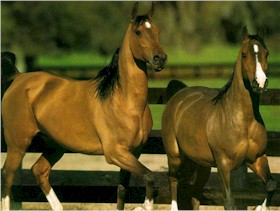
The horse personality is made up of a number of deeply ingrained instincts that were acquired in the process of evolution. The horse, like humans, possesses the five senses: taste, touch, hearing, smell and sight. However, in the horse, these five senses are far more developed. Furthermore, the horse has a sixth sense, a heightened perception, which is apparent in their species but rare in ours.
Little is known about the horse's sense of taste, although we know that it is associated with touch and that it plays an important role in mutual grooming. We presume that horses like sweet things, and feed manufacturers add sweeteners to their products to make them more palatable, but there is no proof to support this assumption.
The sense touch is more relevant to our understanding of the horse. It is used as a means of communication between horses, and between humans and horses. The act of grooming is one example, and in riding the horse, much of the language of the aids is concerned with touch. The leg, for instance, exerts small pressures on the receptor cells on the horse's sides and the hand communicates by touching the mouth through the rein and the bit. The whiskers on the muzzle evaluate by touching objects that the horse cannot see, such as the contents of a feed bucket. Inexplicably, it is the practice to trim off these whiskers for fashion's sake, thus depriving the animal of a natural faculty.
A horse's hearing is far more sensitive than our own. Indeed, its head may be likened to a receiver served by the large, enormously mobile ears that can be rotated to pick up sounds from any direction. The horse is particularly responsive to the human voice, probably the most valuable training aid. Combined with a firm, soothing hand, the voice is effective in reassuring and calming the horse.
Smell is similarly acute and, like hearing, plays an obvious part in the defense system, enabling horses to recognize each other and probably their home surroundings too. It is suggested that the sense of smell may be related to the horse's pronounced homing instinct, its ability to find its way home. Horses can smell human odor and by this detect any nervousness in the handler. They are particularly sensitive to the smell of blood. Smell also plays a large part in their sexual behavior.
Equine sight is unusual in many ways. The horse's eye is large in comparison with that of other animals, such as pigs and elephants, suggesting a heavy reliance upon sight. Unlike humans and other animals, the horse focuses on objects by raising and lowering its head, rather than altering the shape of the eye's lens. Much of its ability to focus on objects in front depends upon the position of the eyes. Placed on the side of the head, as in many heavy breeds, there is wide lateral vision but much poorer frontal vision. In the riding horse such a conformation would be an obvious disadvantage. All horses, as part of the defensive mechanism, have a degree of lateral vision, and are able to move the eyes independently. Indeed, when grazing, the horse has all-around vision without needing to raise or turn its head, and it is quite possible that it can see something of its rider. Although not nocturnal, the horse can see quite well in the dark due to the size of their eyes.
There are numerous examples of horses demonstrating an almost inexplicable perception. The reluctance of horses to pass reputedly haunted places is well-documented. They also have an uncanny ability to sense impending danger and they can be hyper-sensitive in detecting the moods of their handlers and riders.
